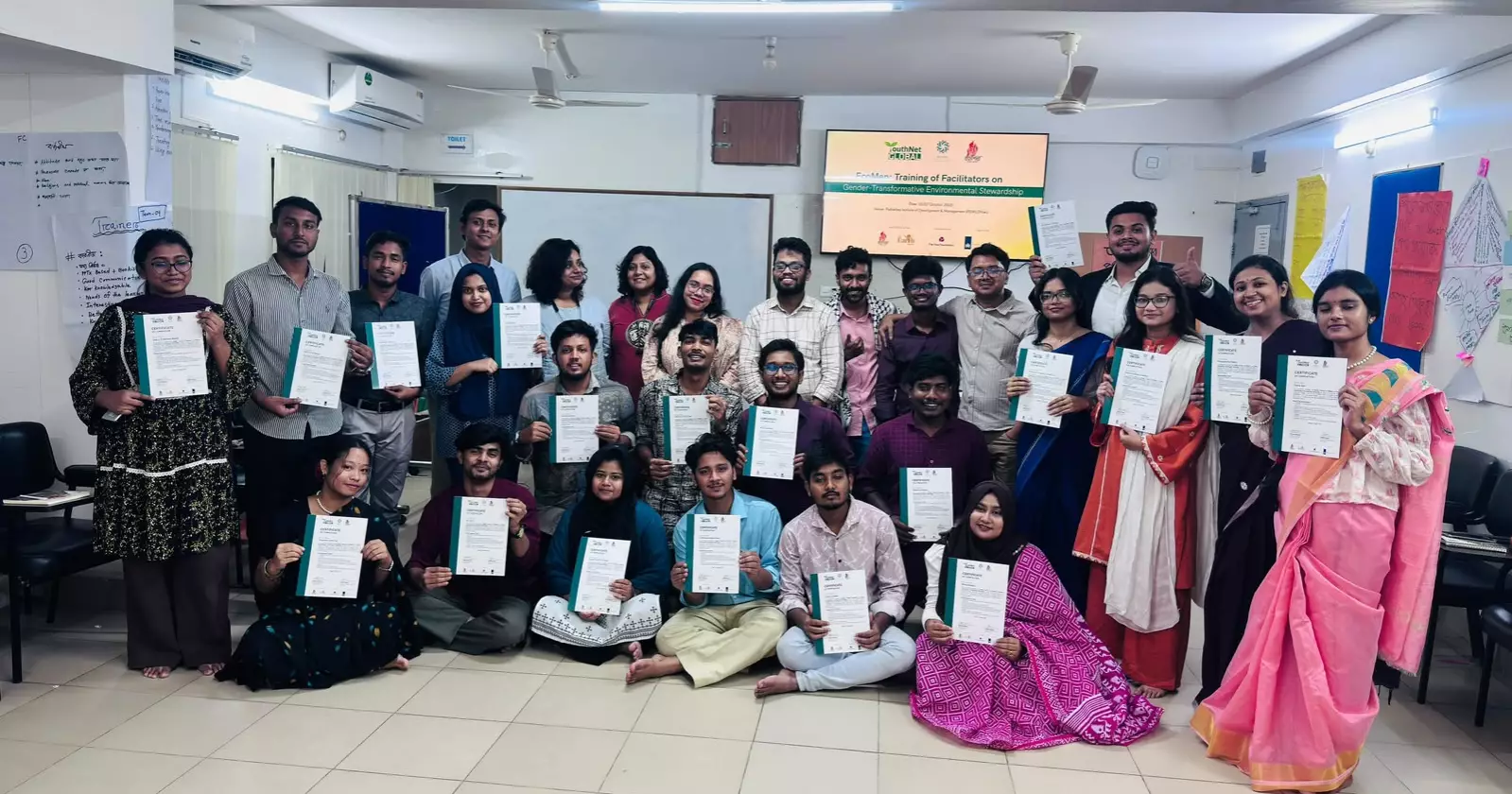
Twenty grassroots youth leaders completed a three-day EcoMen training programme in Dhaka on Wednesday, focusing on gender-transformative environmental stewardship and inclusive climate action.
Titled “EcoMen: Training of Facilitators on Gender-Transformative Environmental Stewardship,” the programme ran from October 5 to 7.
YouthNet Global and Bonhishikha organised it with SheRAA – Women’s Climate Resilience and Adaptation Alliance, in collaboration with The Earth Society.
It is part of a consortium led by The Asia Foundation, with support from the Embassy of the Kingdom of the Netherlands in Bangladesh.
At the closing session, Sumaiya Binte Selim Sudha, chair of SheRAA, spoke with participants and highlighted the importance of linking gender justice with climate and environmental justice.
Participants shared their learning and future plans, and received certificates.
The training was facilitated by Tasaffy Hossain, founder and managing director of Bonhishikha; Sohanur Rahman, executive coordinator of YouthNet Global; S. M. Shahin Alom, additional national coordinator at YouthNet Global; Seyam Sikdar, joint coordinator of YouthNet Global’s Gender and Safeguarding Wing; and Mohaiminul Islam Zipat, YouthNet Global’s environmental justice and sustainability coordinator.
Through facilitated discussions, group activities, presentations and practical exercises, participants examined how gender norms and unequal power shape people’s relationships with the environment, decision-making and care responsibilities.
They also discussed who faces the greatest climate risks and why, including how climate change can increase the likelihood or intensity of some climate-related hazards, while impacts often fall hardest on people with the fewest resources and the least capacity to respond.
Applying a feminist lens, sessions connected the climate crisis with fossil fuel dependence, extractive capitalism, colonial legacies and patriarchal systems.
Participants examined how these forces damage the environment, concentrate wealth and power, and shift the burdens of harm and care onto marginalised communities.
The training also covered climate resilience, gender justice, masculinities, gender-transformative approaches, diversity, inclusion, safeguarding and artivism.
A key focus was how men and boys can challenge patriarchal norms and share responsibility for people and nature as partners in inclusive climate action.
Care at the centre of climate resilience
Discussions on October 6 focused on accountability and recognising care in climate action. Investment in resilient health services, childcare, and support for older people and persons with disabilities can protect wellbeing and support decent jobs in the care sector.
However, care remains insufficiently recognised in many adaptation plans and national climate finance priorities.
Participants said climate resilience means caring for people and nature while transforming the systems that put them at risk.
They underscored the need to hold governments, businesses and high-emitting industries accountable for their climate commitments, and to include care in adaptation plans and budgets. Listening to care workers and communities, and monitoring and publicly reporting progress with community participation, were also identified as important steps.
YouthNet Global calls for climate policy to address how patriarchal structures shape power, resource use, environmental exploitation and the devaluation of care.
The organisation says gender equality risks remaining symbolic unless men and boys challenge harmful norms, share care responsibilities, and take accountability for decisions and environmental harm.
“The patriarchal norms that perpetuate social inequality are the same ones driving environmental exploitation,” said Sohanur Rahman, executive coordinator of YouthNet Global.
Reflecting a global shift
The training’s focus reflects a wider shift in international climate policy. At COP30 in Belém, Brazil, governments adopted the Belém Gender Action Plan for 2026–2034. The plan calls for engaging men and boys as agents and beneficiaries of change, and as strategic allies in achieving gender equality.
It also provides for a high-level event at COP31 on how governments engage women, girls, men and boys as agents of change for socially just transitions. UN Climate Summit COP31 is scheduled for November 9 to 20, 2026, in Antalya, Türkiye.