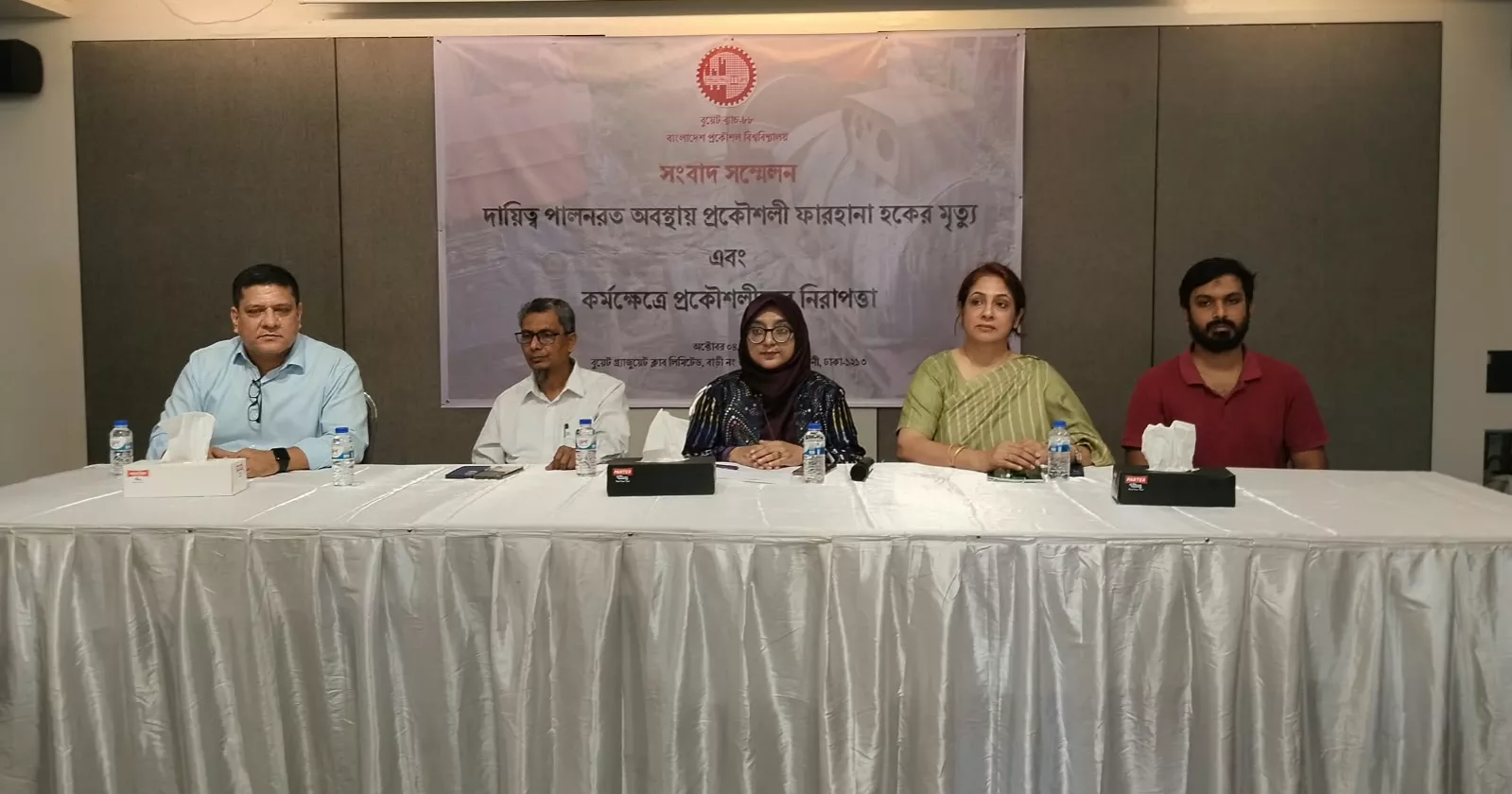
Engineers from BUET Batch-88 have raised questions over workplace safety, use of personal protective equipment (PPE), risk management and accountability following the death of engineer Farhana Haque in an “accident” while inspecting renovation work at a Rohingya camp in Ukhiya of Cox’s Bazar district.
The deceased’s family has also demanded an independent and transparent investigation into the accident and a written report on its findings.
The demands were made at a press conference organised by the Bangladesh University of Engineering and Technology Batch-88 Students’ Welfare Foundation at the BUET Graduate Club in Banani on Sunday.
Sources said Farhana, who had a bachelor’s degree in civil engineering from Ahsanullah University of Science and Technology and a master’s degree in structural engineering from the Military Institute of Science and Technology, joined the IOM’s Cox’s Bazar Infrastructure Unit as a senior field engineer through third-party organisation named Enroute International Limited on August 6, 2026.
Farhana, a mother of two-year-old son, died just 18 days at Cox’s Bazar Sadar Hospital after joining the job while inspecting renovation work at an IOM primary healthcare centre in Rohingya Camp-3 in Ukhiya on August 24.
Her family alleged that they had not been formally informed of the cause of the accident or the outcome of any investigation.
They said emails were sent to IOM on September 3 and September 12 seeking an incident report, CCTV footage, details of safety measures and a meeting with the organisation.
IOM informed the family on September 17 that work at the site was suspended and available CCTV footage and records were preserved.
However, the footage did not capture the moment of the accident, according to the family.
Enroute has said its review and investigation into the incident are ongoing and that no final report has yet been prepared.
Speaking at the press conference, Dr Syeda Sultana Razia, a chemical and occupational safety expert from BUET Batch-88, said workplace safety is not an additional benefit but a fundamental right of workers and a legal and ethical responsibility of employers.
She said PPE is important but serves as the “last line of defence” and stressed the need to determine whether the rotating parts of the running generator had been properly enclosed and whether the renovation area had been adequately isolated.
The investigation should also establish whether a proper risk assessment, safe working procedures, necessary PPE, adequate supervision, and emergency rescue and medical arrangements were in place, Razia said.
She also called for examining whether the accident had been reported in accordance with the Bangladesh Labour Act and relevant regulations.
Farhana’s father, engineer AK Fazlul Haque, said he wants to know the circumstances surrounding his daughter’s death.
“If adequate safety equipment is not available at a worksite, no one goes there to work. I want to know whether sufficient safety equipment was available at the site,” he said.
The speakers urged IOM Bangladesh and Enroute International Limited to complete an impartial investigation promptly and provide a written report to Farhana’s family.
They also called for ensuring workplace safety in all construction and renovation projects carried out by both local and international organisations in the country.