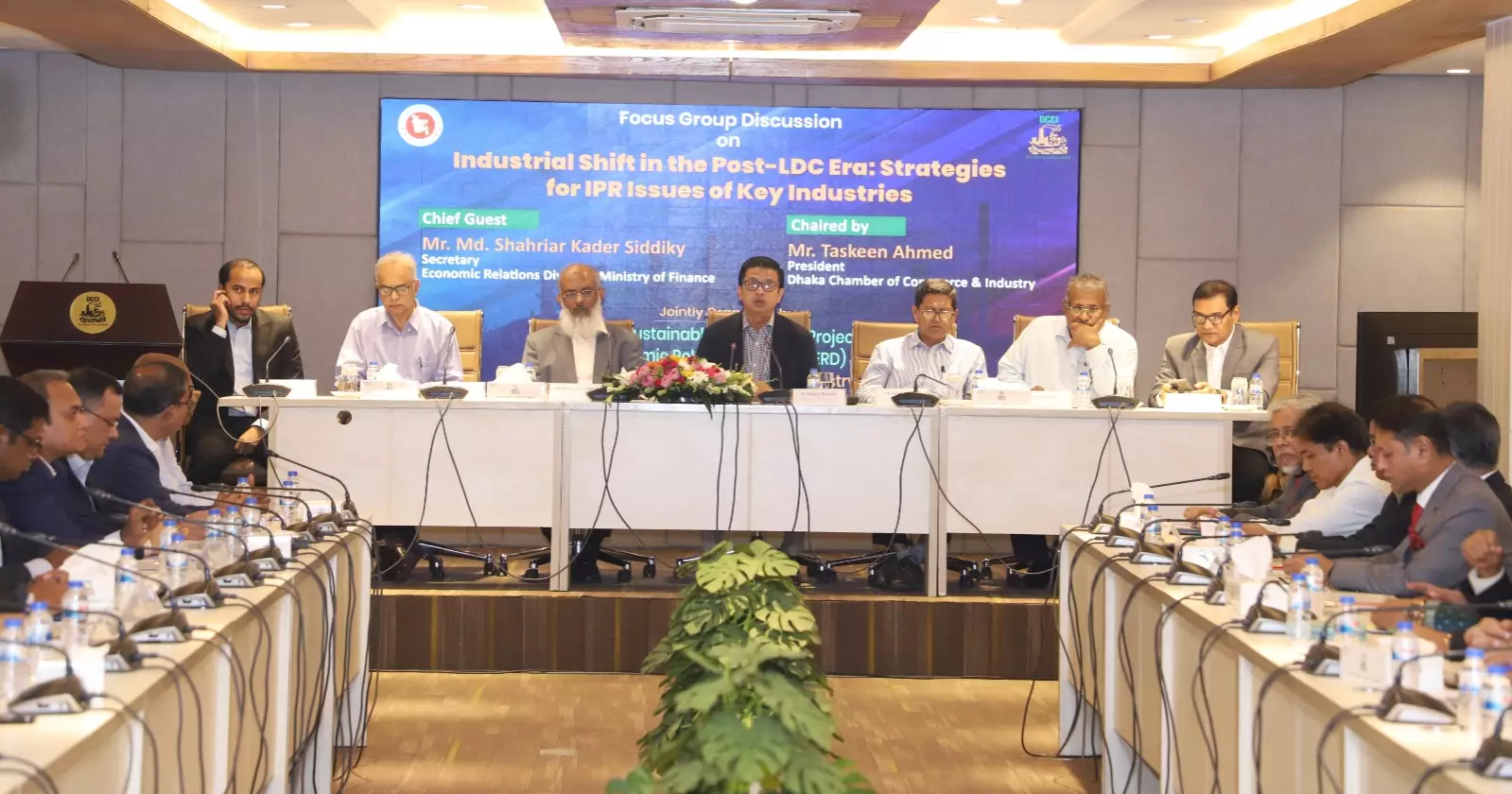
Economic Relations Division (ERD) Secretary Shahriar Kader Siddiky on Monday underscored the need to strengthen the legal framework and institutional capacity of the country's intellectual property rights (IPR) regime ahead of Bangladesh's graduation from the Least Developed Country (LDC) category.
"Locally manufactured products have huge demand in the domestic market, and there is also good potential for exporting these goods if their design and quality can be further improved," Siddiky said, addressing a focus group discussion as chief guest at the DCCI Auditorium.
The discussion, styled "Industrial Shift in Post-LDC Era: Challenges and Strategies Regarding Intellectual Property Rights," was jointly organised by ERD's Support to Sustainable Graduation Project (SSGP) and the Dhaka Chamber of Commerce and Industry (DCCI).
Siddiky identified the small and medium enterprise (SME) sector as the main driving force of the economy and called for greater attention to it.
He noted that budget allocations for research remain underutilised in some cases, while there are also complaints of inadequate allocation in the sector, pointing to a lack of coordination that needs to be resolved.
The ERD secretary said the government is announcing special funds for the SME sector, but stressed that building entrepreneurs' capacity and ensuring sustainable development are essential for effective implementation of such allocations.
He added that the government, through the SSGP project, is working to provide sector-specific technical assistance, with necessary amendments and reforms to be made to relevant policies.
The private sector, too, must come forward, he said, adding that the government has taken an initiative to bring all public services under digital coverage, which is expected to be rolled out soon.
DCCI President Taskeen Ahmed chaired the event.
Speakers said the new realities of IPR protection will bring fresh challenges for Bangladesh's pharmaceutical, ready-made garment, ICT and agriculture sectors, among others, while also opening up new opportunities for innovation, technology development, branding and value addition.
They called for an effective legal and institutional framework, capacity building across industries, research and development, and stronger public-private coordination to address the situation.
In his welcome remarks, DCCI President Taskeen said the importance of intellectual property in the global economy is growing steadily, making a strong IPR ecosystem essential for Bangladesh in the post-LDC period.
He said the country's pharmaceutical, RMG and other promising sectors need to focus not only on increasing production but also on innovation, branding, technology transfer and value addition in the coming days.
Taskeen identified structural delays in the existing IPR law, lack of institutional coordination, absence of necessary policies, limited capacity, and low awareness in the private sector as key challenges.
He proposed setting up a modern and effective IPR office, launching IP tribunals in Dhaka and Chattogram for speedy dispute resolution, introducing an automated digital system for trademark registration, recruiting trained manpower, and raising awareness particularly among SME entrepreneurs.
SSGP Project Director and ERD Additional Secretary A H M Jahangir said in his welcome address that the private sector will face the biggest challenge following LDC graduation, making proper enforcement of IPR laws, industry preparedness and formulation of necessary policies crucial.
Department of Patents, Designs and Trademarks Director General Jahangir Hossain said each industrial sector needs to prepare its own action plan to address post-LDC challenges, with relevant government agencies ensuring proper initiatives and cooperation to that end.
SSGP Project Adviser and former secretary Abdul Baki said all concerned government agencies need to coordinate among themselves and work closely with the private sector to make the best use of the extended timeline for LDC graduation.
DCCI board members and representatives from various government organisations were present at the event.