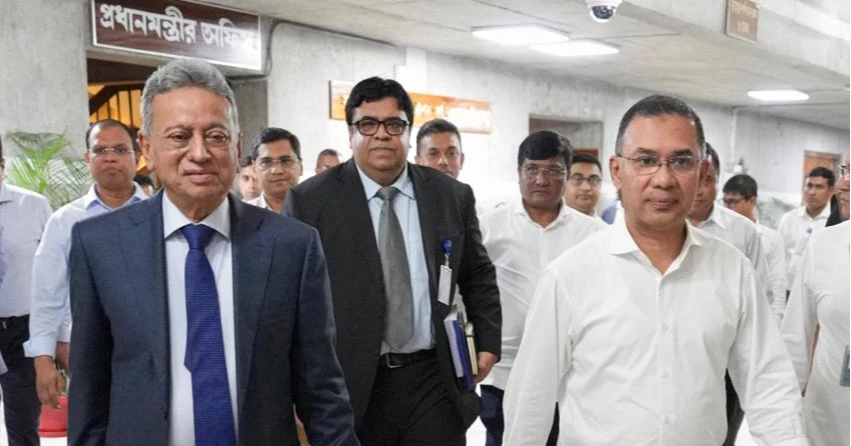
Finance and Planning Minister Amir Khosru Mahmud Chowdhury entered the Parliament chamber carrying a black briefcase on Thursday afternoon ahead of placing the national budget for the 2026-27 fiscal year.
The briefcase contained the budget documents and the Finance Bill of the BNP-led government.
A few minutes before 3:00pm, the Finance Minister entered the House alongside Prime Minister Tarique Rahman.
As they walked into the chamber, photojournalists captured the moment with a flurry of camera clicks.
Lawmakers from both the treasury and opposition benches welcomed the Finance Minister by thumping their desks.
Dressed in a navy-blue suit and blue tie, Amir Khosru appeared relaxed and smiling as he took his seat in the front row of the treasury bench.
His seat is next to that of LGRD and Cooperatives Minister Mirza Fakhrul Islam Alamgir and close to the Prime Minister’s seat.
Earlier in the day, the Cabinet approved the proposed national budget at a special meeting held at the Jatiya Sangsad Bhaban.
The meeting was chaired by Prime Minister Tarique Rahman in the Cabinet Room of the Jatiya Sangsad.
This is the first budget of the Tarique Rahman government, which assumed office on February 17 after the BNP secured an absolute majority in the 13th parliamentary election.
The proposed budget, with an outlay of Tk 9.38 lakh crore, is also the first national budget to be presented by a BNP-led government in nearly two decades.
The last budget presented by a BNP government was for FY2006-07, when late Finance Minister M Saifur Rahman placed the budget in Parliament during the administration of former Prime Minister Khaleda Zia.
The FY2026-27 budget comes in a changed political environment following the July 2024 uprising and the subsequent political transition that paved the way for the 13th parliamentary election and the formation of an elected government.
According to government sources, the proposed budget is expected to focus on curbing inflation, creating jobs, encouraging investment, strengthening economic stability and supporting lower-income and disadvantaged groups.