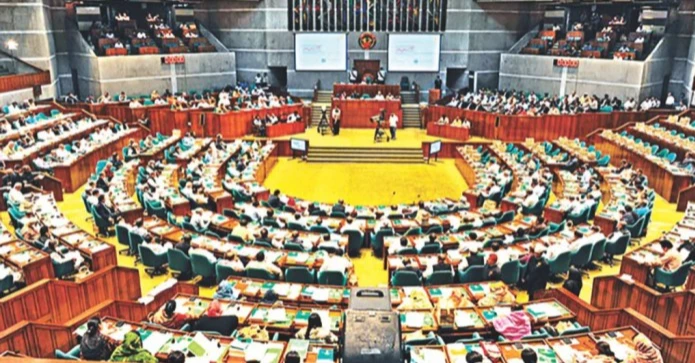
The first session of 13th Parliament was prorogued on Thursday after 25 sittings beginning March 12.
Speaker Hafiz Uddin Ahmad read out the prorogation order of the President at 9:23pm.
Earlier, Leader of the House and Prime Minister Tarique Rahman delivered the valedictory speech.
There were 133 ordinances placed in the Parliament. Some 91 bills were passed against those ordinances. In total 94 bills were passed.
In addition to legislative activities, five standing committees were formed in this session and two special committees were formed.
Some 16 notices were found under the 62 rules of the Rules of Procedure as two of them were discussed.
Nine notices were found under the 68 of the rules of the procedure while only one of them was briefly discussed.
The number of notices under the rules of procedure 71 was 38 while some 207 members were given scope to speak for two-minute for their notices under the 71A rules of the procedure.
One notice was accepted out of 14 notices in 164 rules and sent to the Standing Committee on Privileges.
Two special committees were formed in 266 rules.
In this session, a total of 93 questions were presented at the Prime Minister’s question-answer session. Out of these, he has replied to 35 questions.
A total of 2509 questions have been received for reply by the Ministers of various ministries. Out of these, the Ministers have replied to a total of 1778 questions in Parliament.
Speaker Hafiz Uddin Ahmad before reading out the prorogation order of the President described the Parliament as a rare atmosphere of cooperation between the treasury and opposition benches following a “free, fair and participatory” election after 18 years.
He said the session, which began on March 12, marked a significant step towards strengthening parliamentary democracy, ensuring the rule of law, and promoting transparency and accountability in governance.
Expressing gratitude for the opportunity to serve as Speaker for the first time, he thanked all Members of Parliament for their cooperation and constructive participation, noting that 220 MPs are first-time members in the 13th Parliament.
Despite their inexperience, he said their “tolerance, sincerity and constructive engagement” in legislative and parliamentary activities had been impressive.
He extended special thanks to Prime Minister Tarique Rahman for leading the government and to Opposition Leader Dr Shafiqur Rahman for playing a “positive and effective role” in parliamentary proceedings.
The Speaker also acknowledged the contributions of cabinet members, chief whips, MPs from both treasury and opposition benches.
Referring to the broader national agenda, the Speaker said the government has prioritised programmes such as family cards for households, farmer cards, and strengthening agriculture and the rural economy.
He highlighted initiatives like canal excavation and re-excavation to address waterlogging and improve irrigation, which he said would boost agricultural production and rural livelihoods.
He also stressed the importance of ensuring justice for crimes against humanity and extrajudicial killings committed during what he termed a “fascist era,” alongside efforts to guarantee judicial independence and uphold the rule of law.
The Speaker reaffirmed the commitment to preserving the spirit of the Liberation War and building an inclusive, accountable and humane state.
He expressed optimism that the 13th Parliament would play an effective role in achieving these goals, urging all members to work together despite political differences and place national interest above all.