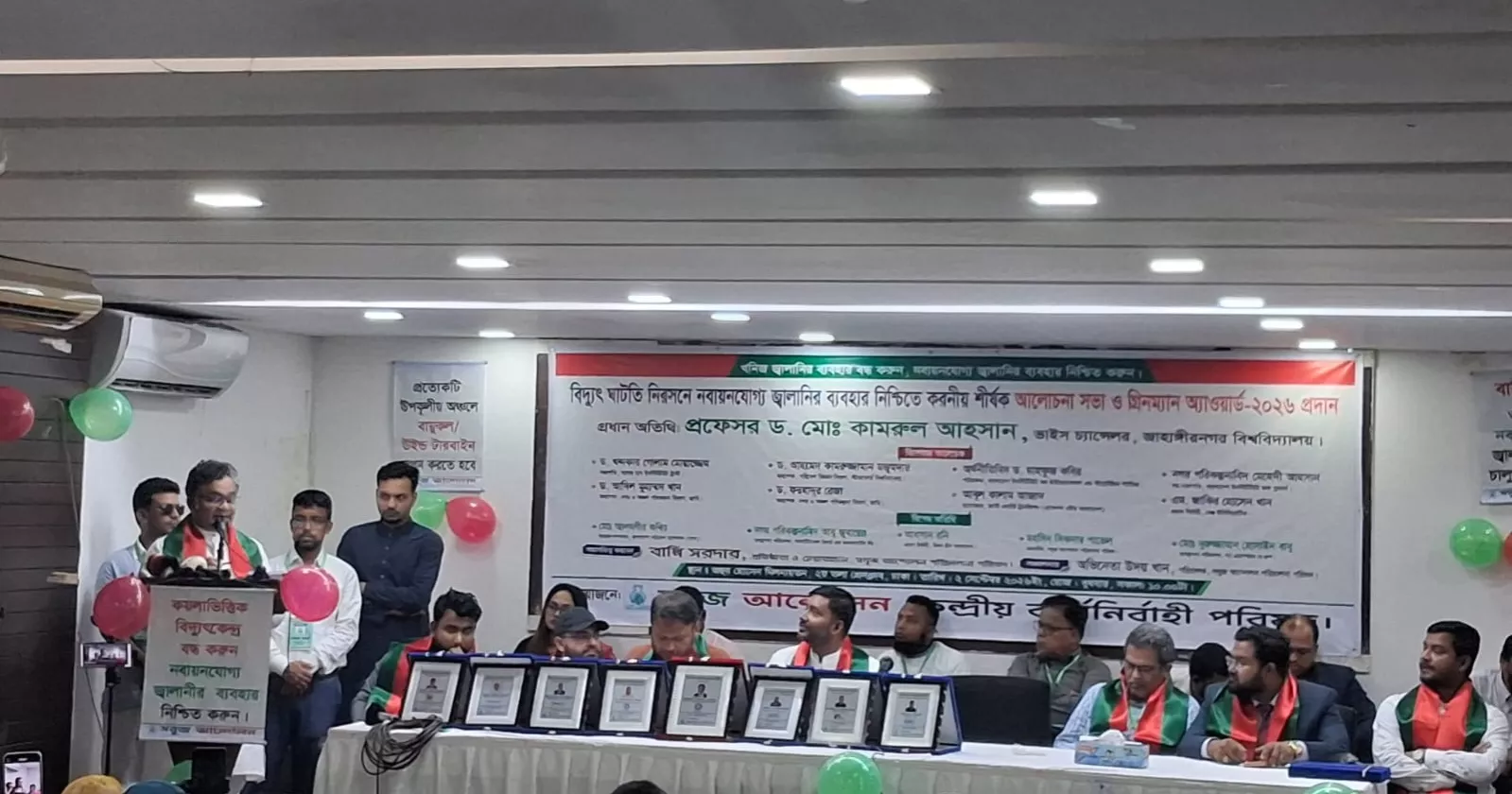
Speakers at a discussion on Wednesday urged the government to formulate a strong, comprehensive energy policy to resolve the ongoing power crisis, stressing the need to keep the emerging green energy sector free from monopoly.
They also called for reviving 37 renewable energy projects cancelled during the previous interim government, prioritising rooftop solar, and implementing strict energy demand management to ensure equitable power distribution across urban and rural areas.
Access to clean energy to become increasingly important for Bangladesh: Michael Miller
The environmental platform Sobuj Andolon (Green Movement) arranged the discussion, titled ‘Measures to ensure the use of renewable energy to address the power deficit,’ at the National Press Club in the city to mark its 9th founding anniversary.
Jahangirnagar University Vice-Chancellor Prof Dr Md Kamrul Ahsan, who attended as the chief guest, said the country cannot overcome the current crisis simply by blaming the fascist regime of the past 17 years.
“Complaints alone will not solve the problem; making efforts to survive is paramount,” he said.
He stressed the need to bring all stakeholders together to formulate a policy based on a balanced fuel mix incorporating coal, gas and renewable energy, while giving greater attention to domestic exploration instead of excessive spending on power-generation capacity and capacity charges.
Criticizing the energy master plans drafted by the ousted Awami regime Prof Dr Adil Muhammed Khan said, “They pushed Bangladesh into an ‘energy trap’ through quick rentals and environmentally destructive fossil fuel projects.”
He also said renewable energy must not fall into the hands of a few large corporate oligarchs like gas and electricity sectors were monopolised in the past.
"Renewable energy is also a business sector. We must establish community-based business models, so that ordinary farmers and households can access and benefit from it easily," Prof Khan said.
Speaking about the stark energy inequity in the country he said, “Air-conditioned high-rises in Dhaka enjoy uninterrupted power while rural areas suffer 10 to 14 hours of load shedding.”
Prof Ahmad Kamruzzaman Majumder of Stamford University Bangladesh pointed out significant operational inefficiencies in existing green projects.
Citing one of his recent studies, he said the country’s 1,500 MW solar power generation capacity loses about 20 percent of its potential output simply due to dust accumulation.
“If solar panels are not cleaned, efficiency drops by 7 to 8 percent within three days and nearly 20 percent within a week,” he explained.
Mohsin Sikder, secretary general of Sobuj Aundolon’s central executive council, urged citizens who have the space and capacity to adopt rooftop solar and biogas systems to ease the mounting pressure on the national grid.
The event was chaired by Sobuj Aundolon founder and Chairman Bappi Sardar, JU Prof Md Farhadur Reza among others was present at the program.
At the program, seven individuals and institutions were honoured with the ‘National Green-man Award-2026’ for their outstanding contributions to environmental awareness and green initiatives.