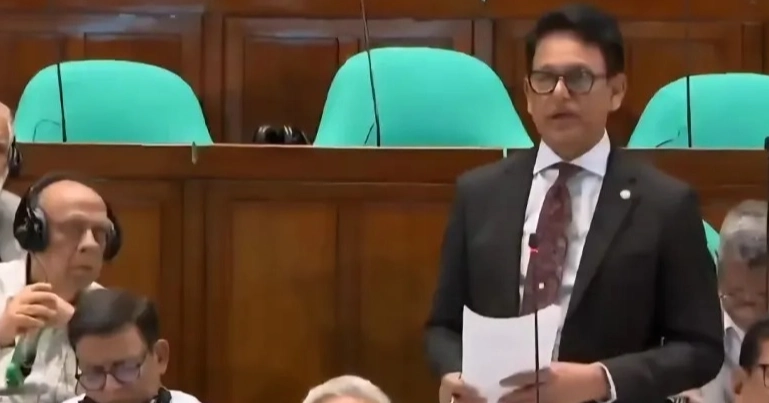
Education Minister Dr ANM Ehsanul Hoque Milon on Tuesday said the government is expanding mother tongue-based education for ethnic communities through the preservation of indigenous languages, development of textbooks and teacher training programmes.
Responding to a notice on calling attention to a matter of urgent public importance raised by BNP reserved seat MP Anna Minj in Parliament, he said protecting the languages of ethnic communities is both a constitutional responsibility and a national commitment.
Recalling past initiatives, the minister said former President Ziaur Rahman had taken a number of measures to improve education standards among ethnic communities and had also arranged for television programmes in their languages.
He added that the International Mother Language Institute, established during the tenure of former Prime Minister Begum Khaleda Zia in 2002, was entrusted with the task of preserving indigenous languages, many of which face the risk of extinction.
Milon said around 30 indigenous languages are considered endangered and the institute has been working to preserve them. “As an initial step, primary school textbooks were developed in five indigenous languages, including Chakma, Marma and Tripura.”
He said the initiative reflects Bangladesh's commitment to safeguarding every child's mother tongue in line with the spirit of International Mother Language Day.
The minister said the National Academy for Primary Education has incorporated mother tongue textbooks for ethnic communities into the weekly class routine of primary schools, and teaching activities are continuing accordingly.
He also informed Parliament that teacher training programmes in five indigenous languages began in 2026. So far, 450 teachers have been trained through 15 batches at five Primary Teachers' Training Institutes.
Milon said the National Curriculum and Textbook Board will distribute 37 new books in five indigenous languages this year to further strengthen mother tongue education.
He added that the government has also decided in principle to extend multilingual education beyond Chakma, Marma, Tripura and Santal languages under a multi-year programme.
The minister assured Parliament that ethnic communities are an integral part of Bangladesh and that the government is committed to ensuring their constitutional rights through educational opportunities and equal access to facilities available in both government and private educational institutions.
He, however, acknowledged that a shortage of teachers remains a major challenge, particularly in the Chittagong Hill Tracts.
To address the problem, the government has initiated a plan to recruit teachers locally and provide them with professional training so that children can receive education in their own communities, Milon added.