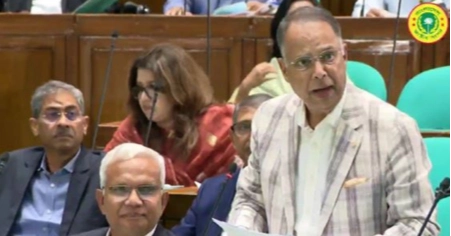
Power, Energy and Mineral Resources Minister Iqbal Hassan Mahmood on Wednesday said the government is negotiating with private power producers to reduce the financial burden of capacity charges and keep electricity prices affordable, though existing contracts backed by sovereign guarantees limit its room for manoeuvre.
Responding to a supplementary question from Bangladesh Jamaat-e-Islami MP for reserved women seat Mardia Mumtaz in Parliament, he said most of the costs associated with electricity subsidies stem from capacity charges and acknowledged concerns over their impact on power tariffs.
French ambassador calls on Energy and Power Minister; France to continue support in sector
Mardia Mumtaz wanted to know whether the government has any specific plan for the next fiscal year to address the rising subsidy burden and costs linked to capacity charges, noting that it is often cited as the main reason behind increases in electricity prices.
In reply, the minister said many of the agreements signed by the previous government with private power companies include sovereign guarantees, making it difficult to terminate or alter the contracts immediately.
"These sovereign guarantees are state commitments, and cancelling them is a lengthy process," he told the House.
Iqbal Hassan said the government is engaged in discussions with the power producers on several issues, including late payment fees. "We are negotiating with them on various matters, particularly late payment fees. We hope these discussions will be productive," he said.
He said once power generation infrastructure is integrated into the national grid, the government cannot simply adopt a confrontational approach with power plants, as maintaining the stability of the electricity system remains a priority.
"As long as these contracts remain in force, we will continue our efforts to reduce electricity prices and ensure power is supplied at an affordable rate," the minister said.
He also attributed recent pressure on electricity tariffs to higher global fuel prices triggered by the Iran-Israel conflict.
Iqbal Hassan said the increase in fuel prices has raised the government's subsidy burden, forcing it at times to adjust electricity tariffs to reduce the level of subsidies.
"As fuel prices rise, we sometimes have to align electricity prices to reduce subsidies. That is why electricity prices increase," he added.