The government has decided to repeal the controversial Section 18(A) of the Bank Resolution Act, 2026 that had drawn widespread criticism for allowing former owners of failed banks to reclaim control under certain conditions.
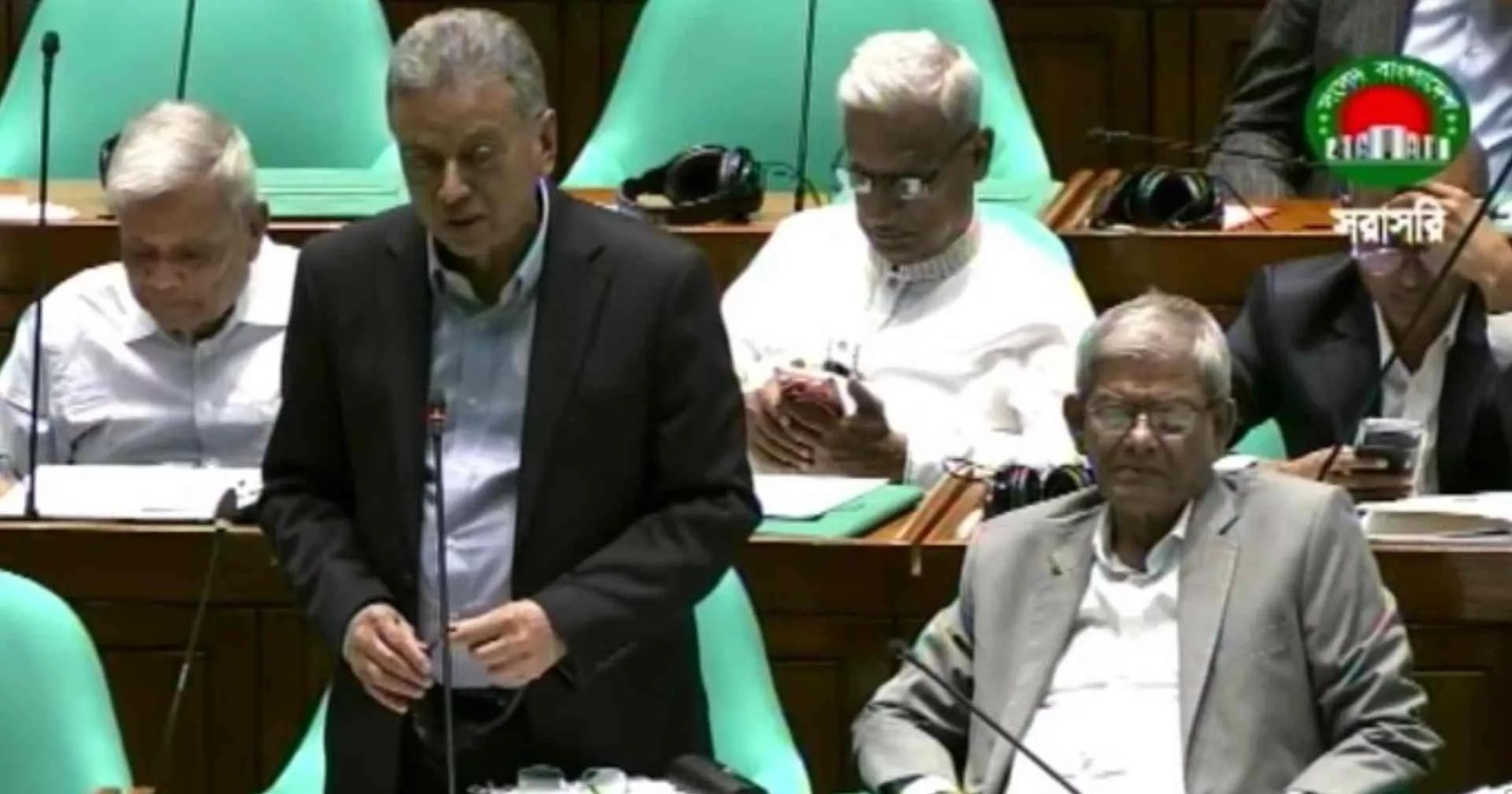
“Based on the opinions of different stakeholders regarding Section 18(A) of the Bank Resolution Act, 2026, the government has decided to repeal the provision,” Minister Amir Khosru Mahmud Chowdhury told Parliament on Monday during the budget discussion.
The minister also reiterated the government's stance on tackling irregularities in the banking sector. “Our message is clear. Those who looted public assets will not be spared. At the same time, depositors’ savings will be protected.”
Section 18(A), inserted when the law was passed earlier this year, allowed former shareholders and directors of banks placed under resolution to apply to Bangladesh Bank to regain ownership of shares, assets and liabilities of those banks.
The provision required applicants to undertake a number of commitments, including repaying all government or Bangladesh Bank support extended to the bank, injecting fresh capital to eliminate capital shortfalls, settling depositors’ and creditors’ claims, paying outstanding taxes and compensating any parties harmed during the resolution process.
Applicants were also required to comply with corporate governance reforms, risk management and compliance requirements, while Bangladesh Bank retained supervisory powers for two years after any transfer of ownership.
The provision stipulated that, before approval, Bangladesh Bank would conduct due diligence and obtain government clearance. Successful applicants would initially have to deposit 7.5 percent of the funds injected by the government or the central bank, with the remaining 92.5 percent to be repaid within two years with 10 percent simple interest.
Despite these conditions, the provision triggered strong criticism from opposition parties, economists, bankers and Transparency International Bangladesh (TIB) who argued that it could pave the way for controversial business groups responsible for bank mismanagement to regain ownership.
Media reports also said the World Bank raised objections to the provision, while officials from the Finance Ministry and Bangladesh Bank earlier indicated that the government has taken a policy decision to scrap it.
The Bank Resolution Act created the legal framework for restructuring or merging financially distressed banks. It also opened the way for the consolidation of five weak Islamic banks—EXIM Bank, Social Islami Bank, First Security Islami Bank, Union Bank and Global Islami Bank.
According to published reports, the five banks together hold around Tk 1.47 lakh crore in defaulted loans, accounting for nearly 79 percent of their total outstanding loans.
Union Bank has a default loan ratio of 98 percent, followed by First Security Islami Bank at 96 percent, Global Islami Bank at 95 percent, Social Islami Bank at 62 percent and EXIM Bank at 48 percent.
Except for EXIM Bank, the other four banks were previously controlled by the S Alam Group, a factor that further fuelled concerns over the inclusion of Section 18(A).
During the budget debate, opposition lawmakers and several members questioned corruption in the banking sector, soaring defaulted loans, the recovery of laundered money and the possible use of public funds to rescue weak banks.
They argued that taxpayers’ money should not be used to rehabilitate those responsible for looting banks.