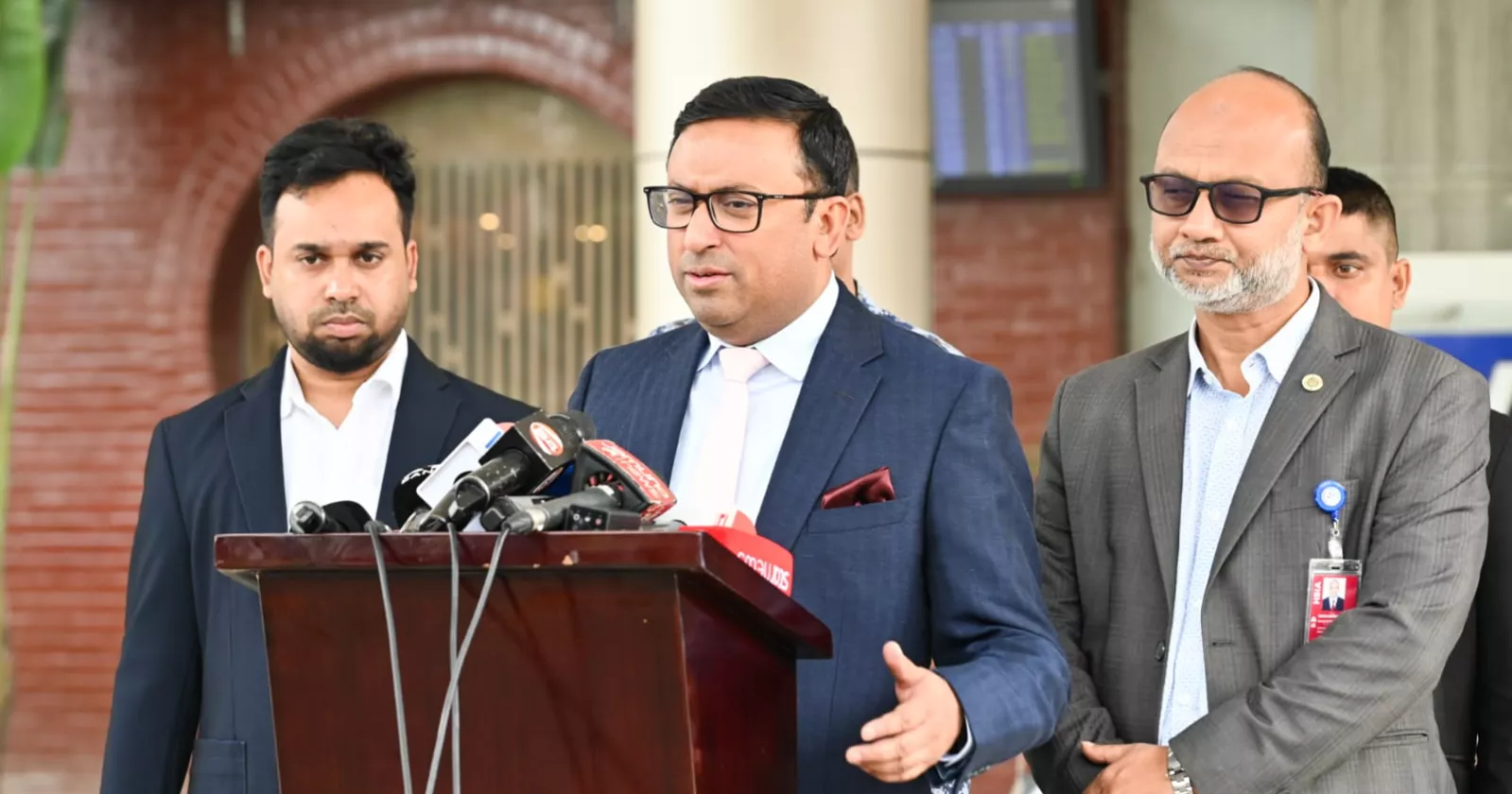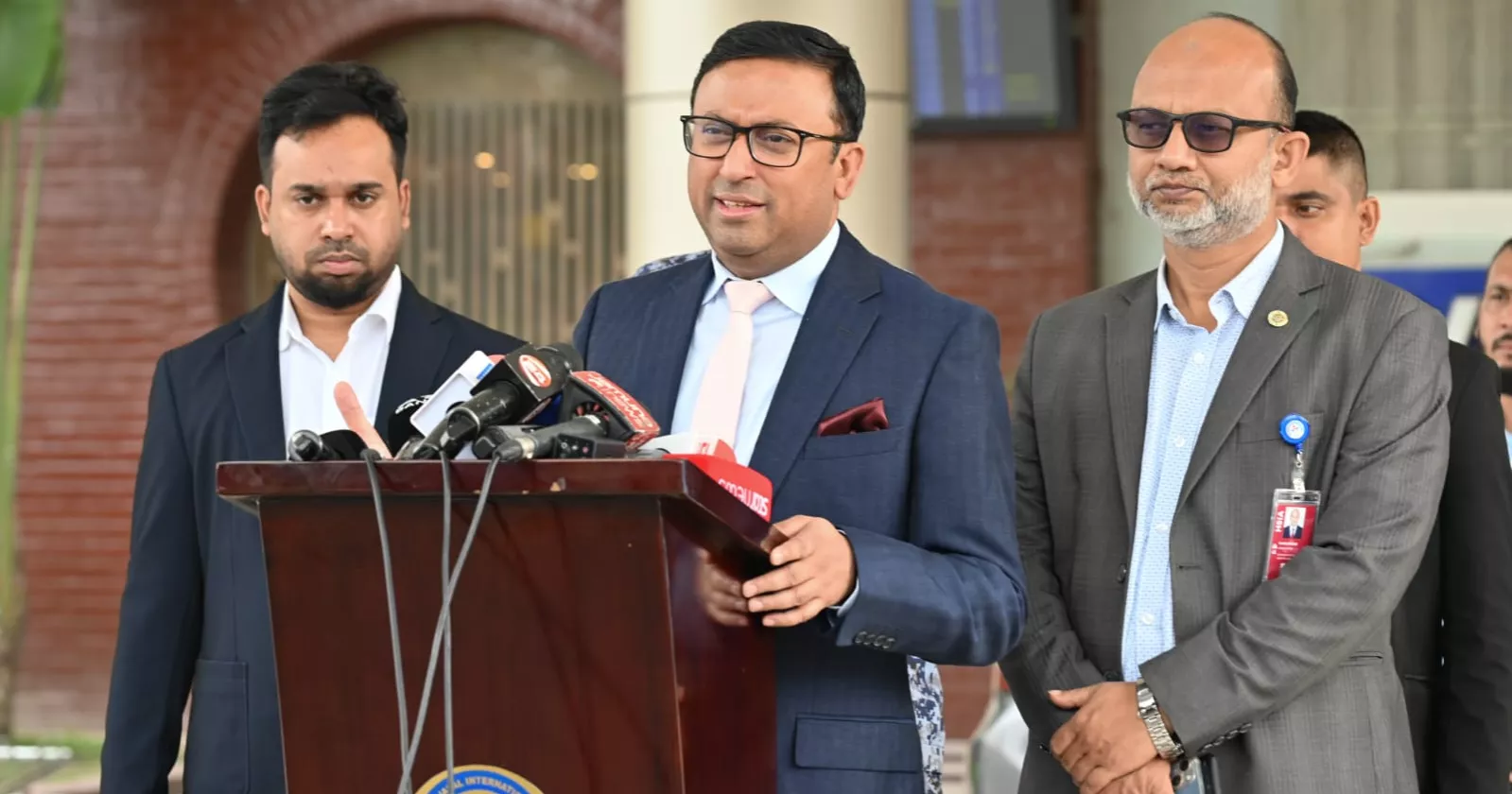
Referring to the existing extradition treaty with India, State Minister for Foreign Affairs Humaiun Kobir on Thursday said they want former Prime Minister Sheikh Hasina, who now faces the death penalty, to be handed over to Bangladesh.
“We want Hasina to be handed over. She will be handed over. She is a terrorist. She is a fled criminal. There is an active extradition treaty between Bangladesh and India,” he told reporters, noting that there is no need to issue her a passport.
Kobir made the remarks while responding to questions from journalists at Hazrat Shahjalal International Airport after seeing off Liu Haixing, Minister of the International Department of the Communist Party of China (CPC) Central Committee.
Hasina, ousted in a mass uprising in 2024, has told The Associated Press that she remains committed to returning to Bangladesh from exile in India next month, despite being sentenced to death over her government's deadly crackdown on protesters.
“If death is my destiny, I would rather die on the soil of my own country, among my own people,” she told AP in response to questions by email. “So, I will return to Bangladesh. That decision has not changed.”
Hasina fled to India after student-led protests forced her from power and has remained there ever since.
In 2025, a Bangladeshi special tribunal sentenced her to death for crimes against humanity, ruling that she was responsible for ordering the crackdown, which left hundreds of people dead and thousands of others injured.
Bangladesh has repeatedly sought Hasina’s extradition, but India has declined to hand her over. She first announced in August her intention to return in December.
On October 3, Indian High Commissioner to Bangladesh Dinesh Trivedi stressed that former Prime Minister Hasina was not brought to India by the Indian Air Force or the Indian Army. He said the legal process concerning Bangladesh’s request for her extradition was ongoing and that no timeframe could be given as the courts were involved.
“To give you a straight answer, again and again, the government of India, through the Spokesperson at the Ministry of External Affairs (MEA), has replied to this that there is a process, and the process involves legality, and it is well structured. So, as far as that is concerned, the process is on,” Trivedi said.
He said the courts were involved in the matter and, therefore, “nobody can give you a timeframe.”
Trivedi said Hasina was still the Prime Minister of Bangladesh when she arrived in India, and New Delhi had to respond to the situation as a neighbouring country.
“At that point in time, Hasina was still the prime minister of Bangladesh. We had hardly any choice on that. It was our duty as a neighbour to accept the reality of life, because situations are such where at times you are not prepared for it,” the Indian envoy said.
Trivedi also referred to the circumstances under which Hasina came to India after leaving Bangladesh in August 2024, saying the Indian authorities were not prepared for the situation.
“Going back to history, Hasina Ji was not brought to India by the Indian Air Force or Indian Army,” he said, referring to the circumstances surrounding her departure from Bangladesh.
He said the situation unfolded because of “tragic circumstances” in Bangladesh at the time, adding that such circumstances should never be repeated anywhere in the world, where innocent people get killed, regardless of which part of the world it is.
He questioned what India's alternative could have been under those circumstances. “What was our choice? If you would have said that no, we are not going to accept, we don’t give landing permission. Things would have been I don’t know what,” Trivedi said.
Bangladesh has repeatedly requested India to extradite Hasina, who has been staying in India since her departure from Bangladesh in August 2024.
The issue was also raised by Prime Minister Tarique Rahman during his meeting with Trivedi in Dhaka in August.
India’s Ministry of External Affairs subsequently said that Bangladesh’s request was being examined in line with established procedures.
Bangladesh-Myanmar-China Economic Corridor
Asked about the proposed Bangladesh-Myanmar-China Economic Corridor, Kobir said a new corridor would be opened once it was implemented, but the Rohingya issue remained important for Bangladesh. “There is a need for stability.”
Bangladesh and China reaffirmed their commitment to taking bilateral relations to new heights under the framework of a “China-Bangladesh Community with a Shared Future in the New Era”.
The commitment was made during a breakfast meeting hosted by State Minister Kobir in honour of Liu Haixing, Minister of the International Department of the Central Committee of the Communist Party of China (IDCPC), at State Guest House Padma on Thursday.