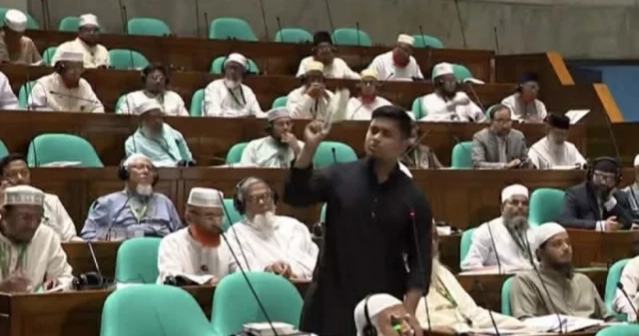
National Citizens Party (NCP) lawmaker Md. Abul Hasnat on Thursday launched a scathing attack on the proposed national budget in Parliament, questioning its revenue targets, investment climate, inflation projections and the government's commitment to tackling loan defaults and financial crimes.
Speaking during the budget discussion, the MP argued that several key assumptions underpinning the budget were unrealistic and disconnected from the country's economic realities.
Hasnat questions progress of ACC cases against Bashundhara Group
Hasnat questioned the government's revenue target of Tk 695,000 crore for the next fiscal year, noting that the current year's revenue collection was likely to fall significantly short of its target.
"If revenue growth in most economies is normally around 10 to 12 percent, what mechanism does the government have to increase revenue collection by such an extraordinary margin?" he asked, expressing doubts over the National Board of Revenue's capacity to achieve the target.
The NCP MP also criticised what he described as an unfavourable tax regime for investors. He claimed that when corporate taxes, dividend taxes and surcharges are combined, businesses in Bangladesh effectively face a tax burden exceeding 56 percent.
"Neither domestic nor foreign investment will be encouraged under such a tax structure," he said, comparing Bangladesh unfavourably with countries such as Singapore, Malaysia and the Maldives, where tax rates are significantly lower.
Hasnat further challenged the government's inflation forecast, arguing that reducing inflation from the current level of around 9.4 percent to 7.5 percent would be difficult without either tighter monetary policy or significant reductions in government spending.
"You cannot simultaneously increase expenditure and expect inflation to fall sharply. These are contradictory positions," he said.
The lawmaker also criticised new taxes imposed on a range of essential goods, saying the burden would ultimately fall on ordinary consumers despite repeated pledges to lower the cost of living.
He questioned the government's election pledge to create more than one crore jobs over five years, asking how many jobs had actually been created during the first four months of the administration.
"Where are those jobs? Have six lakh jobs really been created during this period?" he asked.
Turning to the banking sector, Hasnat accused successive governments of failing to address chronic loan defaults and financial sector mismanagement. He called for tougher action against defaulters and proposed legislation that would disqualify sitting MPs who become loan defaulters during their tenure.
"We are ashamed to share this Parliament with people who take public money from banks, default on their loans and then return as elected representatives," he said.
The NCP legislator also demanded visible progress in recovering allegedly laundered funds and prosecuting individuals accused of financial crimes.
Referring to estimates of large-scale capital flight from Bangladesh, he questioned the government's commitment to bringing back money allegedly transferred abroad.
Hasnat additionally raised concerns about media freedom and political intolerance, alleging that criticism of influential figures could lead to legal harassment and intimidation.
While welcoming what he described as the Prime Minister's reluctance to pursue political vengeance, he stressed that justice for corruption, enforced disappearances and other alleged abuses must still be ensured.
"Not being vindictive and ensuring justice are not the same thing," he told the House, urging the government to demonstrate a stronger commitment to accountability and the rule of law.
Hasnat warned that without credible reforms, public confidence in the budget's promises could remain elusive.