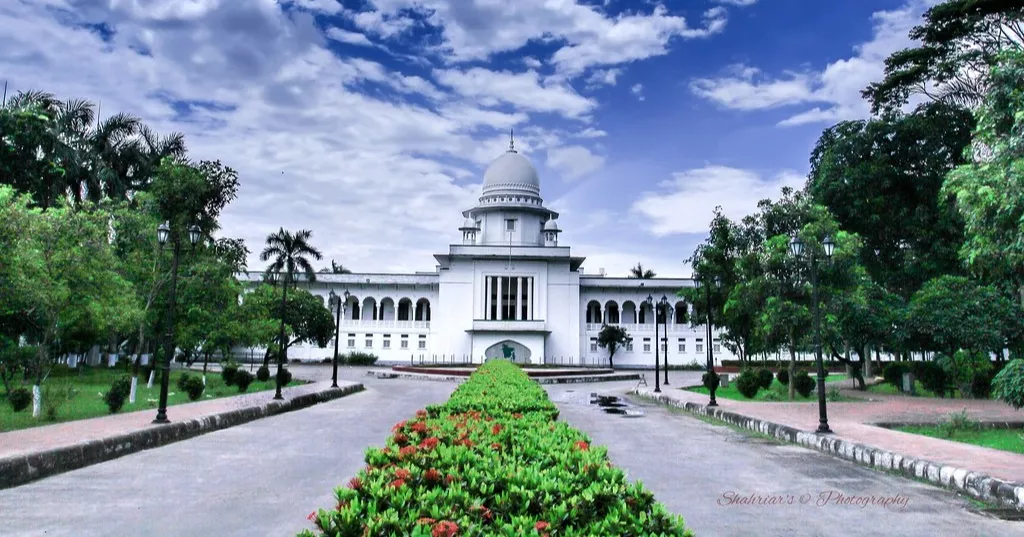
The High Court on Thursday issued a rule asking the government to explain as to why the appointment of three members of the Bangladesh Judicial Service as private secretaries to two ministers and a state minister should not be declared illegal.
The HC bench, led by Justice Md Toufiq Inam, issued the rule after hearing a writ petition challenging the legality of assigning judges to executive branch positions outside their judicial duties.
The court also wanted to know why directives should not be issued to prevent serving judicial officers from being appointed or posted to the executive branch.
Public administration, law, home and primary and mass education secretaries among others were made respondents to the rule which is returnable in four weeks.
Advocate Chanchal Kumar Biswas stood for the petitioner.
Supreme Court lawyer Rashedul Haque Khokon filed the writ petition on September 21, challenging the appointments of three judicial service members as private secretaries to two ministers and a state minister.
The petition referred to Rule 4(1) of the Bangladesh Judicial Service Formation Rules, 2025, stating that the posts specified in the rules’ schedule are designated as cadre posts of the judicial service.
However, the posts to which the three judges were recently appointed are not included in that schedule, according to the petition.
The petition stated that a notification issued on March 9 appointed GM Farhan Ishtiaque, a senior assistant secretary in the Law and Justice Division and a joint district judge, as private secretary to the primary and mass education minister.
Another notification, issued on February 25, transferred Kamrul Hasan, a senior assistant secretary in the Law and Justice Division and a joint district and sessions judge, to the post of assistant private secretary to the home minister.
A separate notification issued on September 16 appointed Md Abu Bakar Siddique, a metropolitan magistrate in Chattogram with the designation of senior civil judge, as private secretary to the state minister for social welfare.
The petition said the appointment orders, issued by the Law and Justice Division under the Law Ministry, mentioned consultation with the Supreme Court.
It further argued that the appointments were inconsistent with the constitutional framework for separating the judiciary from the executive branch, the structure prescribed under the Bangladesh Judicial Service Formation Rules, 2025, and the principles laid down by the Appellate Division in the Masdar Hossain case.
The writ petition was initially listed for hearing before a High Court division bench on September 28. However, the vacation bench that day removed it from the hearing list.