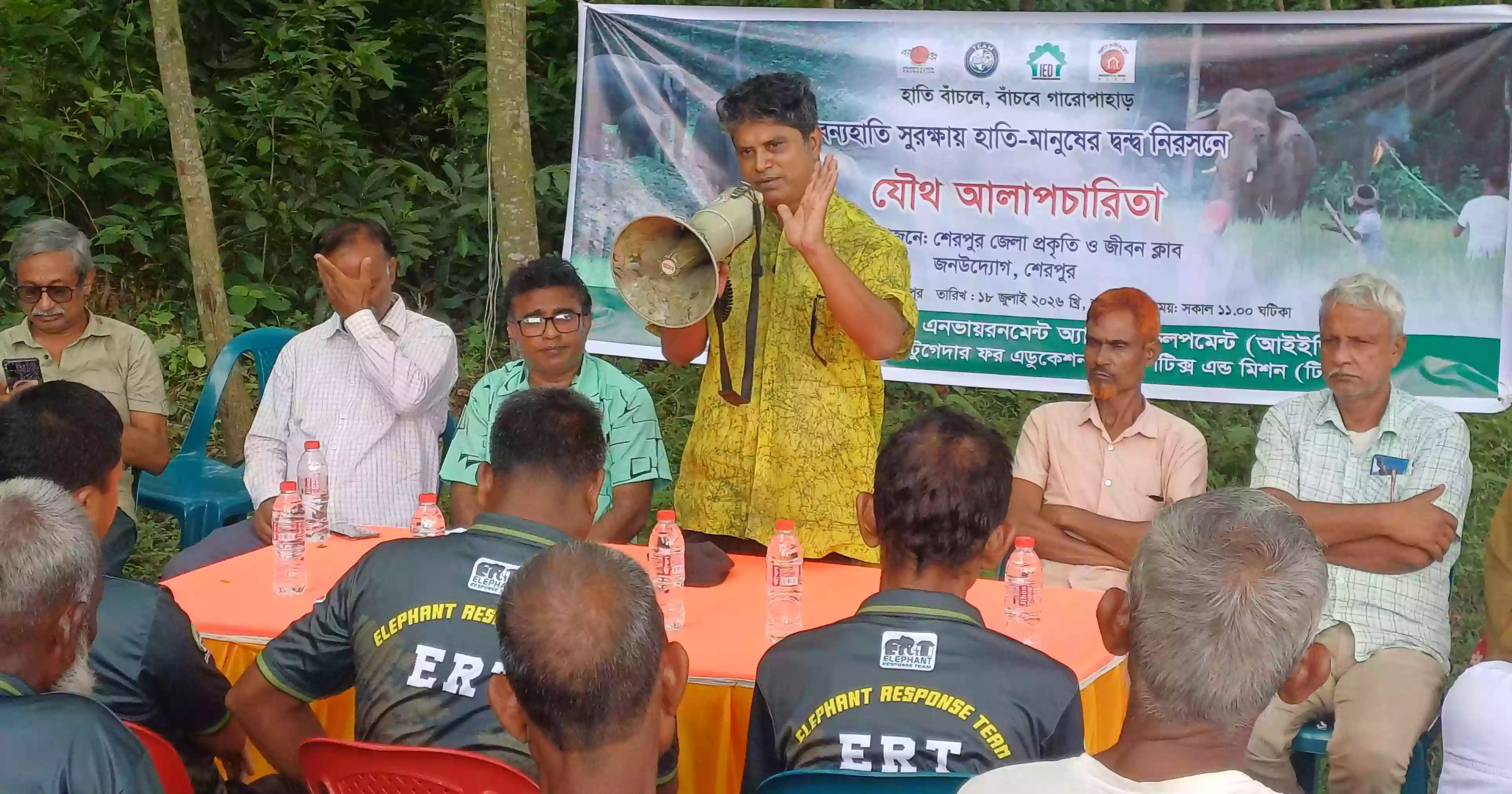
A dialogue was held in Sherpur's border-adjacent Garo Hills on Saturday to explore ways to reduce the growing phenomenon of human-elephant conflict and ensure the protection of wild elephants through peaceful coexistence.
The programme, styled as a "Joint Dialogue," took place in the Batkuchi area under the Madhutila Range of Nalitabari upazila, where residents affected by elephant attacks, members of the Elephant Response Team (ERT), nature conservationists and volunteers shared their experiences and recommendations.
The event was jointly organised by the Sherpur District Nature and Life Club and the civic platform Jan Udyog Sherpur, under the slogan "Save Elephants, Save the Garo Hills." It was supported by the Institute for Environment and Development (IED), Nature and Life Foundation and Together for Education, Athletics and Mission (TEAM).
Speakers expressed concern that wild elephants frequently descend from the hills in search of food, damaging crops, houses and property and, in some cases, causing human fatalities. They also noted that elephants are increasingly being killed by people attempting to protect their lives and livelihoods.
Presiding over the programme, Jan Udyog Sherpur Convener Abul Kalam Azad said sustainable measures were needed to reduce conflict while protecting both wildlife and local communities.
Among those who spoke were Sherpur District Nature and Life Club General Secretary Jyoti Poddar, journalist and coordinator Hakim Babul, Sherpur Bird Conservation Society organiser Debdas Chandra Babu, local union parishad member Azharul Islam, ERT member Asmat Ali and TEAM representative Ilias Khan.
Participants called for the creation of elephant-friendly habitats in the hills by planting food-producing trees and developing water sources to discourage elephants from entering villages.
Local union parishad member Ansar Ali, whose area is frequently affected by elephant incursions, urged authorities to establish wildlife sanctuaries in the Garo Hills, saying both humans and elephants should be able to coexist safely.
Volunteer Ilias Ali said repeated elephant attacks were discouraging farmers from cultivating their land and called for alternative livelihood opportunities as well as the formation of dedicated Elephant Rescue Teams alongside the existing ERTs.
Farmer Amir Hossain said his area lacks an Elephant Response Team despite being highly vulnerable to elephant attacks. He demanded the formation of an ERT, along with the supply of high-powered flashlights and free kerosene for torches used to drive elephants away safely.
ERT member Azmat Ullah alleged that some social media content creators were provoking elephants to attract online views, worsening the conflict. He called for legal action against those responsible.
Wildlife experts attending the meeting stressed the need to restore elephant habitats by planting suitable food species, preserving water sources and keeping traditional elephant corridors free from obstruction.
They also recommended reducing cultivation of crops favoured by elephants, such as paddy, in vulnerable border areas and encouraging alternative crops like chilli. They suggested expanding beekeeping as an alternative source of income for local communities.
According to the Forest Department, 46 people have been killed in human-elephant conflicts in Sherpur's hilly region over the past 16 years, while elephant attacks have caused property damage worth several crore taka. During the same period, 34 elephants have died.
Sherpur Wildlife Range Ranger Md Abdullah Al Amin said food shortages in forest areas were the main reason elephants entered human settlements. To address the problem, the Forest Department has planted elephant-friendly trees on nearly six acres of forest land, which are expected to become a significant food source within the next two to three years.
He also said Elephant Response Teams have been formed in several areas, while solar fencing and bio-fencing have been introduced to reduce conflict.
The ranger added that Sherpur-2 lawmaker Mohammad Fahim Chowdhury recently announced plans to install 15 AI-powered cameras along elephant corridors in Nalitabari. The cameras are expected to help monitor elephant movements, provide early warnings and improve public safety.
Participants expressed hope that the combined conservation initiatives would eventually transform the Garo Hills into a safe habitat for Asian elephants and establish Sherpur as a recognised conservation district for elephants.