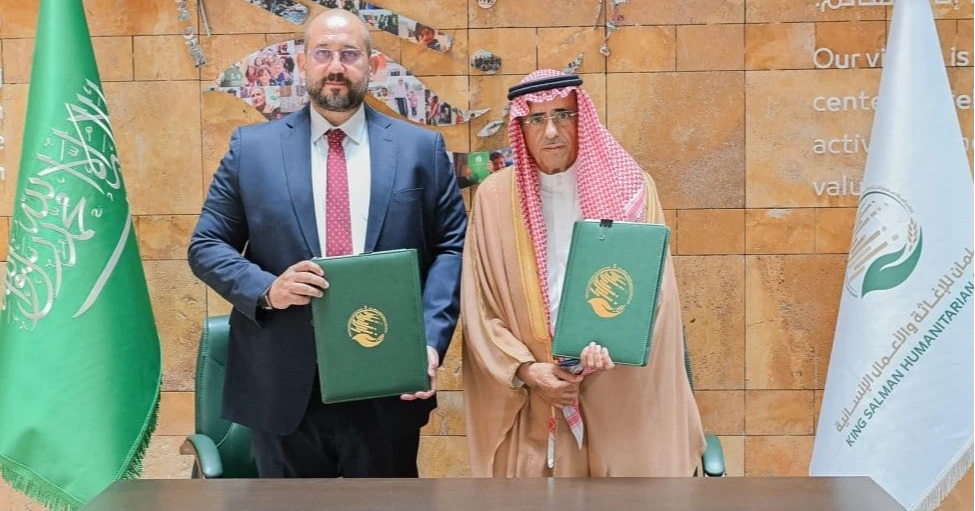
The International Organization for Migration (IOM) and the King Salman Humanitarian Aid and Relief Centre (KSrelief) have signed a USD 2.5 million agreement to strengthen safe, dignified and sustainable water, sanitation and hygiene (WASH) services as part of the Rohingya response in Cox's Bazar, Bangladesh.
The agreement, which was signed in Riyadh by Eng. Ahmed bin Ali Al-Baiz, KSrelief Assistant Supervisor General for Operations and Programs, and Othman Belbeisi, IOM Regional Director for the Middle East and North Africa, aims to support essential WASH services and improve critical infrastructure in areas supported by IOM.
The project will combine essential service delivery with durable infrastructure improvements.
Planned activities include upgrading solar-powered water networks; constructing and upgrading decentralized wastewater treatment systems; improving faecal sludge collection and transfer networks; and rehabilitating latrines and bathing facilities, among other activities, said the UN agency on Monday.
The initiative will also support distributing water containers, colour-coded waste bins and hygiene management kits; and strengthen community engagement and targeted training.
These efforts will help reinforce local capacity and promote longer-term ownership of WASH services.
“This agreement reflects the Kingdom of Saudi Arabia's continued commitment, through KSrelief, to supporting humanitarian responses with practical and sustainable solutions,” said Eng. Al-Baiz.
“By strengthening essential water and sanitation infrastructure and introducing environmentally effective waste management, the project will help in protecting public health and improve daily living conditions within the Rohingya Refugee camps in Cox's Bazar,” Eng. Al-Baiz added.
The agreement comes at a critical time for the Rohingya response.
Severe funding pressures, ageing facilities, overcrowding and limited space for sanitation infrastructure are increasing public health and protection risks.
Gaps in water supply, faecal sludge management, solid waste systems and access to essential hygiene materials threaten to reverse gains made over recent years.
“KSrelief's support will enable IOM to ensure the delivery of essential services while investing in systems that are safer, more efficient and more sustainable,” said Othman Belbeisi.
“This partnership moves beyond short-term assistance by improving durable WASH infrastructure and introducing innovative solutions.”
The KSrelief-funded project complements an earlier phase supported by the government of the United Kingdom through the Foreign, Commonwealth and Development Office.
The phased approach links urgent hygiene support with longer-term improvements to WASH infrastructure and service delivery.
KSrelief and IOM have built a long-standing strategic partnership to effectively respond to humanitarian needs across the globe.
This cooperation has supported life-saving assistance, recovery efforts, and more sustainable solutions across multiple humanitarian contexts.