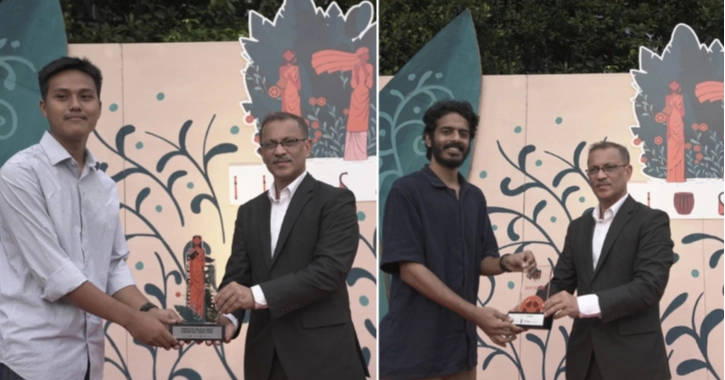
Iranian filmmaker Farzam Tabibi’s ‘Portraits’ won the Zahir Raihan Best Short Award at the 17th International Inter-University Short Film Festival (IIUSFF), which concluded at the University of Dhaka on Wednesday.
Bangladesh’s Mong Sai Shwe Marma won the Tareque Masud Best Emerging Director award for ‘Regresa’, while Türkiye’s Furkan Arslantaş received the Best One Minute Short award for ‘Louder’.
The Best Reels of Resistance award went to Iranian filmmaker Ghazal Zoghiniya for ’Narmook’, while Bangladesh’s Ahsabul Yamin won Best Sound for ‘Dyspepsia by Salty Biscuits’.
The three-day festival was arranged by Dhaka University Film Society (DUFS), with 1,269 films submitted from 92 countries.
Speaking at the closing ceremony, Romana Schweiger, senior adviser on Rule of Law and Human Rights at UNDP Bangladesh, said supporting young filmmakers means supporting their ideas and visions for the future.
“The films selected for this festival show that the struggles, dreams and aspirations of young people in Bangladesh are shared by many others around the world,” she said.
She said visual storytelling has historically played an important role in Bangladesh and stressed the importance of creating spaces where young people can engage in dialogue, reflection and planning.
Professor Dr Kazi Mohammad Mahbubur Rahman, dean of the Faculty of Social Sciences at Dhaka University, said film can help people rethink important aspects of personal, family and social life.
“Film is a reflection or mirror of our society, family and personal lives,” he said.
He, however, cautioned filmmakers against allowing artistic presentation to become detached from reality, saying films disconnected from real life could contribute to misconceptions and create new social challenges.
Bangladesh is going through a major transition following the mass uprising and democratic transformation, he said, stressing the need to understand the role of cinema in shaping the emerging society.
“Film is an extraordinary tool for building society. But the major challenge now is how we use this tool in the right way,” he said.
The closing programme also featured a discussion titled “Film, Memory, and the Politics of Hope,” moderated by DUFS Assistant International Affairs Secretary Rifat Ara.
The panel included UNDP’s Jinbo Choi, teacher and film activist Mrittika Kamal, filmmaker and curator Santua Tripura, and independent filmmaker and artistic director Farid Ahmed.
The festival was supported by the Royal Norwegian Embassy, UNDP and OHCHR.