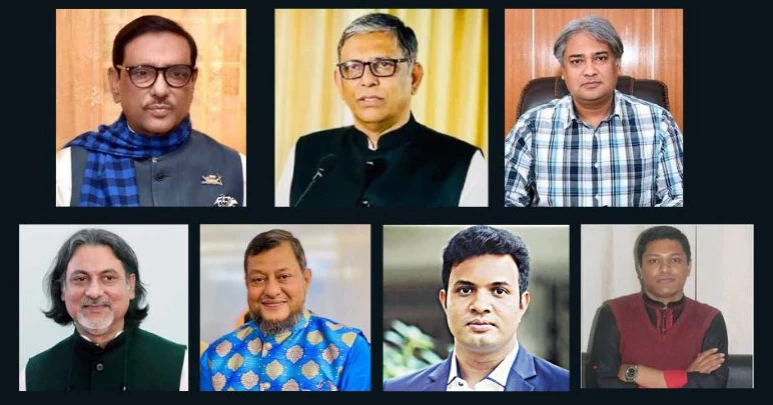
The International Crimes Tribunal (ICT) on Tuesday sentenced seven people, including Awami League General Secretary Obaidul Quader, to death for their alleged roles in suppressing the July 2024 mass uprising through incitement, provocation, attacks and killings.
The tribunal found the accused responsible for crimes against humanity committed during the movement, including directing and inciting party activists to attack protesters, organising resistance against the movement and involvement in killings and other acts of violence, according to the formal charges.
The three-member ICT-2, chaired by Justice Nozrul Islam Chowdhury, pronounced the verdict.
The other condemned convicts are Awami League Joint General Secretary AFM Bahauddin Nasim, former State Minister for Information and Broadcasting Mohammad Ali Arafat, Jubo League Chairman Sheikh Fazle Shams Parash and its General Secretary Mainul Hossain Khan Nikhil, and banned Bangladesh Chhatra League (BCL) President Saddam Hossain and General Secretary Sheikh Wali Asif Enan.
All seven convicts are currently absconding.
The tribunal also ordered that 50 percent property of the five Awami League and Jubo League leaders be confiscated and the proceeds be provided to the family members of those who were killed and injured during the July uprising.
According to the prosecution, a total of seven charges were brought against the convicts in the case.
The investigation began on June 18, 2025, and the probe report was submitted on December 7 of the same year.
Later, formal charges were filed, and the tribunal took cognisance of the charges on December 18.
Charges were framed against the accused on January 22, 2026.
The opening statement in the case was presented on February 17, followed by the recording of prosecution evidence. A total of 29 prosecution witnesses were listed in the case, including the investigating officer.
Closing arguments began on August 4 and concluded on August 17. The tribunal allocated a total of nine working days for the arguments.
A total of 123 documentary exhibits were presented before the tribunal, along with 27 material exhibits.
Witnesses were examined and their statements recorded at different stages on July 27, July 29 and August 2, 2026.
After the closing arguments concluded on August 17, the tribunal kept it pending for judgement.
‘Charges brought against the convicts’
The seven Awami League leaders were accused in the case of playing roles in suppressing the movement, incitement, provocation, attacks and killings.
Obaidul Quader faced three counts. According to the charges, during a phone conversation with BCL President Saddam Hossain on July 11, 2024, he ordered action against the protesters.
He was also accused of inciting BCL leaders and activists against the protesters through his July 15 statement – “Chhatra League will respond to the self-proclaimed Razakars.”
Quader was accused of ordering a slowdown of internet speed on July 16 and directing that various areas of Chattogram be kept under control.
The charges also stated that on July 17 and 18, Quader instructed party leaders to prepare to suppress the movement in their respective areas and build resistance on the streets.
On July 19, he reportedly made a “shoot-at-sight” remark in connection with the imposition of a curfew and deployment of the military.
Later, on August 3, he allegedly directed party leaders and activists to take positions in neighbourhoods and resist the movement.
Awami League Joint General Secretary Bahauddin Nasim was accused of supporting and endorsing Quader’s statements and supervising efforts to suppress the movement in Madaripur.
He was also accused of attending the party programme on August 3 and making an inflammatory statement about protesters at Farmgate on August 4.
Arafat was accused of making inflammatory statements about protesters, ordering attacks and overseeing the violence.
His role in the deaths of six protesters in the Mohakhali area on July 19 was mentioned in the formal charges. He was also accused of temporarily shutting down the broadcasts of several television channels during the movement.
Parash was accused of directing leaders and activists of the Jubo League under his control to suppress the movement. The charges stated that armed Jubo League activists carried out attacks at various locations, resulting in several deaths in Chattogram and Mohakhali of Dhaka on July 18 and 19.
The charges also referred to killings in Lakshmipur and Rajshahi on August 4 and 5.
Nikhil was accused of directing party leaders and activists on July 12 to remain prepared to resist the protesters and of leading an armed procession and attacks in Mirpur on July 19. He was also accused of being present during and supervising several killings in Mirpur on August 4 and 5.
Saddam was accused of threatening and inciting protesters and directing and supervising BCL activists in attacks at Dhaka University and various educational institutions across the country. His statements on July 11 and his roles in various programmes on July 15 and 16 were cited in the charges.
Wali Asif Inan was accused of planning and issuing directives to suppress the movement, making inflammatory statements and leading attacks in the Dhaka University area on July 15. He was also accused of supporting threats issued by Saddam on July 16 and directing and supervising violence on July 18.
According to the formal charges, as a result of these activities, more than 1,400 protesters were killed and over 25,000 people were seriously injured across the country during the July mass uprising, with lethal weapons allegedly being used.