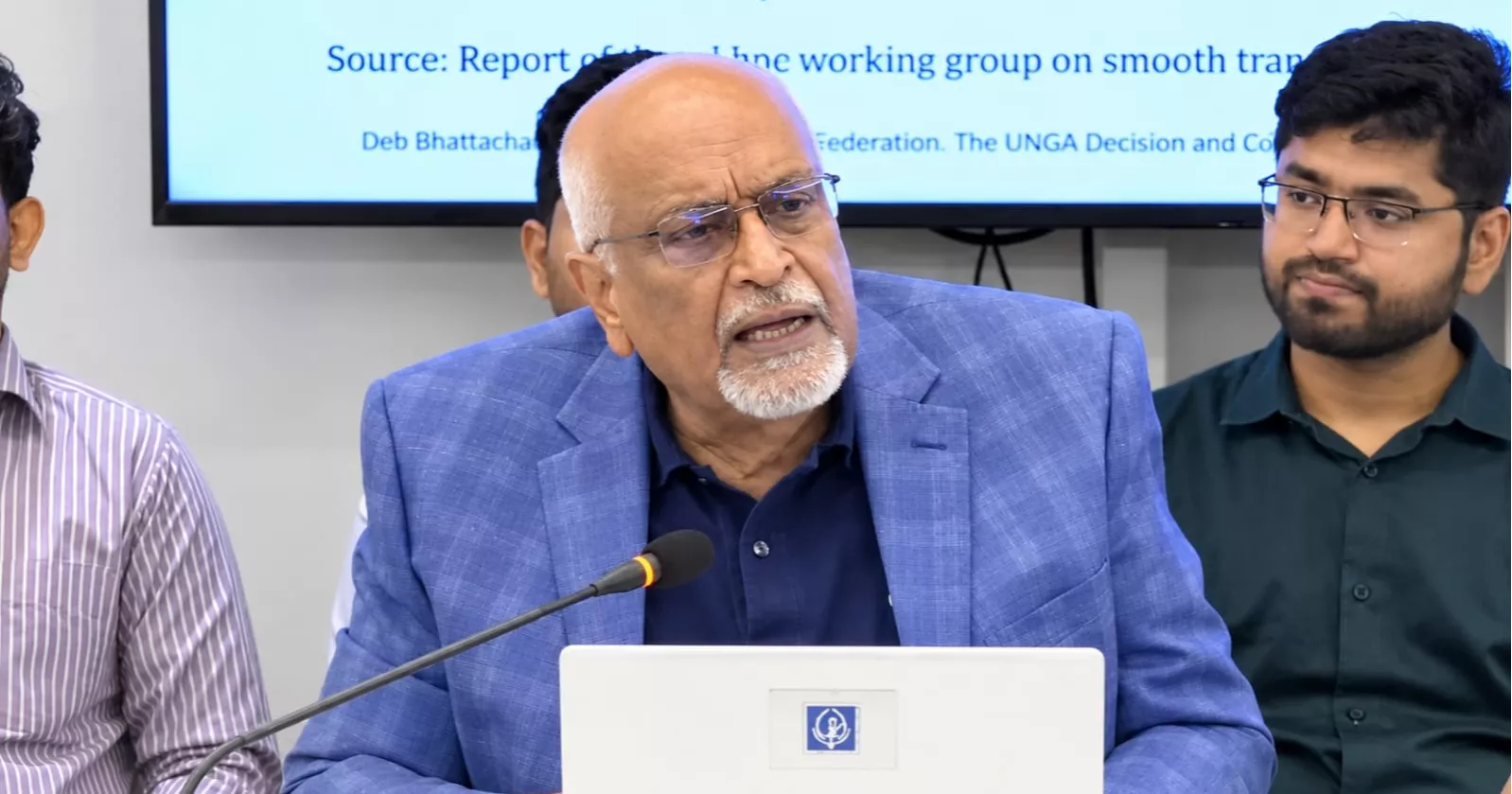
Distinguished Fellow of the Centre for Policy Dialogue (CPD) Dr Debapriya Bhattacharya on Sunday said the three-year extension of Bangladesh's LDC graduation is a one-off concession, not a precedent, and the country must show "exceptional" performance in return.
"An exceptional decision demands exceptional performance," he said while presenting a paper at a CPD briefing at its Dhanmondi office in the capital.
The UN General Assembly unanimously decided last week to move Bangladesh's least developed country (LDC) graduation to 24 November 2029. The decision was granted "on an exceptional basis".
Debapriya, who is also a member of the UN Committee for Development Policy (CDP), said the CDP has made clear it will not support any further extension.
He said the UN accepted that the recent political transition compounded external shocks and strained the government's capacity to respond.
The current graduation framework does not recognise domestic political transitions as grounds for extension, the CPD Distinguished Fellow noted, calling this a rare step. "The issue is capacity, not political will."
He said Bangladesh met all three graduation criteria by wide margins in 2024. "The question is no longer eligibility but preparedness."
Debapriya said the resolution asks the Ministry of Finance to report to the CDP every year and expects significant progress on domestic reforms.
He added that the UN Resident Coordinator in Dhaka will support monitoring of milestones.
The renowned economist described the government's press note on the decision as welcome but incomplete, saying it did not mention the "exceptional basis" of the extension or the CDP's reform expectation.
"It also did not say who owns the three-year action plan, whether it will be made public, or how it relates to other planning documents," he said, urging the finance ministry to publish the plan with milestones and a clear owner.
Citing the starting point of the reform pathway, Debapriya said tax revenue stood at 6.9 percent of GDP in FY26, while non-performing loans were 32.8 percent of total outstanding loans in June 2026.
Ready-made garments accounted for 80.6 percent of exports in FY26, and private investment was 21.5 percent of GDP. Load shedding peaked at 3,757 MW on 10 August, he said, while Bangladesh ranks 88th among 139 countries in the World Bank's Logistics Performance Index.
"Bangladesh has been more adept at drafting commitments than at delivering them," the CPD Distinguished Fellow said, noting that the final Smooth Transition Strategy (STS) was issued only in 2025, four years after the 2021 recommendation.
He laid out a reform pathway for the STS in four areas: public financial management, energy, social protection and logistics.
These, Debapriya said, should drive export diversification and productivity, and ultimately competitiveness.
He recommended moving STS coordination from the Economic Relations Division to the Prime Minister's Office, as it is "beyond ERD's mandate and competence".
The economist also called for placing the STS and the 2026-2029 roadmap before Parliament, and for considering a special parliamentary committee on LDC graduation.
In addition, he proposed a public STS dashboard, updated regularly, to track progress.
Debapriya further urged the government to identify every measure available only to LDCs, such as export cash incentives, and to set a timeline to phase each out before November 2029.
On trade, he said most deals remain at an early stage and the next three years must turn talks into signed and ratified agreements.
The CPD distinguished fellow cited talks agreed with the European Union, the Economic Partnership Agreement signed with Japan in February with ratification pending, and the working group set up in September on accession to RCEP.
He added that CPD will track STS reforms, including public finance and banking, in a new LDC graduation domain of its Bangladesh Reform Tracker, and will assess progress every year until November 2029.