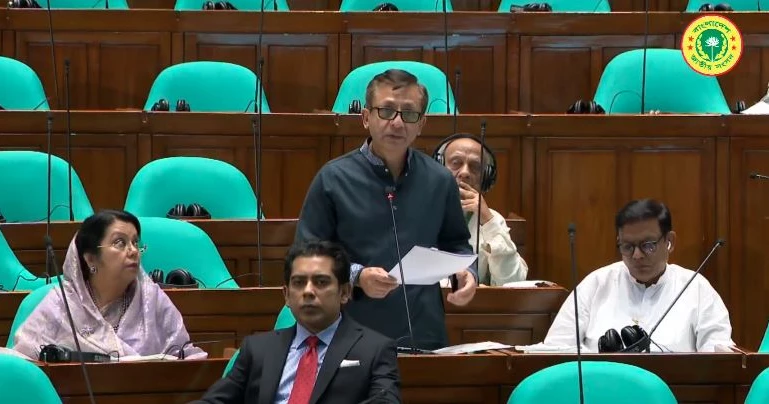
Commerce Minister Khandakar Abdul Muktadir on Monday said Bangladesh's leather industry has the potential to generate more than $10 billion in export earnings, making it a strong alternative export sector alongside the country's existing major industries.
Responding to a supplementary question from ruling party lawmaker Alhaj Jashim Uddin Ahmed (Chattogram-14) in Parliament, the minister said leather exports have remained stagnant at around $1.10-$1.15 billion annually over the past three years due to several structural challenges.
He said the relocation of tanneries from Hazaribagh to Savar, although intended to modernise the industry and improve environmental compliance, has adversely affected leather processing capacity because of implementation shortcomings.
"The capacity of leather processing has significantly decreased compared to earlier levels," he said.
The minister noted that the decline has become particularly evident during the Eid-ul-Azha season, with both the collection and preservation of raw hides falling sharply.
To revitalise the sector, the government has undertaken a number of initiatives, he said.
These include improving slaughterhouse operations in coordination with the Ministry of Livestock to ensure mechanised skinning and proper collection of hides, upgrading the Central Effluent Treatment Plant (CETP) in Savar from its current operational capacity of 14,000-16,000 cubic metres to its designed capacity of 25,000 cubic metres per day, and providing technical and financial assistance to tanneries for establishing their own Effluent Treatment Plants (ETPs).
The minister also said all factories in the Savar leather industrial zone would be brought under full environmental compliance, alongside enhanced technical and financial support from the government.
"If these measures are properly implemented, the leather industry will emerge as a strong alternative export sector for Bangladesh," he added.
Replying to another supplementary question from NCP lawmaker Atikur Rahman Mujahid (Kurigram-2) regarding the expansion of trade facilities in the northern region through the Sonahat Land Port, the minister said expanding the port could boost trade activities.
However, he said the government would first assess the project's feasibility before taking any further steps.
Responding to a separate supplementary question from independent lawmaker Rumeen Farhana (Brahmanbaria-2) on alleged illicit financial flows, Abdul Muktadir described the issue as complex and requiring extensive research.
He said Bangladesh's trade ecosystem involves a wide range of goods and financial mechanisms, including pricing clauses, pre-shipment inspection systems and various import structures.
Citing macroeconomic indicators, the minister said Bangladesh's trade volume, including imports and exports, now stands at approximately $130 billion.
He stressed that identifying money laundering through specific products requires detailed investigation and analytical studies.
"We are aware of the concerns and are conducting studies. If any irregularity is identified, the government will take appropriate action," he told Parliament.