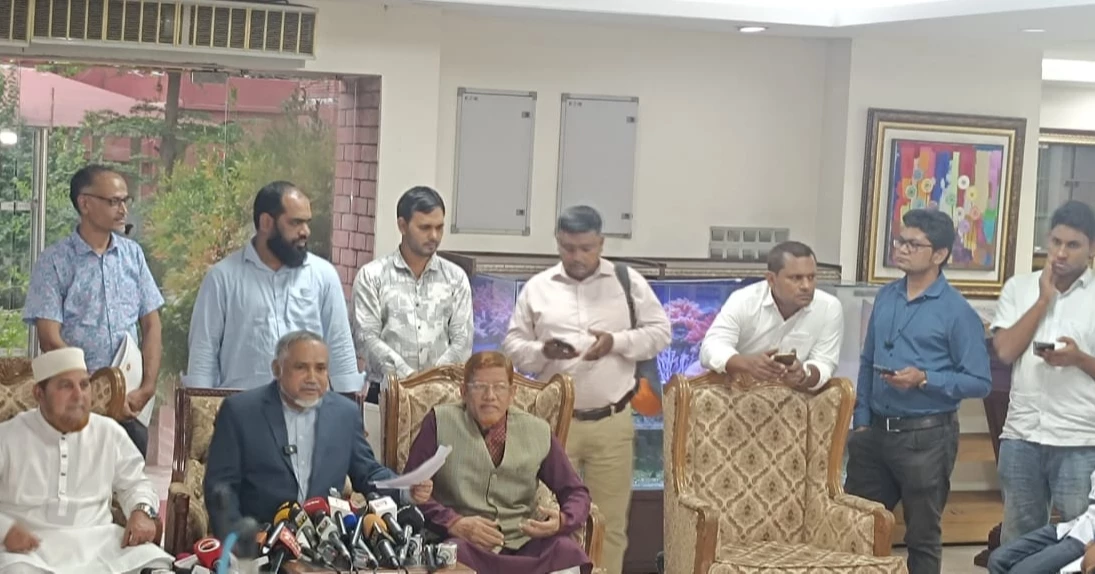
Bangladesh Jamaat-e-Islami Nayeb-e-Ameer Syed Abdullah Muhammad Taher on Sunday said a legal foundation must be established before the next general election to ensure the implementation of agreed reform proposals so that the next government cannot deny the issues.
“We’ve discussed many issues here. But there is no legal basis yet. Those who come to power could change it. That’s why we strictly think a legal basis must be laid before the election,” he said.
The Jamaat leader made the remarks, replying to a question at a press briefing after the 12th day of the second-round reform dialogue of the National Consensus Commission with the political parties, held at the Foreign Service Academy in the city.
No scope for electoral alliance with Jamaat, door not closed for NCP: BNP’s Salahuddin
He, however, said the issue of legal binding for reform proposals has not yet been formally discussed in the dialogue. “When it comes up, there will be differences and arguments. But we hope to reach a point (consensus) finally, InshAllah,” he said.
Reiterating his party’s position, Dr Taher said, “Our clear stance is that we must reach consensus on fundamental issues … and ensure a legal basis for them—so that nobody can deny or avoid these issues.”
On Sunday, political parties in the reform discussion reached a consensus on two more important reform proposals --the promulgation of emergency and the appointment of Chief Justice, he said.
They agreed on a proposal to change the emergency promulgation provision of the Constitution in a bid to prevent its misuse as political tools.
According to the proposal, the Proclamation of Emergency can be issued for 90 days and ‘internal disturbance’ will be replaced by the threats towards independence, sovereignty and integration of the State, pandemic or natural disaster. But such Proclamation shall require for its validity the prior approval of the Cabinet.
The leader of the opposition or in his/her absence, the deputy leader of the opposition shall be invited to the Cabinet meeting to be held to endorse the decision to declare the emergency, said the proposal.
During the emergency, two rights of any citizen shall not be undermined. These are – right to life: and right to protection from persecution, cruel, inhumane or defamatory behaviour or punishment.
Besides, the political parties agreed on another proposal that the most senior justice of the Appellate Division shall be appointed as the Chief Justice. But if any political party promises in its next electoral manifesto that the chief justice shall be appointed from the most two senior justices, the provision can be incorporated in the Article 95 (1) of the Constitution.
Though another issue–caretaker government-- was discussed on Sunday, it needs further discussion for its formation. The issue will again be discussed on Tuesday.