State Minister for Foreign Affairs Humaiun Kobir has urged BIMSTEC member states to remain committed to regional cooperation despite bilateral differences and tensions, stressing the need for mutual trust, political will and a shared sense of purpose.
“Let us not walk away from regional cooperation regardless of differences. We must have the tenacity. We must have the vision to digest difficult challenges, difficult tensions, and difficult dialogue to make regional cooperation a success with mutual trust, political will, and a shared sense of purpose,” he said while speaking at a reception as the chief guest.
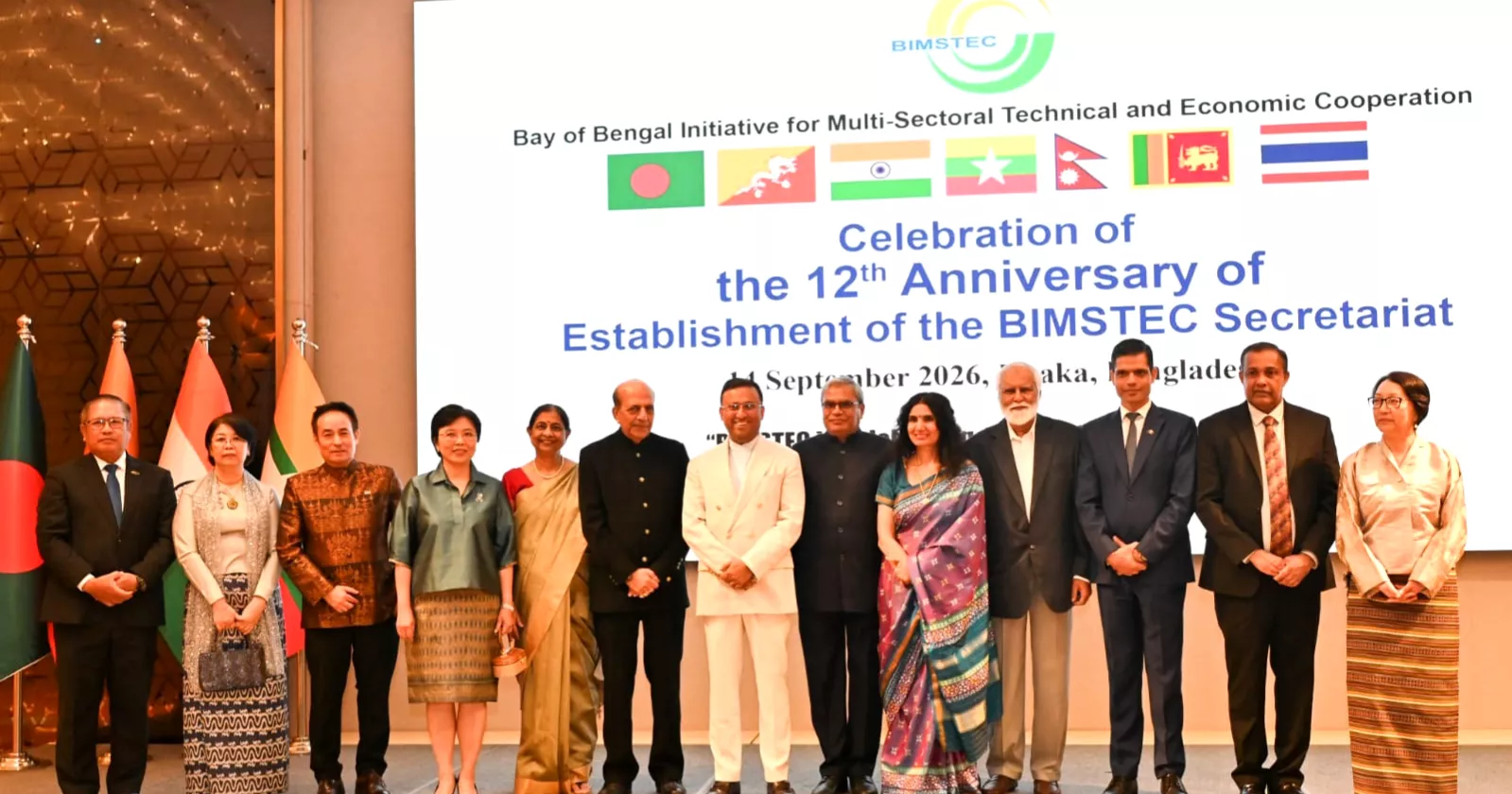
The Bay of Bengal Initiative for Multi-Sectoral Technical and Economic Cooperation (BIMSTEC) celebrated the 12th anniversary of the establishment of its Secretariat on Monday night.
The State Minister said BIMSTEC could become an even more dynamic bridge between South and Southeast Asia and a strong force for regional peace, progress and sustainable development.
“For BIMSTEC to be successful, we must not dwell on bilateral tensions but widen the nets of engagement,” Kobir said.
The reception was also attended by State Minister for Disaster Management and Relief M Iqbal Hossain, along with ambassadors and high commissioners of BIMSTEC member states, ambassadors of embassies in Dhaka, representatives of diplomatic missions, members of the business, media, think tank, cultural and academic communities, development partners, and officials of the BIMSTEC Secretariat.
BIMSTEC Secretary General Indra Mani Pandey highlighted the progress made by BIMSTEC in strengthening regional cooperation and developing the institutional framework required for it to function as an effective regional organisation.
He noted that BIMSTEC’s cooperation is guided by its Charter and the BIMSTEC Bangkok Vision 2030, and supported by an extensive institutional architecture comprising summits, ministerial and senior officials’ meetings, sectoral mechanisms and BIMSTEC centres.
The Secretary General also highlighted BIMSTEC’s growing partnerships with international and regional organisations in support of the shared development aspirations of its member states.
He underscored that, since its establishment in Dhaka in September 2014, the BIMSTEC Secretariat has emerged as the anchor for implementing regional cooperation initiatives, facilitating consultation, communication and coordination among member states, and monitoring the implementation of their decisions.
The State Minister said Bangladesh would work closely with member states and the Secretariat in the coming months to advance implementation across BIMSTEC mechanisms and prepare for the next BIMSTEC Summit.
He highlighted the role of BIMSTEC as a bridge between South and Southeast Asia and stressed the need for member states to work together to address common challenges and advance shared prosperity.
The State Minister also underscored the importance of strengthening regional economic integration, connectivity and people-to-people contacts, while emphasising the need to translate BIMSTEC decisions into practical outcomes.
Kobir said Bangladesh would work closely with all member states and the Secretariat in the coming months to advance implementation across mechanisms and prepare for the next BIMSTEC Summit, which Bangladesh is expected to host in Dhaka in 2027.
The gathering of heads of state and government in Dhaka will provide an important opportunity to review progress, set new priorities and provide further political direction to the common regional agenda, he said.
On behalf of the government and people of Bangladesh, Kobir extended warm felicitations to the governments and peoples of all BIMSTEC member states on the occasion.
“Bangladesh is proud to host this regional institution and remains committed to providing the support necessary for it to discharge its responsibilities effectively,” he said.
The seven BIMSTEC member states - Bangladesh, Bhutan, India, Myanmar, Nepal, Sri Lanka and Thailand - together represent a vast pool of people, resources, talent and economic potential. “Our task is to transform this shared geography into shared prosperity,” Kobir said.
He noted that economic uncertainty, fragmented supply chains, climate change, energy insecurity, public health risks, cyber threats, transnational crime and humanitarian challenges do not respect national borders.
“No country can address them effectively in isolation. A stronger BIMSTEC is therefore not simply desirable; it is a strategic necessity for the peace, resilience and prosperity of our region,” he said.
Referring to the 6th BIMSTEC Summit held in Bangkok on April 4, 2025, Kobir said it had provided renewed momentum to the regional process through the adoption of the Bangkok Vision 2030, the BIMSTEC Rules of Procedure and the report of the Eminent Persons Group.
The signing of the BIMSTEC Agreement on Maritime Transport Cooperation and important partnerships with international organisations also provided a stronger institutional and strategic foundation for the future, he said.
“Our responsibility now is to move decisively from adoption to implementation, from declarations to delivery,” Kobir said.
Bangladesh assumed the BIMSTEC chairmanship with a clear commitment to making the organisation more functional, visible, inclusive and, importantly, people-centred, he said. “Our approach is guided by practical cooperation and measurable outcomes,” he said.
As the lead country for trade, investment and development, including the blue economy, Bangladesh attaches particular importance to strengthening regional economic integration, expanding connectivity, promoting the sustainable use of marine resources and creating opportunities for businesses and people, Kobir said.
“More than two decades after the framework agreement, our region still trades far below its potential,” he said, calling for renewed political and technical momentum to conclude constituent agreements, reduce barriers to trade, improve customs and logistics cooperation, strengthen regional value chains and create a more enabling environment for investment and enterprise.
“We should have the vision to look at an integrated economic market for the BIMSTEC region,” Kobir said.
He also highlighted the importance of the blue economy, describing the Bay of Bengal as one of the region’s greatest shared assets. “Connectivity must remain at the heart of the BIMSTEC project,” he said.
“What we now need is sustained implementation, innovative financing, and stronger engagement with the private sector and our development partners,” Kobir said.
He also underscored the importance of people-to-people connectivity through tourism, education, culture, youth exchanges, professional networks, think tank cooperation, innovation and greater interaction among private-sector stakeholders.
He reaffirmed Bangladesh’s commitment to BIMSTEC and the Secretariat in Dhaka, saying the government deeply values the contribution of the Secretary General and his team and will continue working with all member states to strengthen the Secretariat’s capacity and institutional effectiveness.
The celebration also featured a cake-cutting ceremony by the chief guest, the BIMSTEC Secretary General and heads of missions of BIMSTEC member states, followed by a group photo session.