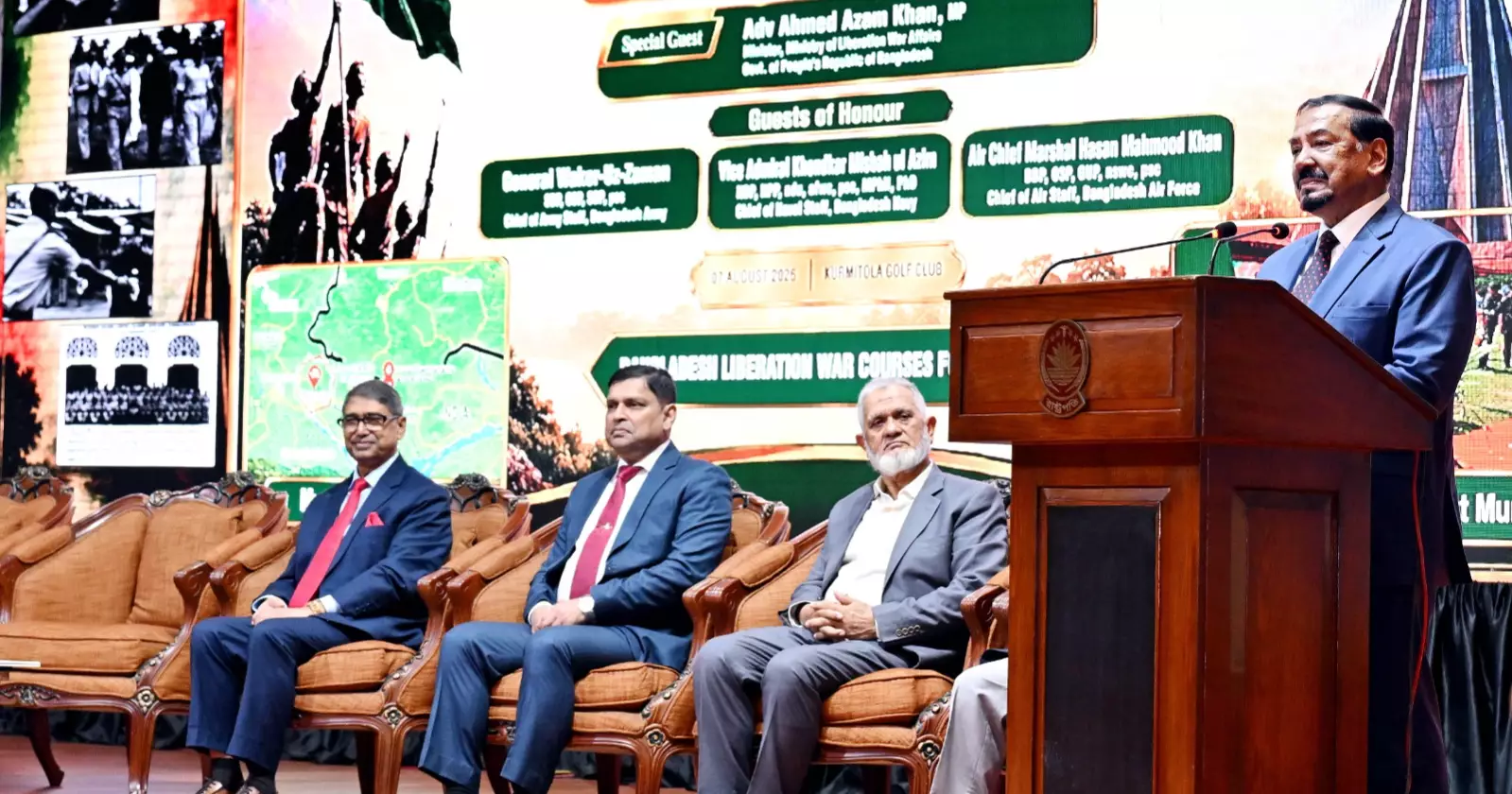
Acting President Hafiz Uddin Ahmad Bir Bikram on Friday said the Liberation War of 1971 was a people’s war, not a war of any particular political party, and urged all to play a responsible role in realising the ideals of democracy, human dignity, equality and social justice.
“The Liberation War was a people’s war. We have to build a democratic Bangladesh based on the ideals of the Liberation War,” he said.
The Acting President made the remarks as the chief guest at the 54th Commissioning and Fellowship Day celebration of the Bangladesh Liberation War Courses, organised by the Bangladesh Liberation War Courses Foundation at the Kurmitola Golf Club in Dhaka Cantonment .
Stressing the need to establish a democratic system in the country so that no autocrat can emerge in the future, Hafiz Uddin said, “We want to see a happy, prosperous and democratic Bangladesh. There should be no autocrat in this country again.”
He said the people would change governments through elections and, if a government makes mistakes, those mistakes should be corrected through people and democratic institutions.
“But under no circumstances should anyone destroy the democratic system,” he said.
The Acting President also called upon politicians to learn from the country’s past.
“Our politicians also have a lot to learn. If a section of the politicians had fought in 1971, risking their lives, there would have been no one-party rule in this country. Democracy would have been given its due dignity,” he said.
Highlighting the spirit of the Liberation War and the responsibility of the present generation, Hafiz Uddin Ahmad said the people of Bangladesh risked their lives for independence in 1971 and the responsibility of realising that dream now rests with the next generation.
“We responded to the call of the country and fulfilled our responsibility in 1971. Now the responsibility lies with the next generation. It is our expectation that the present generation will fulfil the dream we had,” he said.
The Acting President expressed hope that Bangladesh has once again regained its strength and is moving towards democracy.
“I hope our nation has risen again. Democracy has been established again. In the coming days, we hope that the next generation will certainly fulfil the dream for which we fought,” he said.
He said many of those who came to power after independence did not want to present the true picture of the Liberation War before people.
“As a result, many events, sacrifices and acts of heroism of the Liberation War have not yet received their rightful place in history. They remain unknown to many ordinary people. This history must be properly documented and presented before people,” he said.
The Acting President said attempts had been made after independence to establish the notion that the country had become independent merely through a few speeches.
“In reality, countless young people, sons and daughters of ordinary families, soldiers and others sacrificed their lives to liberate the country,” he said.
He said the Great Liberation War was a struggle to establish democracy, human dignity, equal rights and a state free from discrimination.
“The new generation must know how the country became independent and what the dreams of the freedom fighters were. They should work to fulfil those dreams and build a happy, prosperous and democratic Bangladesh,” he said.
Recalling various events during the Liberation War, Hafiz Uddin said the greatest strength of the freedom fighters was their sacrifice and patriotism.
He said many young people who were unable to join the war because of physical limitations would break down in tears and plead for an opportunity to fight for the country.
“They would even lie down in front of vehicles, asking to be allowed to participate in the war,” he said.
He described such incidents as unique and glorious chapters in the history of the Liberation War.
The Acting President said the then Pakistani ruling authorities had shown no respect for the people’s votes.
“In the 1970 election, the people of this country voted in favour of regional autonomy based on the Six-Point demand, but that popular mandate was ignored,” he said.
Later, he said, the Pakistani military launched genocide and brutal repression against unarmed people.
“In such a situation, when there was no effective opportunity from the political leadership to reassure or provide direction to people, the Bengali soldiers and officers of the East Bengal Regiment and the EPR declared a revolt and began armed resistance,” he said.
Hafiz Uddin said if the members of the East Bengal Regiment and the EPR had not revolted against the Pakistani forces in March 1971, the history of Bangladesh’s War of Independence could have been different.
He said battalions of the East Bengal Regiment in different cantonments built resistance, while thousands of students and young people joined the Liberation War under the leadership of a limited number of soldiers.
He said around 80,000 young people responded to the call of nearly 5,000 soldiers and joined the Liberation War, while the number of freedom fighters eventually reached around one lakh.
“These freedom fighters were trained and prepared for the war by soldiers and officers of the East Bengal Regiment and the EPR,” he said, stressing the need to properly document these aspects of history.
The Acting President also recalled the contribution and strong leadership of Shaheed President Ziaur Rahman, saying that the declaration of independence by Major Ziaur Rahman inspired the nation.
He also made the declaration on behalf of Sheikh Mujibur Rahman, he said.
Hafiz Uddin Ahmed said the freedom fighters had not fought to gain personal credit or recognition.
“They took up arms to protect the existence of the country, the lives of its people and the honour of our mothers and sisters,” he said.
He said the Pakistani ruling authorities had believed that Bengalis would not be able to fight.
“But in 1971, Bengali soldiers and freedom fighters proved that notion wrong through their courage, skill and sacrifice,” he said.
Recalling his wartime experience, the Acting President said that, on the orders of the Chief of Army Staff, he recruited young people from various youth camps to form a new battalion.
“Thousands of school and college students were waiting at camps along the border to fight for the country. Despite harsh living conditions, limited food and an uncertain future, they were eager to go to the battlefield and sacrifice their lives for the country,” he said.
He recalled in detail the contributions and sacrifices of the fearless military and civilian people of Bangladesh during the Liberation War.
Hafiz Uddin said that after independence, while undergoing military training abroad, he would recount to foreign military instructors the bravery of the freedom fighters in battles including the Kamalpur battle.
“The foreign military instructors would be astonished. They would say that such an attack was not possible even for a professional force; only those who were prepared to sacrifice their lives for their country could demonstrate such extraordinary courage,” he said.
Noting that the dreams of the freedom fighters had not been fully realised even five decades after independence, he said the mass uprising staged by the people of Bangladesh in August 2024 was also an expression of their aspiration for democracy.
He also stressed the need for politicians to engage in self-criticism.
In his speech, the Acting President paid deep respect to former Prime Minister Begum Khaleda Zia, saying that the four-time prime minister had been detained by the Pakistani forces during the Liberation War.
“During the Liberation War, the Pakistani forces searched extensively for Begum Khaleda Zia in Dhaka and arrested her from the house of a relative,” he said.
He also remembered his late wife Dilara Hafiz.
Describing how the Bangladesh Army was formed after independence, he said the Bangladesh Army was small in 1972.
“But its greatest strength was the indomitable spirit of sacrificing one’s life for the country,” he said.
He expressed hope that the present and future generations would uphold the spirit of the Liberation War and build an egalitarian, democratic and prosperous Bangladesh.
Major A Matin Chowdhury delivered the welcome address at the programme.
Chief of Army Staff General Waker-Uz-Zaman, Chief of Air Staff Air Chief Marshal Hasan Mahmood Khan and Chief of Naval Staff Vice Admiral Khandaker Misbah ul Azim also spoke at the programme.
Liberation War Affairs Minister Ahmed Azam Khan addressed the event as the special guest.