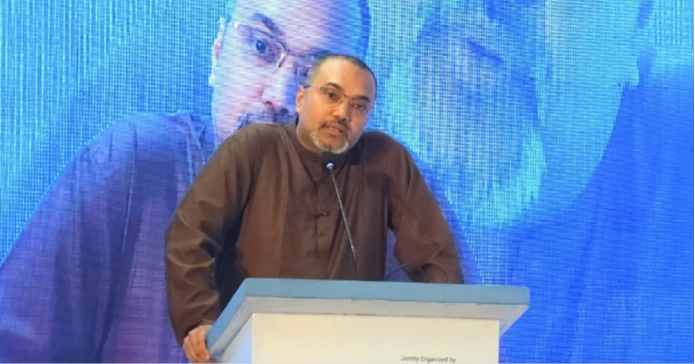
Prime Minister’s Adviser Mahdi Amin on Thursday stressed the need for stronger collaboration between industries and academic institutions to harness the potential of artificial intelligence (AI) and turn research-based knowledge into productive economic assets.
Speaking at the Bangladesh AI Business Summit 2026, he said the success of AI adoption would depend on how effectively the technology could be aligned with Bangladesh’s economic realities and needs.
AI could offer effective solutions to real-world challenges across various sectors, including ready-made garments, textiles, agriculture, pharmaceuticals, financial services, logistics and small and medium enterprises (SMEs), said Mahdi, also the Prime Minister’s Office spokesperson.
He emphasised the importance of connecting university research, innovation and technological solutions with the practical demands of industries, alongside expanding investment to translate research-based knowledge into productive economic activities.
The government is working to create a business-friendly environment in the country, the adviser said, adding that coordinated efforts among government agencies, universities, trade bodies and technology entrepreneurs were essential to achieving this goal.
The summit, the first of its kind in Bangladesh, was jointly organised by the Dhaka Chamber of Commerce and Industry (DCCI) and the Ministry of Science and Technology at the Bangladesh-China Friendship Conference Centre in the city, under the theme “AI-fication for Tomorrow’s Economy”.
President Mirza Fakhrul Islam Alamgir inaugurated the summit as the chief guest.
Speaking at a thematic session on industry-academia linkage, former DCCI President Rizwan Rahman said aligning academic curricula with industry and business requirements was crucial to developing an AI-ready skilled workforce in Bangladesh.
He stressed the importance of AI literacy, data analytics and practical problem-solving skills, saying effective partnerships among the government, industries, educational institutions and development partners were necessary to accelerate the country's AI-driven transformation.
FLAXA President Syed Nasim Manzur called for tax incentives on investments in education and research to encourage greater private-sector participation.
He also stressed the need to modernise existing intellectual property laws to attract domestic and foreign investment, noting that local entrepreneurs could introduce AI-based services to address existing challenges in the industrial sector.
Transcom Limited Group CEO Simeen Rahman said the adoption of AI should be expanded to boost productivity and strengthen the capacity of the industrial sector.
Science and Technology Secretary Md Anwar Hossain proposed establishing a national AI ecosystem through collaboration between the public and private sectors.
DCCI President Taskeen Ahmed, who moderated a session on AI transformation, its prospects and challenges, said AI had emerged as a transformative force in the global economy, reshaping business operations, industrial production and institutional decision-making.
He said Bangladesh was increasingly moving towards digital services, automation, data-driven decision-making and technology-enabled business solutions.
However, limited technological infrastructure, a shortage of skilled professionals, high implementation costs and cybersecurity concerns continued to impede the country's AI journey, Taskeen added.
The thematic sessions brought together government policymakers, business leaders, local and foreign entrepreneurs, investors, academics, students and young researchers to assess the country's AI sector, identify existing challenges and explore future opportunities.
An exhibition titled “AI Business Expo” was also organised alongside the summit, featuring more than 150 AI-based stalls where local and foreign entrepreneurs showcased their products and services.
Young innovators and entrepreneurs from 20 public and private universities also displayed their innovations, creating opportunities for business networking, exchange of ideas and commercial partnerships.