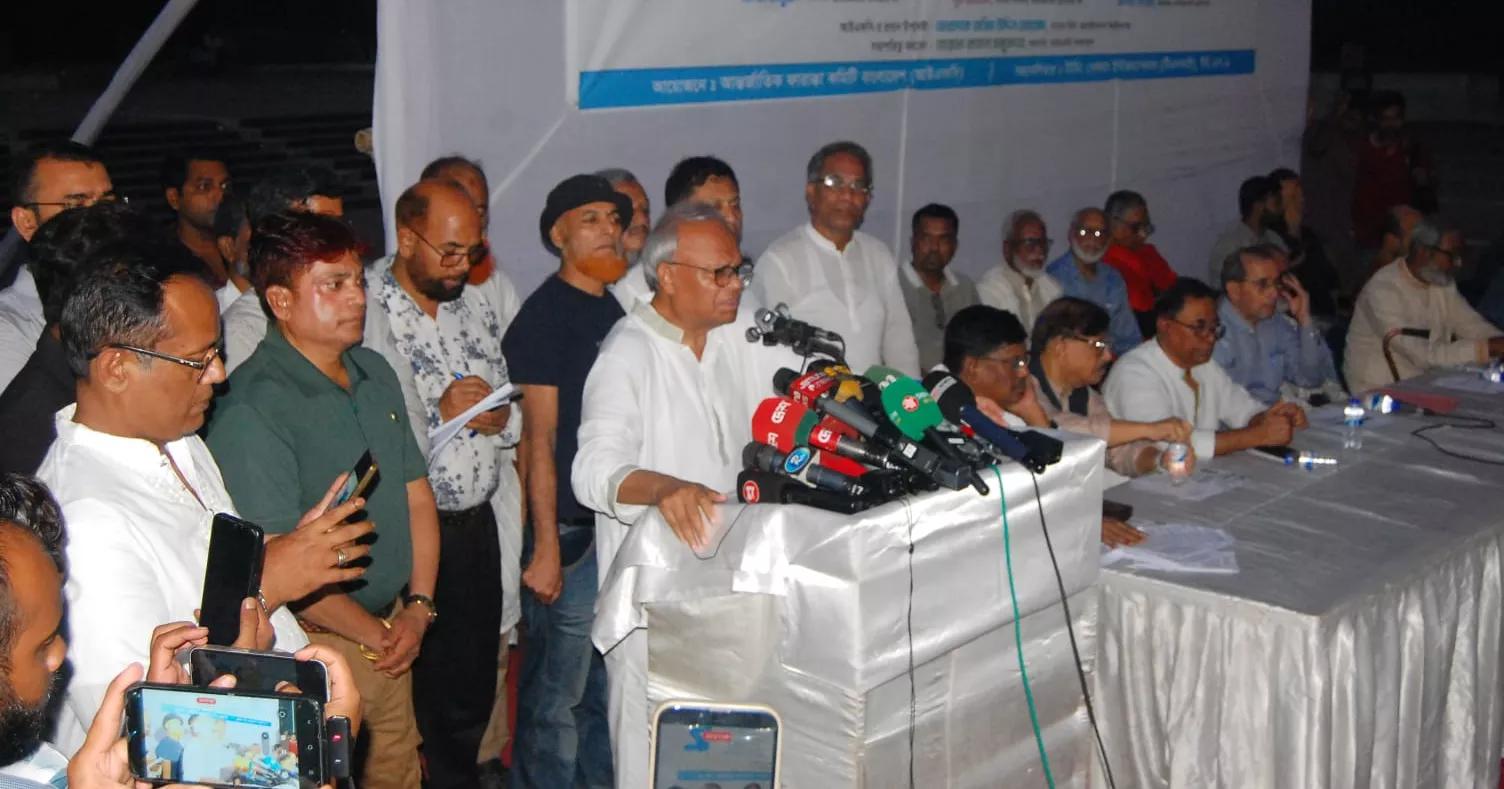
Speakers at a mass rally marking the 50th death anniversary of Maulana Abdul Hamid Khan Bhashani on Monday called for national unity, beyond political affiliations, to secure Bangladesh's fair share of water from all transboundary rivers and ensure their natural flow.
The rally, organised by the International Farakka Committee (IFC) Bangladesh at the Central Shaheed Minar in the capital, highlighted the adverse consequences of unilateral water withdrawal and upstream regulation of river flows. Touching Souls International (TSI), a US-based organisation, extended support to the programme.
The speakers said unilateral diversion of water and control over upstream river flows had put the existence of river-dependent Bangladesh at risk, causing serious damage to the country's environment, ecosystems, biodiversity, agriculture, economy and people's livelihoods.
They also expressed concern over the Ganges Water Sharing Treaty, which is due to expire on December 11, saying there had been no visible progress towards its renewal.
They added that no agreements had yet been reached on water sharing and integrated management of the Teesta and 53 other transboundary rivers.
Addressing the rally as the chief guest, Prime Minister's Political Adviser and BNP Acting Secretary General Ruhul Kabir Rizvi called on people to uphold Bhashani's legacy of struggle and raise their voices to protect the country's rivers and water rights.
He said protests against India's unilateral withdrawal of water upstream must be intensified.
Rizvi alleged that India had repeatedly failed to honour its commitments under water-sharing agreements, including the Ganges treaty, depriving Bangladesh of its legitimate share of water.
Describing the 1996 Ganges Water Sharing Treaty as a "deceptive agreement", he said an earlier agreement signed during the tenure of Ziaur Rahman had a guarantee clause, which was dropped in the 1996 treaty.
He called for continued diplomatic engagement with India alongside stronger national unity to secure Bangladesh's fair share of water, stop border killings and protect the country's national interests.
Referring to the adverse effects of the Farakka Barrage, the BNP leader said the once-mighty Padma had lost so much of its water flow that handcarts and vans could now move across parts of its riverbed.
He also said the Farakka Barrage had become a source of suffering for people in West Bengal and Malda, arguing that obstructing the natural flow of rivers could ultimately put everyone at risk.
The Farakka Long March led by Maulana Abdul Hamid Khan Bhashani in May 1976, demanding demolition of the Farakka Barrage, was recalled by various speakers.
Rizvi further alleged that India was planning to construct a dam upstream of Tipaimukh to divert water.
Biplabi Workers Party General Secretary Saiful Haque said Bangladesh should reconsider all unequal agreements signed with India, including those related to transit, if the neighbouring country continued to delay or undermine the Farakka agreement.
He said India must be compelled to ensure Bangladesh's fair share of water. He also called for organising multiple long marches, if necessary, and raising the issue at the United Nations.
Nagarik Oikya President Mahmudur Rahman Manna stressed the need for national unity and adequate preparation to address the losses Bangladesh had suffered due to deprivation of its fair share of water.
AB Party General Secretary Barrister Fuad Hossain called for forming an expert commission to assess the damage Bangladesh had incurred over the past 50 years due to the Farakka Barrage.
Presiding over the rally, IFC Bangladesh President Mostafa Kamal Majumder said the movement for Bangladesh's river and water rights was closely linked to the campaign against India's inter-basin river-linking project.
He said the central objective of the movement was to prevent the diversion of water from one river to another and protect the livelihoods of communities living along riverbanks.
Among others, the rally was addressed by IFC Bangladesh Chief Adviser and former Jahangirnagar University Vice-Chancellor Professor Jasim Uddin Ahmed, Bangladesh Labour Party leader Mostafizur Rahman Iran, Freedom Fighters Command Council Convener Naim Jahangir, Bhashani Janashakti Party Chairman Sheikh Rafiqul Islam Babul, IFC General Secretary Mahbubul Alam, Janatar Andolan Editor Muhammad Ullah Madhu, Jatiyatabadi Muktijoddha Dal General Secretary Nur Ahmed and Kalam Faizi.
The rally was conducted by Rafiqul Islam Azad and Ataur Rahman Ata.
The rally put forward a six-point demand to protect Bangladesh's water rights. The demands included removing all obstructions to the natural flow of transboundary rivers upstream; dismantling the Farakka Barrage; dismantling the Gazoldoba Barrage on the Teesta; signing basin-based water-sharing and management agreements for all transboundary rivers; signing the 1997 UN Convention on the Law of the Non-Navigational Uses of International Watercourses; and ensuring equitable distribution and integrated management of all transboundary rivers under UN supervision.