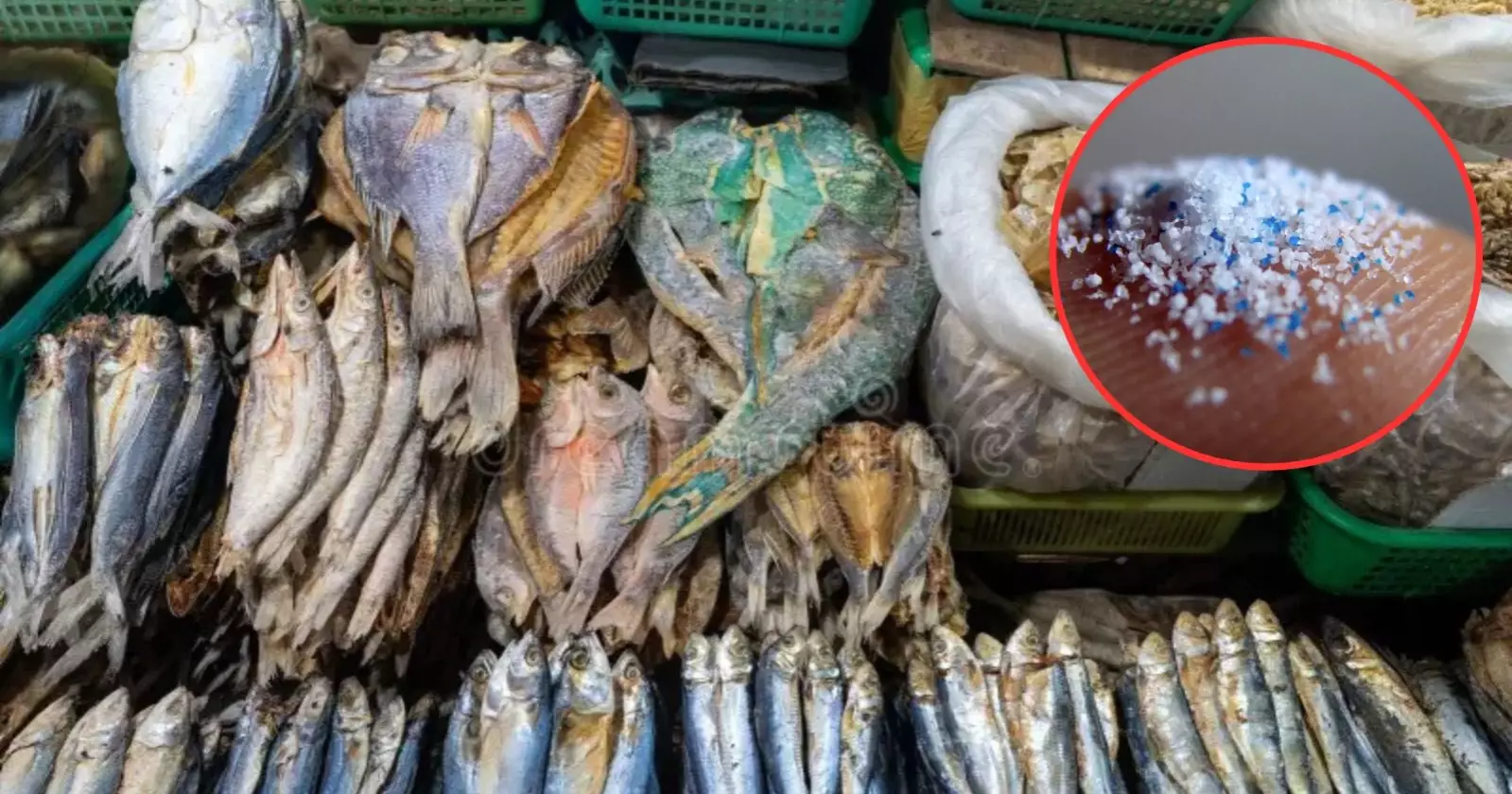
Microplastics (MPs) have been detected in all commercially dried seafood samples examined from four coastal regions of Bangladesh, with abundance ranging from 0.25 to 1.30 MPs g− 1 dry weight, according to a latest study.
Hazardous polymers (PP, PE, PET) contributed to elevated risk levels and multivariate analysis revealed distinct spatial pollution signatures.
Microplastic (MP) contamination in seafood has received increasing attention, yet information on commercially dried seafood remains limited.
Mohammed Ashraful Azam Khan, Kazi Nusrat Jahan Ouishi, Habibur Rahman Pias, Nadia Islam Riya, Shanjida Akter Joyoti from the Department of Fisheries, Faculty of Marine Sciences and Fisheries, University of Chittagong, conducted the study titled “Occurrence, characteristics, and polymer associated hazard of microplastics in commercially dried marine seafood from coastal Bangladesh.”
The study assessed MP abundance, physical characteristics, polymer composition, spatial variation, and polymer associated hazard in commercially dried seafood from the Sundarbans, Kuakata, Teknaf, and Cox's Bazar.
Six species were examined: Harpadon nehereus, Trichiurus lepturus, Setipinna phasa, Johnius argentatus, Penaeus monodon, and Metapenaeus monoceros.
MPs were detected in all samples, with abundance ranging from 0.25 to 1.30 MPs g− 1 dry weight. Regional mean abundance ranged from 0.57 ± 0.26 MPs g− 1 in Teknaf to 0.91 ± 0.36 MPs g− 1 in Sundarban, with no significant difference among the four regions (p = 0.165).
Fibers were the dominant morphology, blue and black particles were frequently observed, and smaller size fractions constituted a substantial proportion of the recovered MPs, according to the Marine Pollution Bulletin, an international peer-reviewed journal published by Elsevier that focuses on the marine environment, pollution control, and the management of ocean and coastal resources.
Fourier-Transform Infrared Spectroscopy (FTIR) analysis identified seven polymer types, with polyethylene (30.49%) and polypropylene (24.39%) occurring most frequently.
The Polymer Hazard Index (PHI) varied markedly among regions, from 86.7 in Sundarban to 2642.7 in Kuakata, reflecting differences in polymer composition and polymer specific hazard scores.
Multivariate analyses further revealed interconnected variation in MP abundance, physical characteristics, and polymer composition across the examined samples.
Overall, the findings provide a quantitative baseline for MP occurrence and polymer-associated hazard in commercially dried marine seafood from coastal Bangladesh and highlight the need to distinguish environmental contamination from inputs occurring during post-harvest processing and handling.
Overall, this study provides a quantitative baseline for the occurrence, characteristics, polymer composition, and associated polymer hazard of MPs in commercially dried marine seafood from coastal Bangladesh.
As contamination may occur at different stages, from the marine environment through postharvest processing and handling, future studies comparing seafood before and after drying, together with assessment of individual processing stages and dietary exposure, are needed to clarify the major contamination pathways and establish the implications for consumer exposure and food safety.
Microplastics (MPs), defined as plastic particles smaller than 5 mm, have emerged as one of the most persistent and ubiquitous contaminants in aquatic environments.
They originate from the fragmentation of larger plastic debris (secondary MPs) as well as from primary sources, including industrial products, synthetic textiles, wastewater effluents, and personal care products.
Owing to their persistence, resistance to degradation, and continuous release into the environment, MPs have become widely distributed throughout marine ecosystems, where they are recognised as an emerging threat to ecological integrity and environmental sustainability.
What is Microplastic?
Microplastics are tiny particles of synthetic polymers and plastics and their products that are less than 5 millimeters in size.
Microplastics can either be intentionally added to products, for example in cosmetics or cleaning products, or be a waste product from the decomposition of larger plastic parts.
Microplastics enter the environment through many different pathways, where they are difficult to degrade and can pose a potential threat to wildlife and human health.