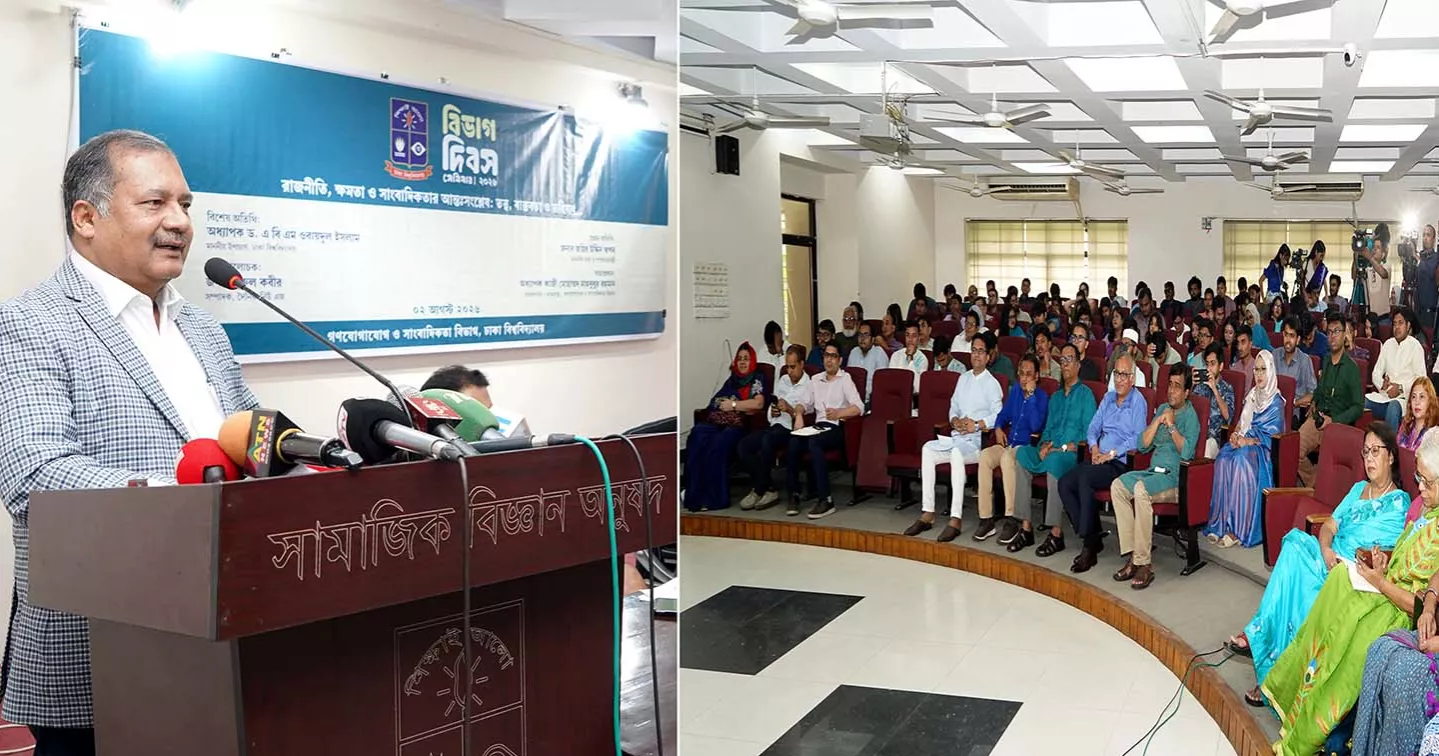
Information and Broadcasting Minister Zahir Uddin Swapon on Sunday described misinformation as the biggest challenge facing journalism in the digital age, saying the government has already taken several initiatives to tackle the growing problem.
Speaking at a seminar titled "Politics, Power and Interconnections: Theory, Reality and the Future" organized by the Department of Mass Communication and Journalism at the Dhaka University to mark its 64th founding anniversary, Swapon said misinformation has expanded significantly with the rise of digital platforms.
"Earlier, information flowed in one direction, and there was still scope for misinformation. But in the digital era, the spread of misinformation has increased many times over. We have taken several measures to combat it, and the government is working on the issue with great importance," he said.
Quoting political theorists, the minister stressed the indispensable role of journalism in a democratic society. "Where there is no journalism, one may even question whether a state truly exists. If one had to choose between a state without journalism and journalism without a state, any civilized person would choose journalism without a state. Journalism is an essential component of civilization and the fourth pillar of the state," he said.
Swapon said journalism carries the dual responsibility of uncovering the truth and maintaining objectivity, while acknowledging that public welfare or activism can also be an important part of the profession.
"However, when a journalist is driven by a predetermined objective, whether good or bad, objectivity risks being distorted. If information is presented only to achieve a particular goal and the discovered truth does not support that goal, truth and aspiration come into conflict, and objectivity is often sacrificed," he said.
Speaking on governance, the minister warned that a state could become an instrument of oppression if those in power lack vision or are motivated only by the pursuit of authority.
Commenting on history and political narratives, he said every historic event has an established narrative, but the crucial question is who constructs that narrative. Unless the process of uncovering the truth becomes universal, historical debates will remain unresolved, he added.
Earlier in the seminar, New Age Editor Nurul Kabir criticized the concept of "neutral journalism", arguing that journalists should stand in favour of public interest and people's rights rather than remaining detached from political and social realities.
Responding to Kabir's call for repealing colonial-era media laws, Swapon said the government is working on amending the Printing Presses and Publications Act, 1973.
"The Prime Minister has instructed that the provision should be amended so that it refers to writing against the state instead of writing against the government. We will work on the reform," he said.