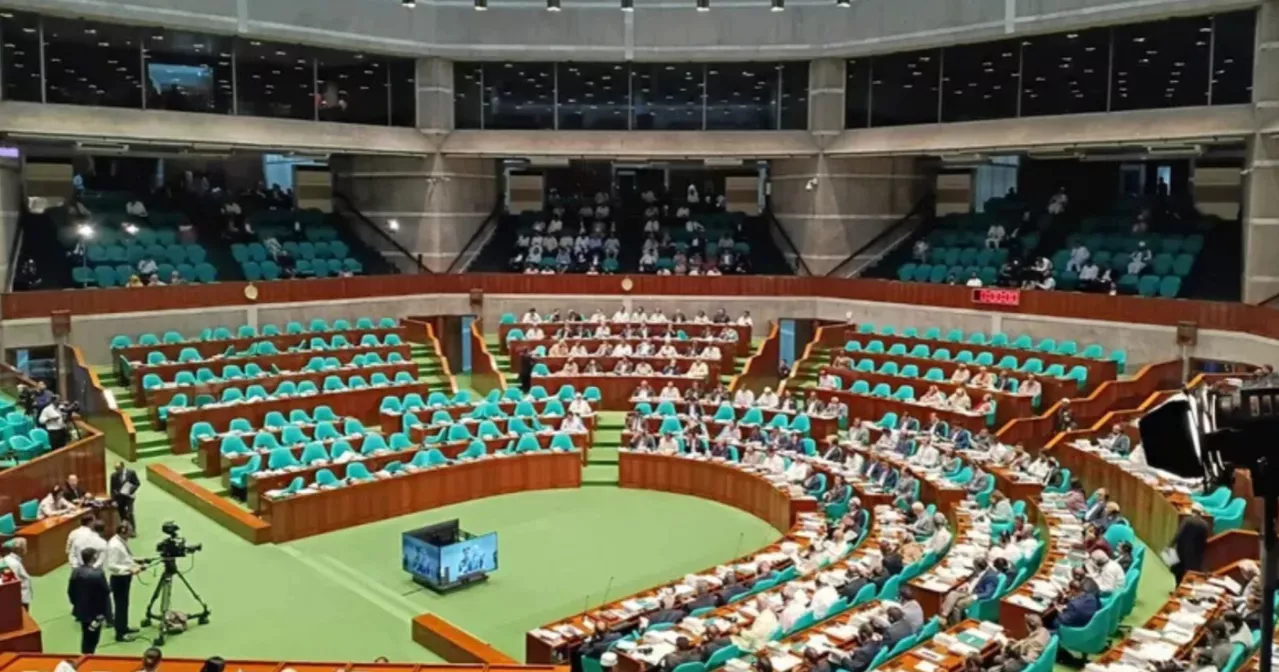
Parliament on Sunday passed three bills, including two important ones -- the National Human Rights Commission Bill, 2026 and the Enforced Disappearance Prevention and Redress Bill, 2026 -- amid protest from opposition lawmakers.
Law, Justice and Parliamentary Affairs Minister Md Asaduzzaman piloted the National Human Rights Commission Bill, 2026 and the Transfer of Property (Amendment) Bill, 2026, while Home Minister Salahuddin Ahmed moved the Enforced Disappearance Prevention and Redress Bill, 2026.
The three bills were passed separately by voice votes in the House.
The opposition lawmakers were present when the Transfer of Property (Amendment) Bill was passed but walked out of the House before the passage of the National Human Rights Commission Bill and the Enforced Disappearance Prevention and Redress Bill.
Before staging the walkout, Opposition Leader Dr Shafiqur Rahman said they had already made their position clear on the bills.
He said the treasury bench had assured that stronger and improved versions of the laws – human rights and enforced disappearance -- would be brought to Parliament, allowing the related ordinances issued under the interim government to lapse.
“But we have already expressed our concerns. There is a clear dual application of the human rights law,” he said.
Shafiqur said the proposed law does not provide the Human Rights Commission with uniform authority to investigate allegations of rights violations.
“If an ordinary person commits a human rights violation, the Human Rights Commission will be able to investigate it directly. But if a member of a law enforcement agency is involved, the agency will first be notified and asked to respond,” he said.
The opposition leader alleged that the government had allowed the earlier bills to lapse and was now bringing the laws in a weaker form.
“For this reason, we will not be partners in passing these laws. We have made our position clear that we will not participate in the discussion on these laws, and we are walking out now,” he said.
Speaker responded to Shafiqur Rahman, saying, “Thank you for walking out.”
Human Rights Commission Bill
The National Human Rights Commission Bill sought to repeal the National Human Rights Commission Act, 2009 and replace it with a new legal framework aimed at creating an effective and independent commission.
Under the bill, the National Human Rights Commission will comprise a chairman and four commissioners. At least one member will have to be a woman, while another will have to come from a small ethnic group or a disadvantaged community.
A 10-member selection committee, headed by the Speaker of Parliament, will recommend candidates for appointment as chairman and commissioners.
The committee will include the law minister, home minister, two MPs—one from the ruling party and one from the opposition—a university professor, a rights expert nominated by the President, a journalist with expertise in human rights, and a human rights expert from a small ethnic group or disadvantaged community.
The bill sought to clarify the commission’s jurisdiction and make the complaint process easier. It will also empower the commission to issue interim orders to protect victims from immediate threats and prevent further harm while investigations are continuing.
The bill contains a separate provision titled “Procedure to be followed in case of disciplined forces”.
Under the provision, if an allegation of human rights violation is made against a disciplined force or any of its members, the commission may, either on its own initiative or on the basis of an application, seek a report from the concerned organisation or institution.
If the commission is satisfied with the report, it will take no further action. If it is not satisfied, it can make recommendations to the concerned organisation or institution on the measures to be taken.
The concerned organisation or institution will have to inform the commission in writing about the action taken within 45 days of receiving such recommendations.
The bill also allows the commission to form one or more investigation teams with the required number of officers and employees.
Enforced Disappearance Bill
The Enforced Disappearance Prevention and Redress Bill, 2026, with a provision of maximum death penalty or lifetime imprisonment punishment for the offence of enforced disappearance.
If a victim dies or remains untraced for more than five years, the punishment could be death or life imprisonment, along with a fine of up to Tk 1 crore.
In case of lesser durations of enforced disappearance, the punishment would be at least three-year imprisonment or lifetime imprisonment and Tk 50,000 in fine.
The bill defined enforced disappearance as a cognisable, non-bailable and non-compoundable criminal offence, establishing a legal framework for prevention, prosecution, locating missing persons and protecting victims and their families.
In his statement of objectives and reasons, the home minister said the proposed legislation is intended to uphold human rights, human dignity, personal liberty and the rule of law.
Courts will be empowered to issue search warrants to trace disappeared persons. The bill also provides for trials in absentia, the acceptance of digital evidence and protection for witnesses, complainants, whistleblowers and victims.
Victims and their families will have the right to receive updates on investigations, seek the truth about what happened and learn the whereabouts or fate of the disappeared person.
The framework also provides state-funded legal assistance, medical treatment, rehabilitation and compensation through a dedicated fund.
Compensation could be recovered from the assets of convicted persons, while the state will meet the cost where recovery is not possible.
Spouses and dependent family members will also be allowed to use the disappeared person’s property for maintenance and essential expenses.
The bill further provides for distributing the property among heirs after five years through the issuance of a disappearance certificate. The bill also contains a provision for maintaining a central database.
Both investigation and trial proceedings will have to be completed within a maximum of 120 days.
If an allegation is brought against a disciplined force or any of its members, the concerned force will not be allowed to investigate the allegation itself.
Instead, on an application by any party or on its own initiative, the government will assign the investigation to another disciplined force or an inter-force investigation team, excluding the force accused in the allegation.
Transfer of Property (Amendment) Bill
The Transfer of Property (Amendment) Bill, 2026 brought changes to the Transfer of Property Act, 1882 to introduce legal recognition of lifetime usufruct rights.
The provision will allow parents, grandparents and other eligible donors to transfer property to specified blood relatives or spouses while retaining the legal right to use and enjoy the property during their lifetime.
According to the law minister’s statement of objectives and reasons, the existing law sets out various forms of property transfer but contains no specific provision allowing a donor to make a gift keeping the right for lifetime enjoyment of the property.