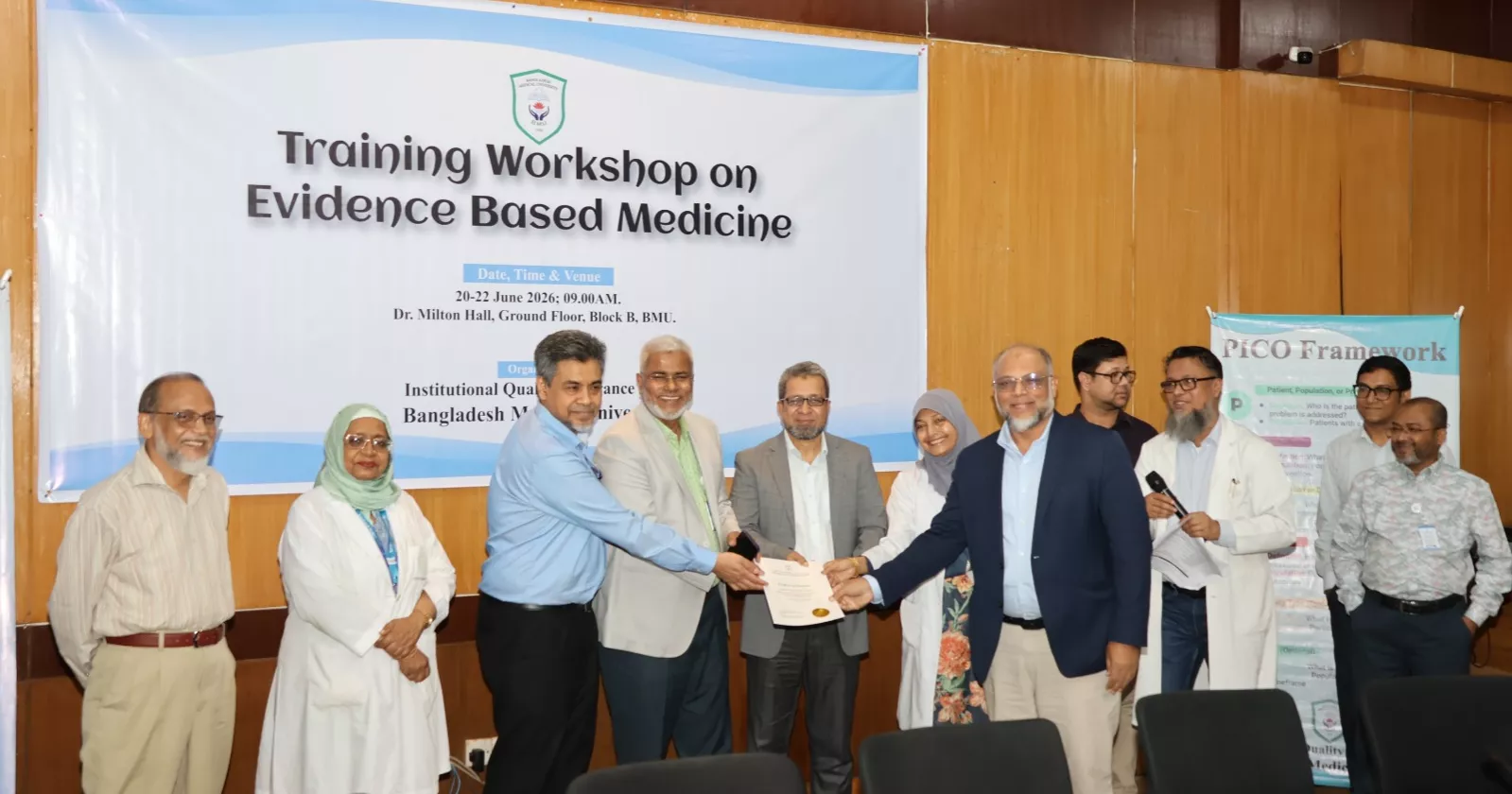
Speakers at a certificate distribution ceremony on Monday said there is no alternative for physicians to acquiring the necessary knowledge and skills in Evidence-Based Medicine (EBM) through proper training, as it plays a crucial role in ensuring scientific, effective and cost-efficient healthcare services.
They made the remarks at a programme marking the completion of EBM training for 269 faculty members and senior physicians of Bangladesh Medical University (BMU).
A total of 269 faculty members and senior doctors from different departments of BMU received training on Evidence-Based Medicine, an approach that can significantly contribute to reducing treatment costs for patients, ensuring scientifically sound healthcare services, and improving the quality of medical care, education and research.
The training was organised by the Institutional Quality Assurance Cell (IQAC) of the university through 10 batches of workshops. Certificates were distributed among participants of the 10th batch at the concluding session of the three-day training workshop held at Shaheed Dr Milon Hall on Monday.
Among others, Acting Vice-Chancellor and Pro-Vice Chancellor (Administration) Professor Dr Md Abul Kalam Azad, Pro-Vice Chancellor (Academic) Professor Dr Md Nazrul Islam, Pro-Vice Chancellor (Research and Development) Professor Dr Md Mujibur Rahman Howlader and Treasurer Professor Dr Nahreen Akhtar attended the programme.
The session was chaired by IQAC Director Professor Dr Nurun Nahar Khanam and moderated by IQAC Additional Director and cardiologist Associate Professor Dr Dine Mujahid Md Faruk Osmani.
During the three-day workshop, experts presented papers and delivered sessions on key aspects of Evidence-Based Medicine, including the PICO framework, the importance of medical audit and the clinical audit cycle.
Speaking at the closing ceremony, the university officials highlighted the growing importance of EBM in clinical practice, noting that physicians must always consider patients’ preferences, concerns and rights while making treatment decisions.
They said evidence-based medicine has become indispensable in modern healthcare and is making a significant contribution to improving the quality of medical education. Therefore, acquiring knowledge and expertise in EBM has become a demand of the time for teachers, physicians and other healthcare professionals.
The speakers further noted that effective implementation of evidence-based decision-making at every level of research, healthcare delivery and medical education would help build a fair, efficient and trustworthy healthcare system. Promoting the practice of evidence-based medicine would also strengthen patients’ rights and open new horizons for qualitative improvements in the health sector.
They added that BMU has already taken pioneering initiatives to promote evidence-based healthcare practices in Bangladesh. With support from Oxford University, the university celebrated the World Evidence-Based Healthcare Day for the first time in the country and has also earned international recognition as an “Evidence Ambassador.”
The university hoped that the trained faculty members will play a leading role in integrating evidence-based practices into teaching, research and patient care across the country's healthcare system.