
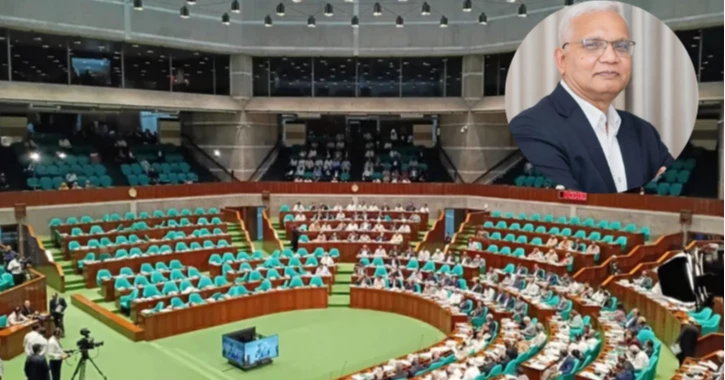
The government has taken an initiative to establish One-Stop Crisis Centres (OCCs) at all public medical college hospitals across the country to provide integrated support services to women and children subjected to violence, Women and Children Affairs Minister Abu Jafar Md Zahid Hossain told Parliament on Wednesday.
Responding to a notice on an urgent matter of public importance raised under Rule 71 he said the move aims to expand access to medical, legal and psychosocial support for survivors.
The issue was raised by reserved-seat lawmaker Nipun Roy Chowdhury, who drew attention to violence against women and girls and the need for improved access to treatment, legal aid, psychosocial counselling, shelter and rehabilitation services.
Referring to findings from the Bangladesh Bureau of Statistics (BBS) and UNFPA's Violence Against Women Survey 2024, Nipun said 76 per cent of women in Bangladesh had experienced violence by a husband or intimate partner at least once in their lifetime, while 62 per cent had never disclosed their experiences to anyone.
"If a woman is not safe in her own home, if a girl child is not safe even in familiar surroundings, what courage can we give her to live freely?" she asked.
In response, Zahid Hossain said OCCs were initially established at eight older medical college hospitals and later expanded to six newly established institutions. At present, 15 OCCs are operating nationwide.
He said the centres provide a range of integrated services, including medical treatment, legal assistance, DNA and forensic support, rehabilitation and social reintegration.
According to the Minister, each centre is supposed to have a workforce of 22 personnel, including four doctors, six nurses, four police officers, one clinical psychologist, one legal officer, one computer operator and supporting staff.
He informed the House that a total of 81,928 people have received services through the OCCs so far. Among them, 49,767 were survivors of physical violence, 31,596 were victims of sexual violence and 565 were burn victims.
The Minister said there are currently 37 government medical colleges in the country and steps have been taken to establish OCCs at all of them.
"Through this initiative, we are expanding the scope of services and addressing the growing demand for support," he said.
He also noted that 95 One-Stop Crisis Cells are currently operating across the country, including 30 at district headquarters and 65 at উপজেলা health complexes.
The government's long-term goal is to gradually establish One-Stop Crisis Cells or Centres in all 64 districts and every upazila, he added.
Zahid Hossain said the programme, which began as One-Stop Crisis Cells and was later implemented under a multi-sectoral approach, has now introduced a Quick Response Team (QRT) mechanism to ensure prompt support for survivors and their families and facilitate legal action against perpetrators.
During a supplementary question, Nipun highlighted the low level of public awareness about the national helpline 109 for preventing violence against women and children.
Citing survey findings, she said only 22.3 per cent of women were aware of the helpline, while many victims remained unaware of where to seek assistance or lodge complaints.
She asked whether the ministry had any time-bound plan to improve awareness of the 109 helpline and OCC services at the grassroots level.
In reply, the Minister described violence against women and children as a social ill and said the government was working to build public awareness and a broader social movement against such violence.
He stressed that preventing violence could not be achieved by a single ministry alone and required the involvement of political parties, elected representatives, social organisations, community leaders and teachers from schools, colleges and madrasas.
The Minister said awareness campaigns are being planned from the national level down to every union ward, with the participation of adolescent clubs.
He also informed Parliament that employees of the 109 call centre had not received salaries for years.
"The call centre operates through the 109 hotline. Those working there have been serving despite not receiving salaries for years. We have now taken steps to provide a special allocation to ensure their salaries are paid," he said.
The government is simultaneously expanding OCC and crisis cell services and strengthening awareness programmes to ensure survivors know where and how to seek help, he added.