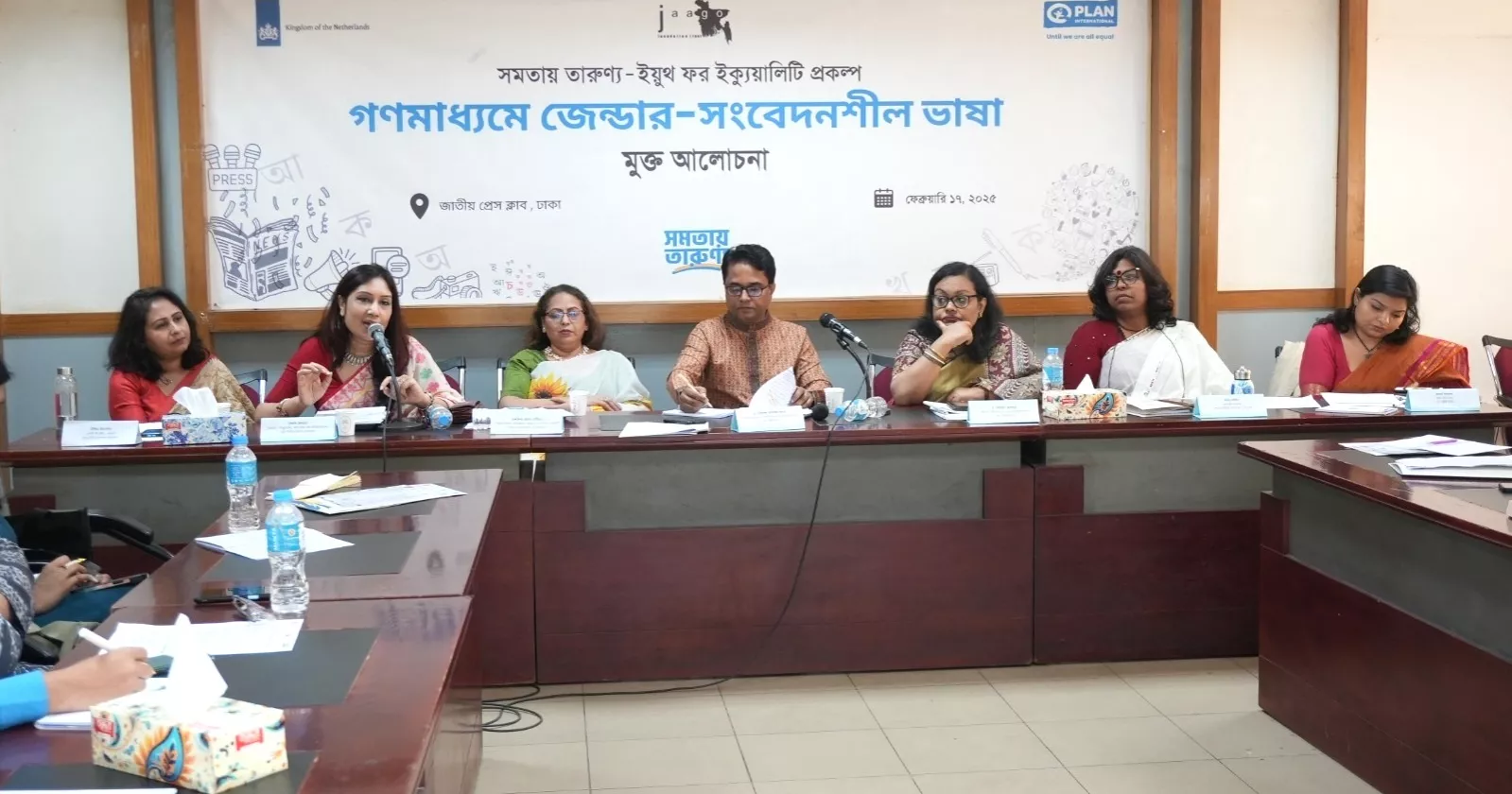
An open discussion on gender-sensitive language in mass media was held at the National Press Club on Monday, aiming to sensitize Bangladeshi media professionals.
Organized by Plan International Bangladesh under the ‘Shomotay Tarunno: Youth for Equality’ project, the discussion brought together media professionals, academicians, influencers, and government representatives.
Dr Md Khorshed Alam, Associate Professor, Department of Mass Communication & Journalism, Dhaka University, moderated this open discussion. Dr Sanzida Akhter, Professor, Department of Women & Gender Studies, Dhaka University; Mushfiqua Zaman Satiar, Senior Policy Advisor – Gender and Civil Society, Embassy of the Kingdom of the Netherlands (EKN); Zyma Islam, Senior Reporter, The Daily Star; Monira Shormin, Associate Professor, Press Institute Bangladesh (PIB) and Nishath Sultana, Director, Influencing, Campaign and Communications, Plan International Bangladesh spoke at the open discussion as panelists.
Salma Hasnayen, Deputy Secretary, Ministry of Information and Broadcasting; Neelima Yasmeen, Deputy Director, Programme, Plan International Bangladesh and Esha Farooqe, Assistant Director of JAAGO Foundation also attended the event.
Dr Md Khorshed Alam said that there are good examples of gender-sensitive reports, usage of gender-sensitive language in media but online harassment, cyber bullying, and use of gender-insensitive language is also present in media.
He also mentioned that there is a social and political pressure and censorship in the media which should be reduced. "Blaming the victims in the media should be stopped as well,” he said.
“Speculative news regarding women spreads very fast, and as soon as it is disseminated, it shapes people’s perception; we get the true information later,” said Dr Sanzida Akhter.
"There is a need for gender-sensitive training for media professionals," she said, adding that women journalists at grassroots level are not getting proper environment at workplaces and this is a must for creating a safe and free space for women in media.
Mushfiqua Zaman Satiar, Senior Policy Advisor, Gender and Civil Society, EKN, said, “Each and every woman in Bangladesh is affected by gender-based violence in some way. We had two women Prime Ministers in Bangladesh who ruled the country for many years, but the situation has not changed.”
“Women who have sustained in journalism, need to endure a series of harassments,” said Zyma Islam, Senior Reporter of The Daily Star. “The newsrooms are horrifyingly homogeneous and male dominated, but there is cultural and religious diversity at the newsroom,” she added.
“It is very tough to break stereotypes which are deeply rooted in our society. Press Institute Bangladesh (PIB) is going to produce a booklet and documentary on gender-sensitive journalism and train over 300 journalists with the content,” Monira Shormin, Associate Professor, Press Institute Bangladesh (PIB), said.
Nishath Sultana, Director, Plan International Bangladesh, expressed, “The language used in media is not an isolated agenda; language is just a reflection of what we perceive and practice. Gender stereotypes are deeply rooted in our society, and we are working to break the stereotypes and harmful norms through this project.”
EU, UN Women sign €4.8 million deal to advance gender equality in Bangladesh
“There’s a lack of mutual respect in our society. If we have mutual respect, we will automatically use gender-sensitive language in the media," said Salma Hasnayen, Deputy Secretary, Ministry of Information and Broadcasting.
Media professionals shared their experiences, emphasizing the need for structural change from families, prioritizing women-focused news, and balancing print and online media. They also stressed the importance of activism against fake news.
Funded by the Embassy of the Kingdom of the Netherlands (EKN), this four-year project by Plan International Bangladesh and JAAGO Foundation Trust engages 13,515 participants across eight divisions, including youth, media professionals, and influencers.