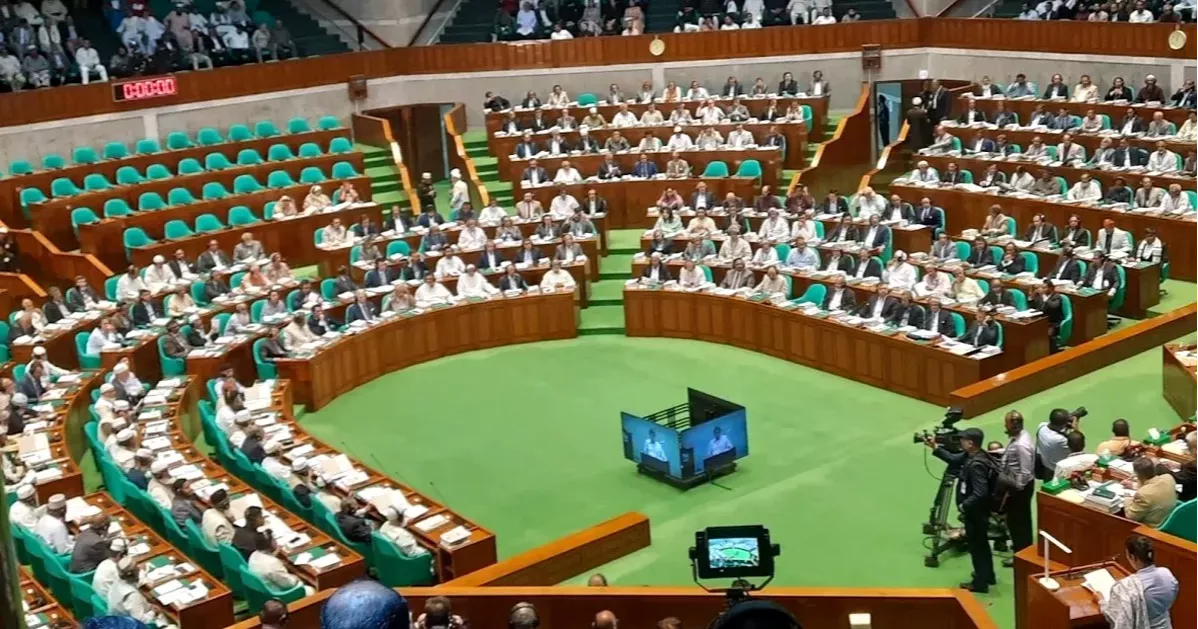
Parliament on Wednesday passed the Invest Bangladesh Bill, 2026, despite strong objections from the opposition, which criticised the government for introducing and passing the legislation on the same day without referring it to a parliamentary committee.
The bill, moved by Home Minister Salahuddin Ahmed, also the minister in charge of the Prime Minister's Office in Parliament, was passed by a voice vote after a lengthy procedural debate, with opposition MPs repeatedly protesting what they described as a violation of lawmakers' right to scrutinise legislation.
The new law abolishes the Bangladesh Economic Zones Authority (BEZA), the Bangladesh Public Private Partnership Authority (PPP Authority) and the Bangladesh Investment Development Authority (BIDA), replacing them with a single statutory body named Investment Bangladesh Authority.
As soon as the minister sought leave to introduce the bill, Bangladesh Jamaat-e-Islami MP Muhammad Nazibur Rahman objected, saying the proposed legislation repeals six existing laws and dissolves multiple authorities, making it too significant to be passed without proper examination.
He argued that although the Cabinet approved the bill on July 9, MPs were not provided with the mandatory documents within the stipulated notice period.
"We have not received any justification as to why the required documents were not supplied despite six days having passed since Cabinet approval," he said.
Nazibur also questioned why the government was in such haste to pass the legislation without sending it to the relevant parliamentary standing committee.
"Is there any vested interest behind this urgency?" he asked while formally proposing that the bill be referred to the committee for detailed scrutiny.
Responding to the criticism, Salahuddin said the practice of referring bills to standing committees began only from the 7th Parliament and stressed that the proposed law was not an entirely new piece of legislation.
He said the government was merely consolidating existing institutions created under different laws because their functions had increasingly overlapped. "We are not creating a new concept. Different authorities with similar responsibilities have created overlapping functions, and investors are not receiving services through a genuine one window system. We are simply merging these authorities into one," he told Parliament.
The minister acknowledged that the government would have preferred to place the bill before Parliament earlier but said Wednesday was the final sitting of the session.
"If there had been any complex legal issue in the bill, I myself would have proposed sending it to the standing committee," he said, urging the opposition to support the legislation.
Nazibur, however, insisted that lawmakers were being deprived of their constitutional responsibility to properly examine a legislation.
"We are lawmakers. Our duty is to make laws after proper scrutiny. If we are deprived of that opportunity, our fundamental right as legislators is being undermined," he said.
The Jamaat MP warned that repeatedly passing bills in haste without allowing sufficient time for review will establish an unhealthy parliamentary precedent.
National Citizen Party MP Md Abul Hasnat, better known as Hasnat Abdullah, also raised concerns, saying several clauses required amendments and questioning how MPs could propose changes after the bill was rushed through.
In reply, Salahuddin said any proposed amendments could be raised orally because procedural requirements had already been waived.
He assured Parliament that reasonable amendments suggested by lawmakers will be considered and, if necessary, incorporated in a future parliamentary session.
Leader of the Opposition Dr Shafiqur Rahman also criticised the rushed legislative process, saying the issue was not merely about parliamentary privilege but also about the responsibility of legislators.
He recalled that several bills had been hurriedly passed during the first session because of time constraints and that the opposition had then hoped such practices would not continue.
"In trying to accommodate one matter in haste, both our rights and responsibilities are being compromised. This will not create a good precedent for Parliament," Shafiqur Rahman said.
In reply, Salahuddin reiterated that the legislation primarily merged existing legal frameworks rather than introducing a completely new regime and publicly pledged to consider justified amendments in future.
Deputy Speaker Barrister Kayser Kamal welcomed the minister's assurance and expressed hope that the commitment made on the floor of Parliament will be honoured.
Despite the protests, the Deputy Speaker declared that the "yes" had prevailed and allowed the bill to be taken up immediately for consideration before it was passed by voice vote.
Under the new law, the Investment Bangladesh Authority will serve as the country's single investment promotion agency responsible for attracting domestic and foreign investment, coordinating approvals across government agencies, approving investment incentives and managing industrial zones and public private partnership projects.
The law also provides for a unified digital platform integrating all investment-related approvals, licences and permits, making participation mandatory for all government agencies. Existing one-stop service portals will eventually be merged into the new platform.
The authority will be empowered to recommend visas and work permits for foreign investors and experts, facilitate investment agreements, oversee industrial land allocation and advise the government on the strategic use or sale of unused state-owned industrial assets.
The Prime Minister, or a nominee, will chair the governing board of the new authority, while ministers responsible for finance, energy, foreign affairs, land, industries, commerce and law will serve as members alongside senior officials and four private sector representatives, including two women.
The legislation also repeals the Bangladesh Economic Zones Act, 2010, the Bangladesh Public Private Partnership Act, 2015, the Bangladesh Investment Development Authority Act, 2016 and the One Stop Service Act, 2018, transferring all assets, liabilities, contracts and personnel of the dissolved authorities to the new body.