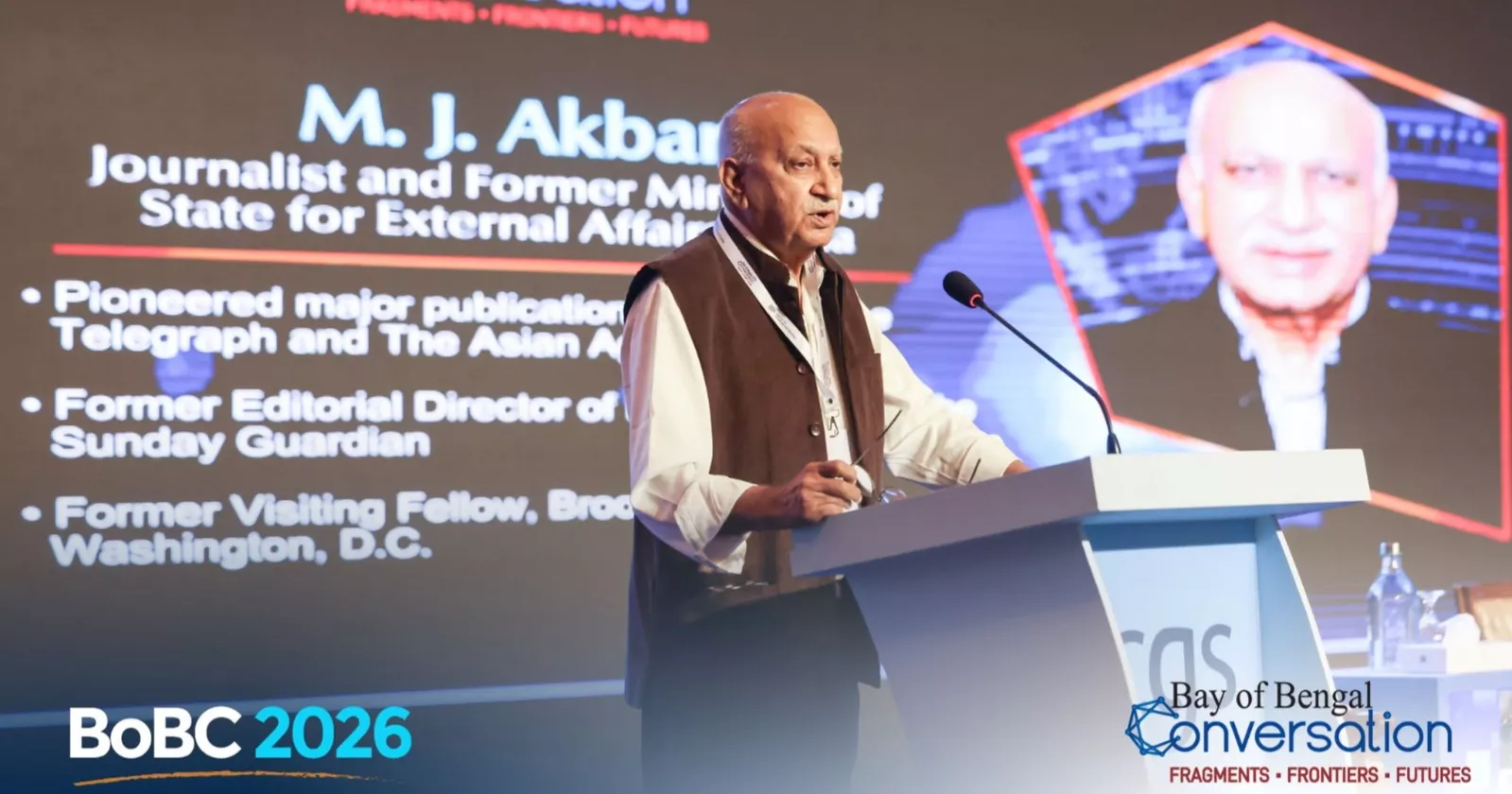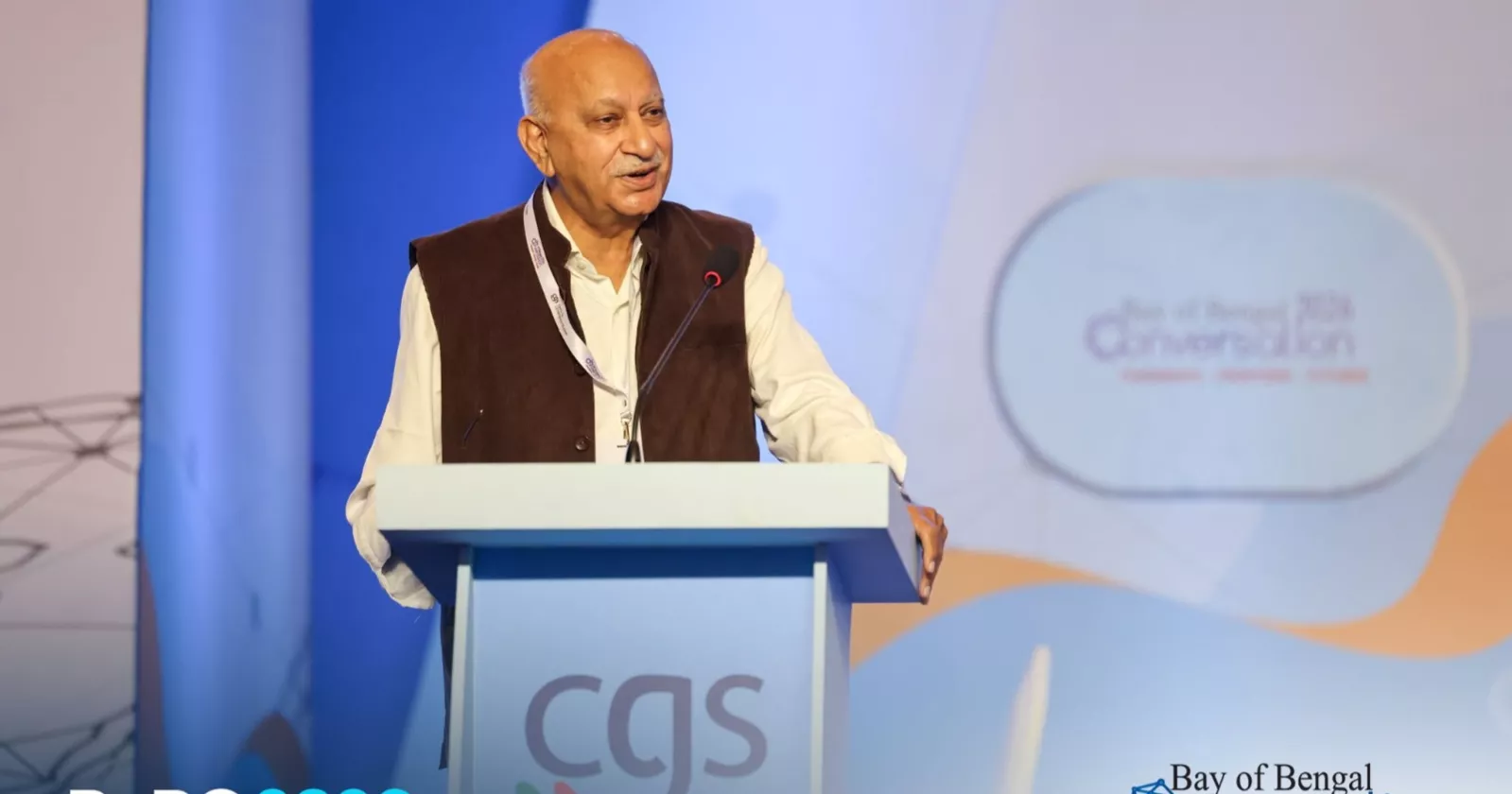
Former Indian Minister of State for External Affairs MJ Akbar on Sunday said temporary “clouds or storms” cannot erase the long-standing ties between Bangladesh and India, describing the two countries as civilisational states with deep historical and cultural links.
“I never think that passing clouds or passing storms can ever remove the sunshine of Indo-Bangladesh ties,” said the eminent writer, journalist and politician while addressing the Bay of Bengal Conversation 2026 in Dhaka, inaugurated by Prime Minister Tarique Rahman on Saturday.
Akbar said there would be ups and downs in the relationship between the two countries, but the issues between them should be approached by looking beyond what is considered immediately possible.
“I urge that the questions that are addressed by the two sides, we always think of or look at it from what is possible. Change the pivot from what is possible to why is it impossible? And suddenly, many, many more avenues will open up,” he said.
Akbar, an author of several internationally acclaimed books, said both Bangladesh and India are civilisational states and Bangladesh’s identity is deeply rooted in language and culture. “It is based on language, the power of language,” he said.
The strategic address examined the struggle over supply routes, Iran’s emerging role and the Gulf’s security challenges amid concerns over declining American influence. It also explored whether separate fires surrounding the Black, Mediterranean, Caspian, Red and Arabian seas could converge into a wider conflict, potentially drawing the Indian Ocean and the Bay of Bengal into its path.
He explored the potential for BRICS to help chart a path towards peace through political and diplomatic engagement.
Akbar also congratulated Bangladesh on the election of its Foreign Minister Dr Khalilur Rahman as President of the United Nations General Assembly, describing it as recognition of the country’s credibility on the international stage.
“This is a recognition of Bangladesh's credibility on the international stage and, in my view, a very long overdue recognition of the credibility,” said the veteran politician.
However, Akbar said the United Nations is facing the biggest challenge in its history, with the future of the institution depending on how the international community responds to growing threats to sovereignty.
He said the UN was built around the principles of sovereign equality, territorial integrity and political independence, which became the foundation of global stability after the Second World War.
Akbar warned that wars are increasingly being initiated or imposed without formal declarations of war, saying failure to respect sovereignty could lead to “a period of intensifying chaos.”
He described the conflicts of the 21st century as a new form of “worldwide war”, arguing that they are not necessarily one continuous global conflict but a series of conflicts that continue or recur across different regions.
Akbar said many of the current conflicts are also linked to competition for control of strategic waterways, including the Mediterranean, Black, Red, Caspian and Arabian seas. “What we are witnessing is actually wars for the control of the seas,” he said.
He also warned about the consequences of unresolved territorial and strategic disputes, describing many countries as “unfinished states”.
“What is an unfinished state? It’s a state whose geography does not synchronise with its strategic requirements by its own estimation or by its cultural definition,” he said.
“If the wars of the unfinished states and the wars of the seas meet, as they are threatening to, then we are looking at a very major conflagration,” he said.
On India’s foreign and security policy, Akbar said national security cannot be purchased or outsourced and must instead be built on internal strength.“Security can only be achieved by internal strength. It cannot be purchased. There is nothing in the world for checkbook security.”