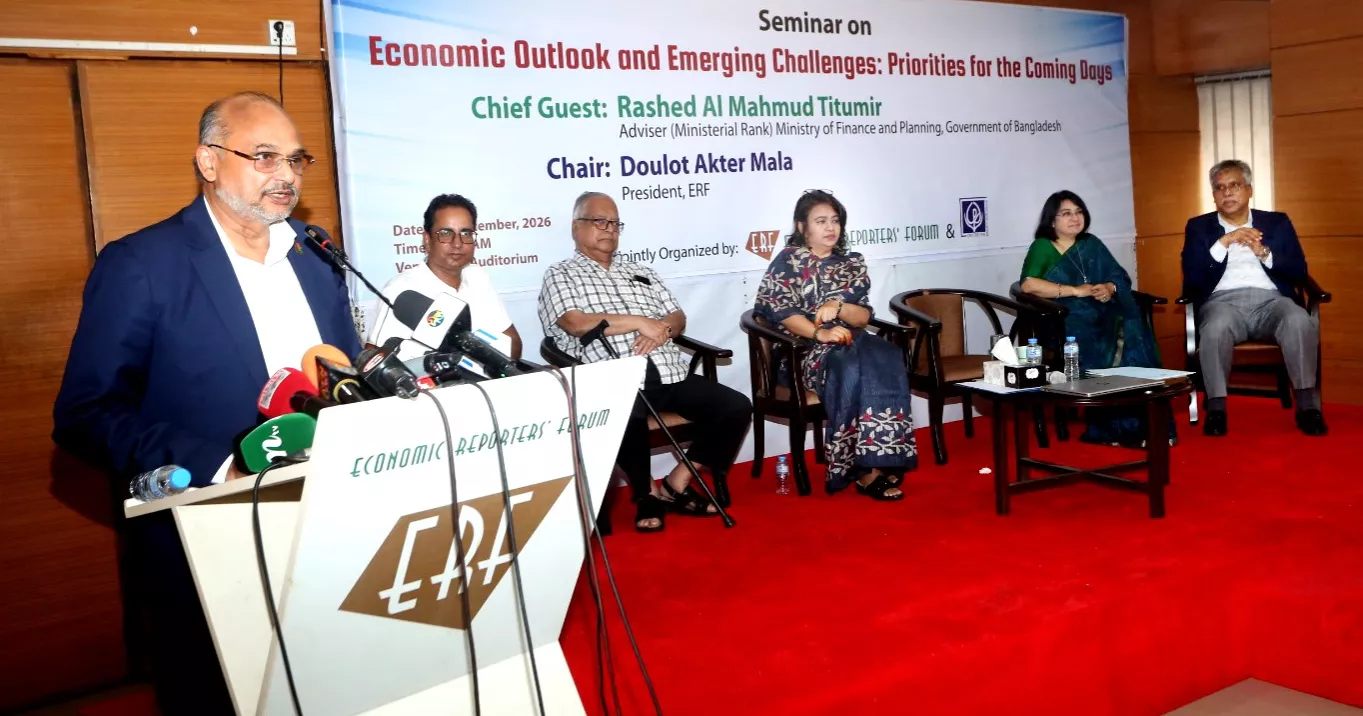
Prime Minister’s Finance and Planning Adviser Rashed Al Mahmud Titumir blamed the past (Awami League) government's flawed energy policies, including over-reliance on imports, alongside its failure to build national capacity, for the ongoing energy crisis in the country.
Speaking as the chief guest at a seminar titled "Economic Context and Emerging Challenges: Priorities for the Coming Days," organized jointly by the Economic Reporters' Forum (ERF) and the Centre for Policy Dialogue (CPD) in Dhaka on Wednesday, he stressed the need to clearly inform the public that the present government bears no responsibility for the current energy distress.
Power situation to improve within 15 days: Amit
"A major portion of the crisis is the result of past wrong policies and decisions. Allowing the public to recognize this distinction enables them to evaluate the effectiveness of an accountable government," Titumir said.
He noted that global energy price volatility and supply uncertainties stemming from Middle East tensions are impacting Bangladesh. LNG imports from Qatar currently cost around $11 per unit, whereas sufficient domestic gas exploration and production could have supplied energy at significantly lower costs.
"Past policies prioritized import dependency over national energy security," he stated, adding that inadequate domestic gas exploration and a lack of initiatives to meet renewable energy targets caused the present situation.
Titumir emphasized the urgency of assessing the 'cost of inaction' alongside the 'cost of wrongdoing,' money laundered abroad, and accumulated energy sector liabilities. He urged the Bangladesh Economic Association, universities, think tanks, and professional bodies to conduct comprehensive research covering these four interconnected areas to ensure governance and accountability.
He remarked that past crony patronage and import reliance created an oligarchic structure in the energy sector, damaging long-term energy security while wasting public funds.
Highlighting ongoing government interventions, Titumir stated that initiatives are underway to secure future energy needs, including a target to produce 4,000 megawatts of solar power. Under a recent notification, measures are being implemented to purchase electricity from solar power producers, transform consumers into producers through net metering, and provide VAT and advance income tax exemptions on solar equipment.
On healthcare, the adviser called for ensuring proper utilization of budgetary allocations while expanding sub-district level health infrastructure, including plans for 150-bed Upazila Health Complexes, district-level kidney dialysis centers, and coronary care units.
Regarding inflation, Titumir attributed past inflationary pressures to corruption, looting, and supply chain irregularities. He noted that inflation currently stands slightly above 8 percent, with a target to gradually bring it down to 6 percent.
He also announced that a Tk 60,000 crore package has been finalized to reopen closed industrial plants, with commercial banks signing agreements to commence financing starting September.
Furthermore, he highlighted record revenue collection at Chittagong Custom House during the last fiscal year and urged media outlets to evaluate government performance based on verified statistics. Detailed progress data following the government's first quarter will be presented in mid-October.
Titumir reiterated that the government aims to recover from past losses and build an accountable, effective, and sustainable state system across energy, revenue, education, health, and employment sectors.
Presided over by ERF President Doulot Akter Mala, the seminar was also attended by National Professor Dr. Mahbub Ullah, FBCCI Administrator Fazlul Haq, and CPD Distinguished Fellow Dr. Fahmida Khatun. as special guests.