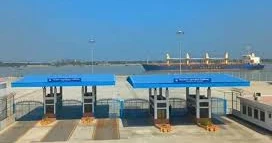
Shipping Minister Shaikh Rabiul Alam on Wednesday told Parliament that the operation of Patenga Container Terminal has significantly improved efficiency at Chittagong Port, bringing the average waiting time for vessels down to near zero.
“The average waiting time for ships at the port has come down to nearly zero since the Patenga Container Terminal began operations,” he said while responding to a question from Jamaat-e-Islami MP Shahjahan Chowdhury elected from Chattogram-15 constituency.
The terminal has been operational since June 2024, he said.
The minister informed the House that the average turnaround time for container-handling vessels at Chittagong Port during the 2024–25 fiscal year was 2.58 days.
Explaining the difference between Chittagong Port and major regional ports, he said Colombo and Singapore mainly function as transshipment hubs where containers are unloaded from large vessels and later loaded onto smaller ships.
“At transshipment ports, customs examination and clearance activities are generally not required,” he said.
In contrast, Chittagong Port primarily operates as a feeder port where customs examination, clearance, and other formalities must be completed, resulting in comparatively longer vessel turnaround times.
The volume of transshipment containers handled at the port remains negligible, with nearly 100 per cent of incoming and outgoing containers intended for Bangladesh’s domestic market or exports from the country, he said.
The minister said the port authority has taken various initiatives to modernise operations, including the addition of advanced equipment and measures to improve port management.
“As a result, vessel turnaround time for container handling has already decreased and is expected to decline further in the future,” he added.
The minister also expressed hope that the Bay Terminal project would become operational by 2030.
Once operational, the Bay Terminal is expected to enhance container-handling capacity at Chittagong Port and allow mother vessels to enter without being constrained by tidal conditions and navigability limitations, he said.
“This will help eliminate overall congestion at the port and significantly improve operational efficiency,” he said.
While responding to a supplementary question from Shahjahan Chowdhury, the minister expressed optimism that all planned container terminals at Chittagong Port would be fully operational by 2029, significantly enhancing the country’s maritime trade capacity and reducing cargo handling times.
Noting that the Laldia Container Terminal is being developed by Danish shipping giant A.P. Moller–Maersk under an agreement with the government, the minister said once developed, the facility will begin container terminal operations and strengthen the port’s capacity.
A Memorandum of Understanding (MoU) has been signed with Singapore-based PSA International regarding the Bay Terminal project, he said.
Discussions are also underway with Dubai-based DP World over Bay Terminal 2, while Bay Terminal 3 is planned to be developed by the Bangladesh government and the Chittagong Port Authority, he said.
“With all these terminals becoming operational, we expect Chittagong Port to function at a level comparable to major international ports such as Singapore and Colombo,” he said.
“At present, no ships are waiting at the deep-sea anchorage. They are berthing directly, although container handling still takes around 2.1 days. Once the new terminals become operational, I believe this can be reduced to nearly half a day,” he said.
Responding to a separate supplementary question from Jamaat-e-Islami MP Nazrul Islam of Satkhira, the shipping minister said Mongla Port is already functioning effectively but has significant scope for expansion.
A Chinese company is constructing three additional jetties at the port, which will substantially increase its handling capacity once completed, he said.
The expanded facilities will particularly benefit businesses and importers in the southwestern region, including areas served by the Noapara river port and districts across Khulna and Faridpur divisions, enabling them to import and export goods more conveniently through Mongla Port, he added.
Besides, cold storage facilities are being developed at the port and supporting infrastructure has already been strengthened, including the rail link connecting Mongla with Khulna, Jashore and Dhaka, he said.
The government has already earned around Tk 110 crore in revenue from Mongla Port so far this year.
He also expressed confidence that once the ongoing infrastructure projects are completed, Mongla Port will play a much greater role in facilitating the country’s import and export activities.