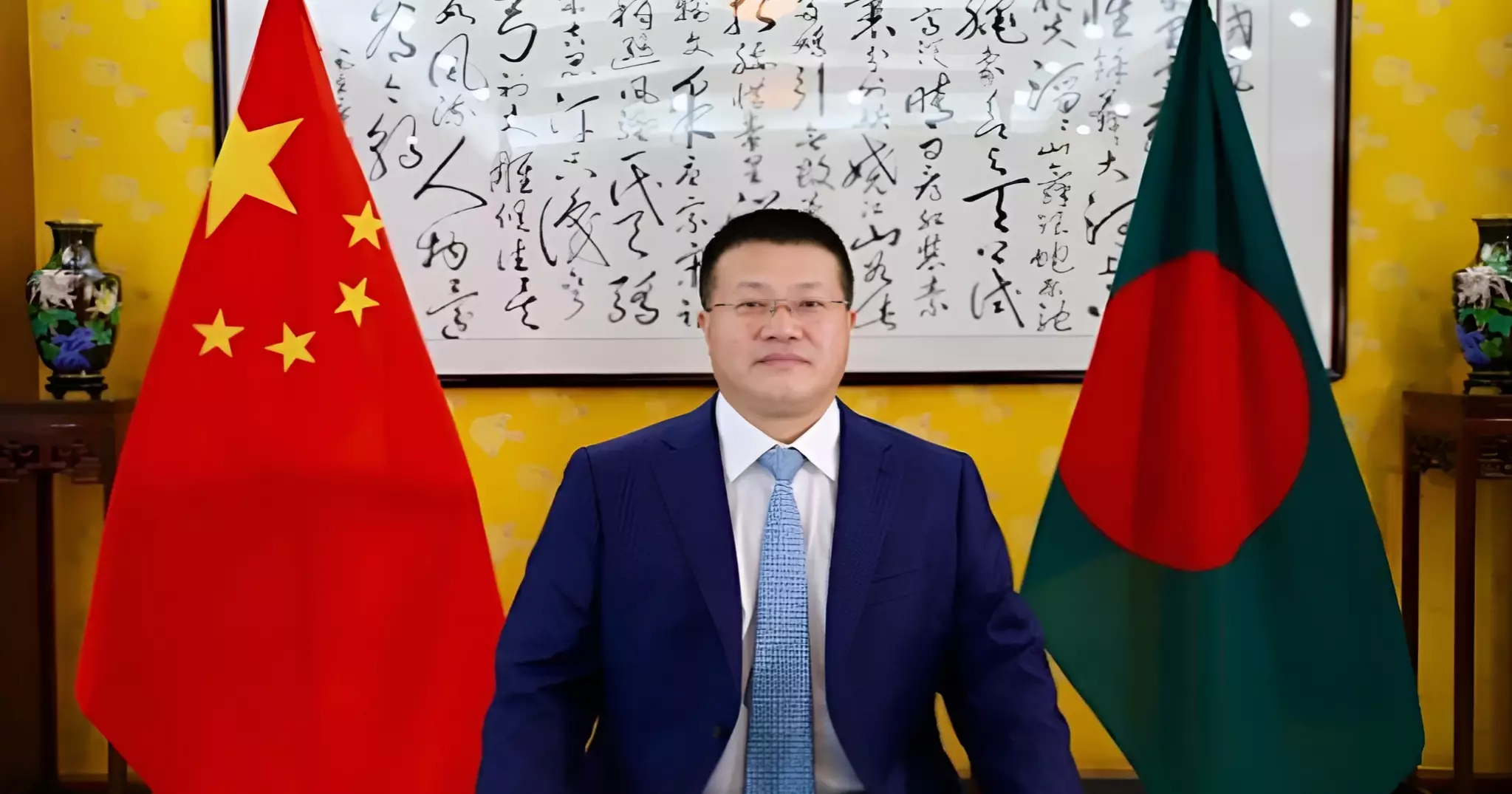
Chinese Ambassador to Bangladesh Yao Wen has said with the tide at full swell and the wind in their sails, Prime Minister Tarique Rahman’s official visit to China (June 23-26) holds "historic significance" and it will surely draw a "more magnificent blueprint" for the development of Bangladesh-China relations.
"Under the strategic guidance of the leaders of both countries, China-Bangladesh relations will forge ahead with more solid political mutual trust, more in-depth practical cooperation, and more robust international collaboration," he said ahead of the visit.
At the invitation of Li Qiang, Premier of the State Council of the People’s Republic of China, Prime Minister Tarique Rahman is about to embark on an official visit to China and attend The World Economic Forum’s 17th Annual Meeting of the New Champions (2026 Summer Davos Forum).
"On the journey of addressing global challenges, China and Bangladesh will always support each other and move forward hand in hand, making new and greater contributions to the stability and development of both countries, to the prosperity and progress of Asia, and to building a community with a shared future for humanity," said the Chinese Ambassador.
During Prime Minister Tarique Rahman’s visit to China, the leaders of the two countries will have in-depth exchanges of views on international and regional issues of mutual interest, further coordinate positions and build consensus.
China firmly believes that a "stable, prosperous and confident Bangladesh" will play a more active and constructive role in Global South affairs.
"Let us look forward to the full success of the visit and to the long-standing friendship between China and Bangladesh shining with even greater brilliance in the new era," said Ambassador Yao.
Looking ahead, he said, as China-Bangladesh relations stand at a new starting point that builds on past achievements and opens up new prospects, they are full of confidence and expectations.
On the political front, he said high-level exchanges and party-to-party exchanges between the two countries will become more frequent and in-depth, and political mutual trust will continue to reach new heights.
On the economic front, the Ambassador said practical cooperation in areas such as the green economy, investment and business development will continue to expand, bringing more tangible benefits to the two peoples.
On the front of people-to-people exchanges, he said cooperation in education, culture, tourism, youth and other fields will become more vibrant and diverse, allowing the flower of China-Bangladesh friendship to bloom ever more brilliantly in the hearts of the two peoples.
At this important moment when Bangladesh and China are ushering in the next golden 50 years of diplomatic relations, he said in an article that Prime Minister's first visit to China holds historic significance in building on past achievements and charting the way forward.
This visit will surely inject strong impetus into the development of Bangladesh-China relations in the coming period and promote the upgrading of the Comprehensive Strategic Cooperative Partnership in both quality and substance, he said.
More Solid Political Mutual Trust
China maintains that all countries, regardless of size, strength or wealth, are equal members of the international community and have equal rights to participate in international affairs.
China firmly follows the principle of amity, sincerity, mutual benefit and inclusiveness on neighborhood diplomacy, and remains committed to non-interference in other countries’ internal affairs and to providing support without any political strings attached.
"This vision has been fully reflected in China-Bangladesh relations," said the Ambassador.
On October 4, 1975, Bangladesh and China officially established diplomatic relations, ushering in a new era of friendly exchanges.
In January 1977, Ziaur Rahman paid his first visit to China in his capacity as Chief Martial Law Administrator and Chief of Army Staff of Bangladesh.
China clearly expressed its support for Bangladesh in safeguarding national independence, laying a solid foundation for the development of bilateral relations.
Begum Khaleda Zia visited China nine times, including five visits as Prime Minister.
"Frequent high-level exchanges between the two sides have provided strong political guidance for the steady development of bilateral relations," said Ambassador Yao.
Over the past half century, regardless of changes in the international landscape, China and Bangladesh have always respected each other, treated each other as equals, and shown mutual understanding and support on issues concerning each other’s core interests and major concerns, he said.
The two countries have become a vivid example of friendly cooperation and mutual benefit between developing countries.
"Prime Minister Tarique Rahman’s visit to China at the beginning of his tenure fully demonstrates the high importance Bangladesh attaches to developing relations with China, and reflects the profound foundation of political mutual trust between the two countries," said the envoy.
At present, both Bangladesh and China are at critical stages of their respective national development, and both face difficulties and challenges on the way forward.
The year 2026 marks the beginning of China’s 15th Five-Year Plan period.
China is advancing Chinese modernization on all fronts and forging ahead toward the strategic goal of building itself into a great modern socialist country in all respects.
Since its establishment, the new Bangladeshi government has taken a series of measures to maintain unity and stability, improve the economy and people’s livelihoods, promote investment and employment, and move toward the goal of building a trillion-dollar economy by 2034.
"These efforts demonstrate its resolve to rise to challenges and press ahead with determination," said Ambassador Yao.
It is precisely because of such shared circumstances and shared aspirations that China and Bangladesh need more than ever to learn from each other and move forward together, he said.
During this visit, the leaders of the two countries will have in-depth exchanges on governance experience and share insights on major issues such as development, economic transformation and reform, further strengthen party-to-party exchanges, and promote more frequent high-level interactions and deeper strategic communication.
"It can be expected that, as exchanges on governance experience continue to deepen, political mutual trust between China and Bangladesh will become even stronger, and bilateral relations will continue to make steady and sustained progress," the Ambassador said.
More In-depth Practical Cooperation
Economic and trade cooperation has always been the ballast and propeller of China-Bangladesh relations.
From 2010 to 2025, China remained Bangladesh’s largest trading partner for 16 consecutive years.
China has also granted zero-tariff treatment to 100 percent of taxable items for Bangladeshi products exported to China and extended this treatment to 2028.
In the field of investment, China has become Bangladesh’s second-largest source of investment.
Nearly 700 Chinese enterprises are registered with Bangladesh’s investment authorities, covering a wide range of sectors including energy, transportation, textiles and garments, and information and communications, creating hundreds of thousands of jobs for local communities.
"China has become an indispensable and important development partner in Bangladesh’s pursuit of development, economic transformation and modernization," said Ambassador Yao.
Prime Minister Tarique Rahman’s visit will inject stronger momentum into Bangladesh-China economic and trade cooperation, he said.
The two sides will have in-depth discussions on expanding bilateral trade and optimizing the trade structure, and promote the entry of more high-quality Bangladeshi products into the Chinese market.
They will further deepen investment cooperation, accelerate project implementation, and attract more Chinese enterprises to invest and do business in Bangladesh.
They will also expand practical cooperation in emerging areas such as scientific and technological innovation, information and communications, green development and artificial intelligence.
"It is reasonable to believe that China-Bangladesh economic and trade cooperation will move toward higher quality and greater depth," said the Ambassador.
China-Bangladesh friendship has long taken root in the hearts of the two peoples.
China has always acted with a sense of responsibility as a major country and carried out a series of livelihood projects in Bangladesh that benefit thousands of households.
China-contracted power projects in Bangladesh, including coal-fired, solar and wind power projects, have reached a total installed capacity of over one gigawatt, providing a continuous source of power for Bangladesh’s livelihood development and people’s daily lives.
China has donated advanced medical equipment to Bangladesh, including physiotherapy and rehabilitation equipment, ventilators and mobile surgical vehicles, contributing China’s strength to protecting the health of the Bangladeshi people.
In the face of floods, China promptly extended a helping hand and provided Bangladesh with emergency relief supplies such as rubber boats, life jackets and generators.
"These concrete actions have brought the warmth of China-Bangladesh friendship to countless places in need. It can be expected that this visit will take livelihood cooperation between the two countries to a new level and bring the hearts of the two peoples even closer," said the Chinese envoy.
At the same time, personnel exchanges between the two countries are becoming increasingly frequent, and cultural exchanges and mutual learning are deepening.
Standing at a new starting point, this visit will open broader space for people-to-people exchanges between the two countries.
The two sides will promote cooperation in education, health and skills training, and help Bangladesh cultivate more professional talent suited to the needs of modernization.
They will deepen exchanges in media, film and television, and other areas, so that the two peoples can enhance mutual understanding and deepen friendship through more diverse interactions.
"It can be expected that the hearts of the two peoples will draw ever closer, and the future of China-Bangladesh friendship will be even brighter," he said.
More Robust International Coordination
As the world’s largest developing country, the envoy said China has always been a natural member of the Global South and has always shared the same breath and destiny with fellow developing countries.
President Xi Jinping has on many occasions emphasized the importance of strengthening solidarity and cooperation among Global South countries and safeguarding their common interests.
He has called for pooling the strength of Global South countries in the spirit of equality, openness, transparency and inclusiveness, and promoting the reform of the global governance system in a more just and equitable direction.
At present, the world is undergoing accelerated changes unseen in a century.
Unilateralism, hegemonism and bullying practices are growing more rampant, and the cause of global peace and development faces severe challenges.
The more difficult the situation becomes, the more countries that uphold justice should stand together to jointly safeguard the legitimate rights and interests of developing countries and maintain world peace and stability.
Bangladesh is the second-largest economy in South Asia and has an important voice on global issues such as climate change, sustainable development and poverty reduction.
Recently, Bangladesh has won the presidency of the 81st session of the United Nations General Assembly.
"China has always deemed Bangladesh as an important partner in the Global South, and stands ready to work closely with Bangladesh in multilateral institutions such as the United Nations and the World Trade Organization to promote reform of the global governance system and jointly safeguard the collective interests of developing countries," said Ambassador Yao.