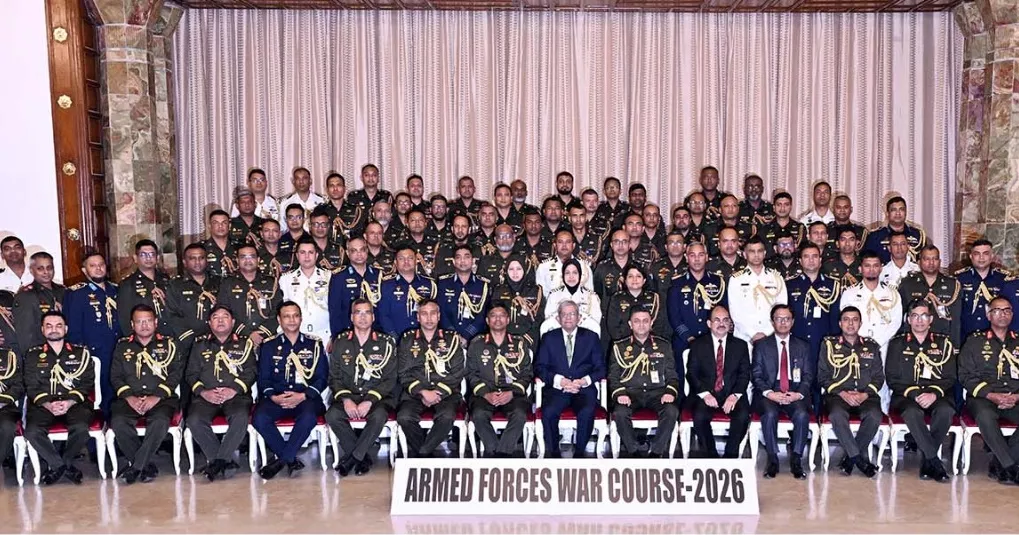
President Mirza Fakhrul Islam Alamgir on Monday stressed the need for strategic foresight, technological preparedness and institutional resilience to address emerging national and global security challenges.
“National security cannot be viewed only through a military lens. It encompasses economic resilience, food and energy security, environmental sustainability, technological capability and the strength of our institutions,” he said.
The President made the remarks while addressing the participants of the National Defence Course-2026 and Armed Forces War Course-2026 at Bangabhaban.
Highlighting Bangladesh's strategic location in the Bay of Bengal and the wider Indo-Pacific region, he said the changing geopolitical landscape, global power shifts, strategic competition and regional conflicts had added new dimensions to security concerns.
Mirza Fakhrul said traditional security threats were now compounded by climate change, cyber threats, transnational crime, terrorism, pandemics, economic uncertainty and disruptive technologies.
He said artificial intelligence, autonomous systems and advanced digital technologies were transforming warfare and security, while misinformation, disinformation and cyber threats were posing growing challenges to national security and democratic institutions.
The President called for developing leaders with strategic foresight, sound judgement, intellectual openness and the ability to work across institutional and national boundaries.
In this context, he said, the National Defence College played an important role by bringing together senior officials from the Armed Forces, civil administration, law enforcement agencies and friendly countries to exchange ideas and develop a shared understanding of contemporary security challenges.
Addressing the Bangladeshi participants, Mirza Fakhrul urged them to put the interests of the country and its people above all else and uphold professionalism, integrity, discipline and accountability in their respective positions.
He said Bangladesh's journey towards becoming a more prosperous, inclusive and resilient nation would depend on the quality of its leadership, the strength of its institutions and national unity.
“Our national security and international engagement must be guided by the principle of Bangladesh First – safeguarding our sovereignty, independence, national dignity, security and people's welfare while pursuing constructive relations based on sovereign equality, mutual respect and mutual benefit,” the President said.
He said prioritising national interests should not come at the cost of friendship and international cooperation.
Mirza Fakhrul also called upon the international course members to act as bridges of friendship and cooperation between Bangladesh and their respective countries, saying their participation had added an important international dimension to the National Defence College.
Bangladesh remained committed to peaceful coexistence, friendship among nations and constructive engagement with the international community, he said. “Let us reaffirm our shared commitment to cooperation over confrontation, dialogue over discord and peace over conflict,” he added.
At the outset, the President paid tribute to the martyrs of the 1971 War of Liberation, Shaheed President Ziaur Rahman, those who sacrificed their lives during the July 2024 mass uprising and the long struggle for democracy over the past 17 years.
He also paid tribute to members of the armed forces who made the supreme sacrifice in the service of the country, including in United Nations peacekeeping missions.
Mirza Fakhrul congratulated the participants of the National Defence Course and Armed Forces War Course-2026 and commended the commandant, faculty members and staff of the National Defence College for their role in developing capable and forward-looking leaders.