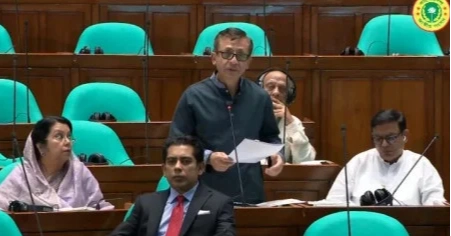
Textiles and Jute Minister Khandakar Abdul Muktadir on Wednesday said the export of raw jute produced in Bangladesh currently remains suspended, while jute products are being exported to 138 countries around the world.
“Currently, the export of jute produced in Bangladesh abroad is halted. Jute is exported from Bangladesh to 30 countries and jute products to 138 countries,” he said in reply to a scripted question from ruling BNP lawmaker Lutfur Rahman (Cox’s Bazar-3) in Parliament.
The Parliament session began at 3:30pm with Speaker Hafiz Uddin Ahmad in the chair.
The minister said the jute export destinations include China, Iran, Spain, Belgium, the United States, the United Kingdom, Italy, Turkey, Pakistan, Indonesia, India, the Netherlands, Germany, Australia, Denmark, Switzerland, South Korea, Russia, Poland, Vietnam, Nepal, Tunisia, Thailand, Malaysia, Austria, France, Latvia, Mexico and Saudi Arabia.
He said Bangladesh earned Tk 12,612.07 crore by exporting 19.25 lakh metric tonnes of raw jute and Tk 71,390.50 crore by exporting 70.69 lakh metric tonnes of jute products over the past 10 years.
In reply to another scripted question from BNP lawmaker Sarwar Jamal Nizam (Chattogram-13), the Textiles and Jute Minister said there are currently 2,923 textile industries registered with the Department of Textiles.
Besides, he said, unregistered textile industry establishments are being brought under registration gradually.
Abdul Muktadir said there are currently 24 closed textile mills under the Bangladesh Textile Mills Corporation (BTMC).
Of the 24 textile mills, initiatives have been taken to operate 15 through public-private partnerships (PPP), he said.
“Already, agreements have been signed with selected private partners and the handover process has been completed for four textile mills under the PPP arrangement,” the minister said.
Production has already started at two of those mills, while activities concerning the remaining mills are ongoing, he added.
He said agreements have also been signed with selected private partners and the handover process completed for two textile mills to be operated under the lease system, and production activities have been initiated there.
The minister said 10 plots out of 22 planned industrial plots have been allocated for establishing a textile village at Chittaranjan Cotton Mills, regulated by BTMC in Narayanganj.
He said work to establish the textile village is ongoing by selling small industrial plots of approximately one acre each to support small-scale industrial entrepreneurs.
“Already, a modern knitting and garment factory has been established on one of the plots sold there, and production has begun. The products are being exported abroad,” he said.
Besides, he said, initiatives have been taken to restart Darowani Textile Mills Ltd in Nilphamari and Magura Textile Mills Ltd in Magura through public-private partnerships.
Subject to receiving final approval, agreements will be signed with selected private partners and the mills will be handed over to them, he said.
The minister said restarting government-owned textile mills through PPP arrangements would increase exports and foreign earnings, create employment, strengthen local industries and the economy, and increase government revenue.