Bangladesh needs an estimated US$1.54 billion in annual investment in renewable energy through 2030, but the current pace of expansion is attracting investment equivalent to only about $190 million - just 13 percent of the requirement, while around 90 percent of energy-sector climate finance comes in the form of loans, according to a new study by Change Initiative.
The findings point to an annual investment shortfall of approximately $1.35 billion and a heavy reliance on debt to finance the country's energy transition.
Released ahead of COP31, the study calls for more grants and affordable financing to expand clean energy without substantially increasing government debt. It recommends greater support from development banks to reduce investment risks and make financing accessible to businesses, farmers and communities.
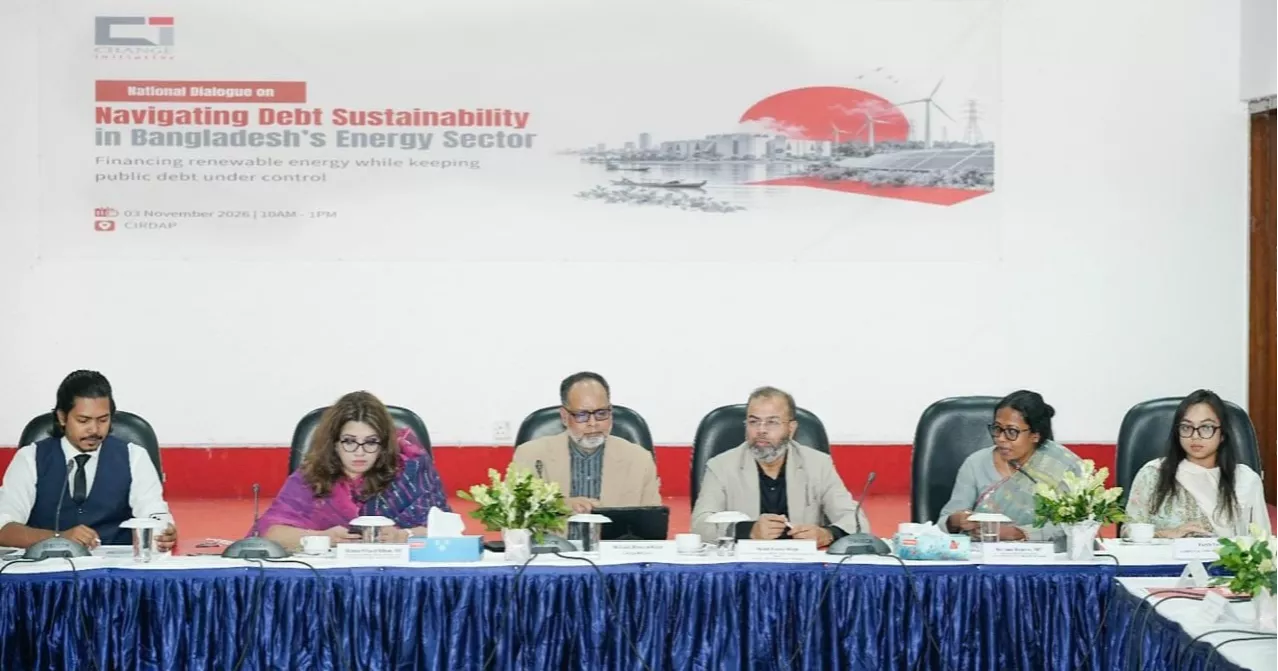
The report, Navigating Debt Sustainability in the Energy Sector in Bangladesh: Channelling Multilateral Development Bank Finance into Renewable Energy through Public Finance Mechanisms, was launched at a national dialogue organised by Change Initiative at CIRDAP in Dhaka on Tuesday.
In his welcome remarks, Co-Founder and Chief Executive of Change Initiative M Zakir Hossain Khan said: “Bangladesh’s long-standing reliance on imported fossil fuels has left our energy system vulnerable to external shocks. Accelerating renewable energy is essential to achieving energy sovereignty and securing greater control over our energy future.”
“The 10,000 MW solar target must be backed by affordable finance. We need grants, concessional funding and responsible investment that help households and industries adopt renewables while reducing pressure on public finances,” he added.
Speaking as the chief guest, State Minister for Foreign Affairs Shama Obaed Islam said Bangladesh needs an energy sector that reduces dependence on imported fossil fuels and avoids excessive debt.
She said the government has set targets for renewable energy to supply 20 percent of electricity by 2030 and 30 percent by 2040.
“Delivering these ambitions requires transparency, coordinated investment and stronger climate diplomacy. At COP, we need a unified national position informed by researchers, civil society, the private sector and young innovators,” the state minister added.
Bangladesh receives $9 in loans for every $1 in grants
The study’s analysis of energy-sector climate finance for 2002-2023 finds that Bangladesh received approximately $ 9 in loans for every $ 1 in grants.
Across least developed countries’ energy sectors, the average was $1.53 in loans for every grant dollar, making Bangladesh’s ratio nearly six times higher.
A separate analysis of renewable energy investment for 2000-2025 found that 90.4% came as debt and only 7% as grants, with negligible use of equity or guarantees.
Speaking as a guest of honour, Sultana Jesmen, MP, said: “The imbalance between loans and grants in climate finance is placing pressure on Bangladesh and its renewable energy entrepreneurs. Financing must become more affordable so that domestic businesses can participate and survive. Climate finance must also respond directly to water insecurity and farmers’ livelihoods.”
The report argues that Bangladesh needs both more investment and better financing terms. Grants can support project preparation and lower costs, while development-bank guarantees can encourage lending by covering part of the repayment risk.
Financing in taka will also reduce currency risks for businesses earning in taka but borrowing in foreign currencies.
Development bank commitments must translate into investment
The study estimates that five major development banks have a combined annual government financing envelope of approximately $ 6.3 billion for Bangladesh.
Eligible commitments in renewables identified for 2024-2026 amounted to around 820 million, equivalent to about 4% of the estimated three-year envelope. Accessing approved funding remains another challenge.
Citing World Bank documentation, the report notes that one renewable energy financing facility has disbursed only 12% of its funding five years after approval.
Annual budget releases for the associated project were also delayed by four to five months.
The study recommends simpler approvals and financing arrangements suited to smaller projects, including rooftop solar and solar irrigation.
Khondkar Morshed Millat, former Director of Bangladesh Bank’s Sustainable Finance Department, said: “A green finance target does not automatically ensure financing for renewable energy. I propose a dedicated renewable energy allocation of at least 1.5% of total lending, alongside a gradual increase in the overall green finance target to 15-20% by 2030.”
“Finance alone is not enough. Bangladesh Bank, relevant ministries, BSCIC and financial institutions must improve coordination, information and access so that available resources translate into practical investment,” he added.
A national facility to make finance more accessible
The report proposes a Renewable Energy Sovereignty Facility (RESF) to bring together grants, development bank support, domestic resources and private investment through existing institutions.
Under the proposal, IDCOL will manage the facility, while PKSF will oversee support for community projects. Grants will support project preparation, reduce interest costs and enable community ownership. Guarantees will share lending risks, helping banks offer more affordable financing in taka.
Under the study’s modelled financing scenario, new sovereign borrowing to meet the $ 7.9 billion investment required for 2026-2030 could fall from approximately $ 4.6 billion to $0.8 billion. These estimates illustrate how a different financing mix could reduce reliance on public debt.
The study recommends establishing the facility by mid-2027 and redirecting at least 5 percent of power and LNG subsidies towards its non-debt financing window from FY2027-28.
Based on the subsidy allocation used in the report, this could provide approximately $190 million annually to reduce investment risks and financing costs.
Turning commitments into action ahead of COP31
State Minister for Environment, Forest and Climate Change Shaikh Faridul Islam, who presided over the programme, said: “The government’s commitments must be demonstrated through action. Expanding rooftop solar, reducing dependence on imported fossil fuels and strengthening environmental protection are practical priorities.”
“At COP, Bangladesh must present the scale of its climate-related loss and damage and work with other Global South countries to advance climate justice. We welcome recommendations from researchers and experts to help translate evidence into national policy and implementation,” he added.
The report also recommends making green financing available before projects are built, simplifying approvals and maintaining stable net-metering rules.
As countries prepare for COP31, the study urges attention to both the volume of climate finance and its terms. For Bangladesh, the priority is affordable funding that reaches projects, expands renewable energy and limits additional debt.