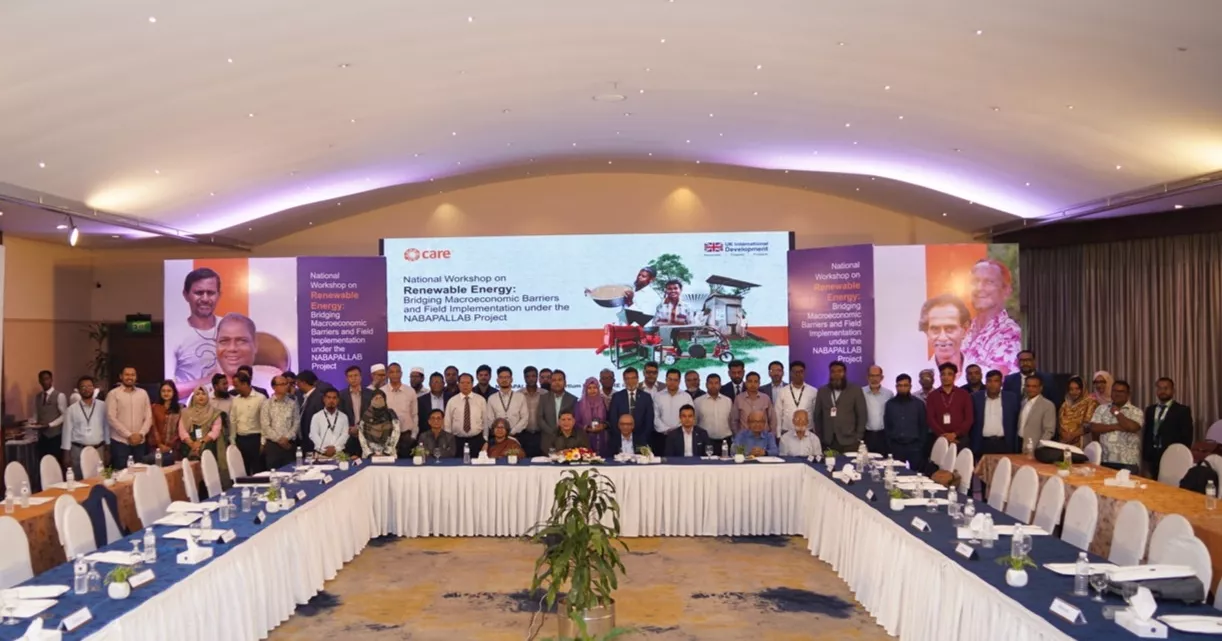
A national workshop on renewable energy held in the capital has underscored persistent financing, policy and implementation challenges hindering the expansion of sustainable energy in Bangladesh’s most climate-vulnerable regions.
Titled “Bridging Macroeconomic Barriers and Field Implementation under the NABAPALLAB Project,” the workshop brought together experts, policymakers, private sector leaders, financial institutions and development partners on Sunday. It was jointly organised by CARE Bangladesh and iDE Bangladesh.
The event focused on identifying scalable and financially viable renewable energy solutions for ecologically critical areas, including the Sundarbans and Hakaluki Haor.
Organised under the Adaptation in Ecologically Critical Areas in Bangladesh (AECAB)/NABAPALLAB project funded by the UK government, the initiative is implemented by a CARE-led consortium comprising CNRS, Cordaid, C3ER at BRAC University, DSK, Friendship, Humanity and Inclusion (HI), iDE and Practical Action.
As part of the consortium, iDE Bangladesh is working to strengthen market systems by engaging private sector actors in nature-based solutions and enhancing the capacity of local institutions.
Through this approach, the NABAPALLAB project is implementing integrated livelihood development and ecosystem restoration models, while piloting renewable energy technologies such as solar irrigation systems, solar-powered livelihood solutions and biodigesters to reduce energy poverty and generate income.
Speaking at the inaugural session, Sameer Karki, country director of iDE Bangladesh, said the project is helping identify effective solutions and existing gaps at the field level.
“As energy demand continues to grow, renewable energy will be critical for building a resilient and sustainable future. However, translating policy into practice remains a major challenge, particularly in vulnerable areas,” he said, stressing the need for coordinated efforts among government, private sector and communities.
Nathaniel Smith, team leader for climate and environment at the British High Commission in Dhaka, said Bangladesh’s energy transition is both an environmental priority and a pathway to long-term economic resilience amid global energy volatility.
“Through initiatives like NABAPALLAB, the UK is supporting community-driven solutions while fostering partnerships and financing mechanisms that can scale,” he added.
Drawing on field experience from the Sundarbans Ecologically Critical Area, the workshop highlighted a significant gap between national renewable energy targets and ground realities.
Participants said adoption of innovative technologies remains limited due to financing constraints, high upfront costs, supply chain gaps, policy implementation challenges, weak market systems and a lack of incentives for private sector participation.
Representatives from renewable energy firms and financial institutions also pointed to difficulties in accessing working capital, managing risks and sustaining operations in underserved rural markets.
Delivering the keynote address, economist Dr Hossain Zillur Rahman said the country’s renewable energy transition is constrained more by structural and political economy challenges than by technological limitations, emphasising the need for inclusive financing and stronger local markets.