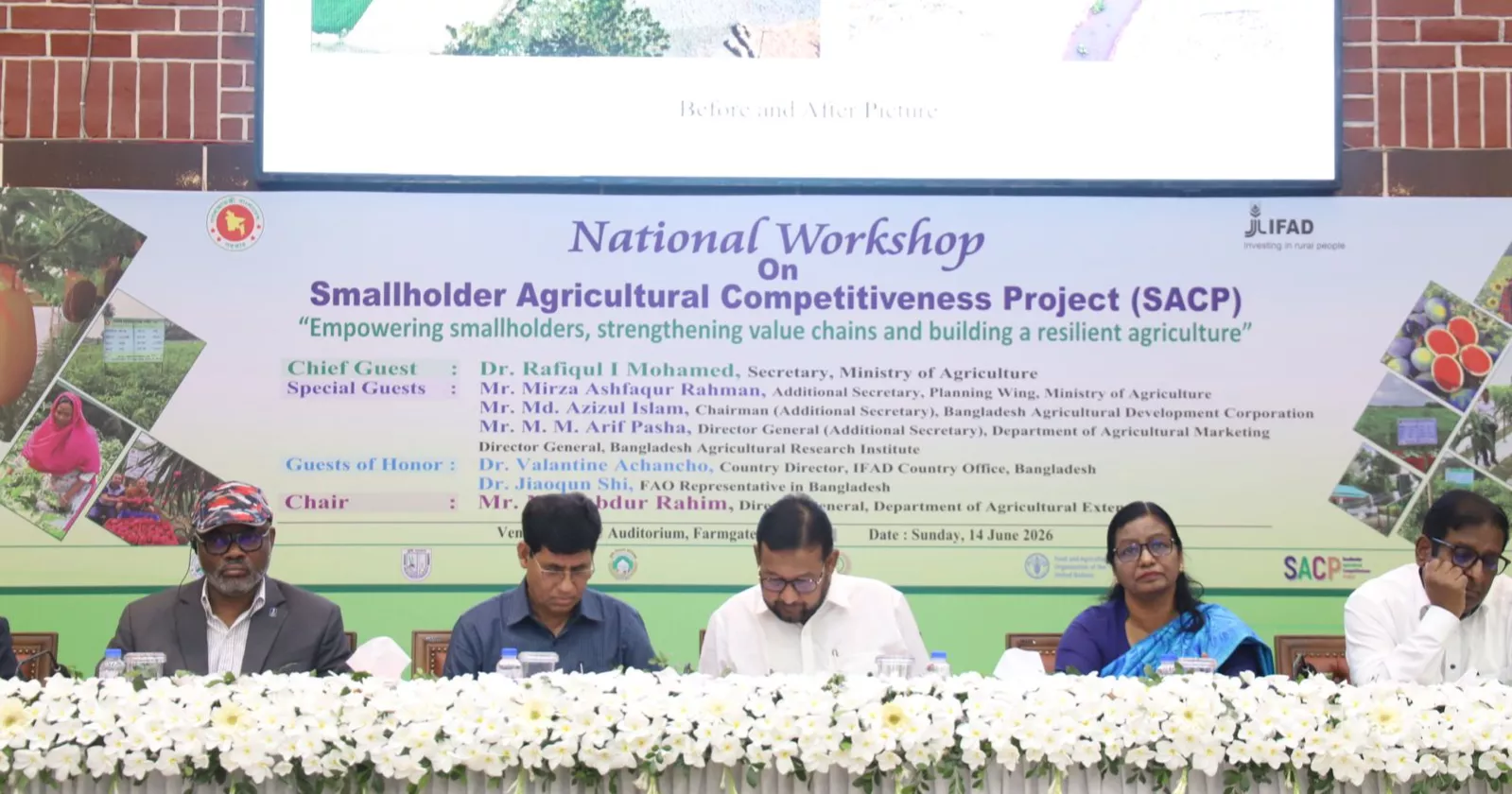
Speakers at a national workshop on Sunday called for scaling up climate-resilient, market-oriented and inclusive agricultural models, stressing continued investment in smallholder farmers, stronger institutions, innovation and partnerships to accelerate Bangladesh's agricultural transformation.
The messages came at the National Workshop of the Smallholder Agricultural Competitiveness Project (SACP), organised by the Ministry of Agriculture at the Bangladesh Agricultural Research Council (BARC) auditorium in Dhaka.
APGG 2026 ends with focus on expanding agro exports
The event brought together policymakers, development partners, researchers, private-sector representatives, agricultural entrepreneurs and farmer leaders to review the achievements of one of Bangladesh's major agricultural development initiatives and explore ways to replicate and scale its successful models nationwide.
Implemented by the Ministry of Agriculture and co-financed by the Government of Bangladesh and the International Fund for Agricultural Development (IFAD), SACP has worked over the past nine years to improve the productivity, competitiveness, profitability and resilience of smallholder farmers in the country's vulnerable coastal regions.
Speaking as chief guest, Secretary of the Ministry of Agriculture Dr Rafiqul Islam Mohamed emphasised building on the project's achievements and expanding successful approaches across the country. "SACP has demonstrated how innovation, collaboration, and farmer-centered solutions can create real impact. As we move forward, we must build on these lessons, learn from both successes and challenges, and scale effective approaches nationwide to ensure that every farmer benefits from research, technology, and improved market opportunities."
IFAD Bangladesh Country Director Dr Valentine Achancho highlighted the strategic importance of empowering smallholder farmers to adapt and thrive in a rapidly changing agricultural landscape. "The future of Bangladesh's agriculture will depend not only on producing more, but on enabling smallholders to innovate, access markets, adapt to climate change and capture greater value from their efforts. The legacy of SACP is therefore not only the results achieved, but the proof that with the right investments, institutions and partnerships, smallholders can drive a more competitive, resilient and prosperous rural economy."
FAO Representative in Bangladesh Dr Jiaoqun Shi underscored the need to sustain and scale up the project's successful interventions. "While SACP is reaching its conclusion, the lessons and achievements will continue to create value. I urge you to build on what has worked well, scale up successful approaches and ensure that smallholder farmers, women and youth remain at the center of agricultural transformation."
More than 88 percent of participating households reported increases in production, sales and profitability, while over 83 percent saw significant income gains from high-value agricultural commodities, the workshop was told. The project also contributed to substantial reductions in poverty, improved household asset ownership and strengthened food and nutrition security.
SACP Project Director Dr Muhammad Emdadul Haque said the project's achievements extend well beyond production gains. "The project promoted nutrition-sensitive agriculture, strengthened women's participation in agricultural decision-making and supported youth engagement in agribusiness development. Investments in irrigation infrastructure, farmer organizations and community-based institutions have also laid a strong foundation for sustainable agricultural growth in coastal Bangladesh."
An agri-entrepreneur from Chattogram, who was supported by the project, shared his experience as a beneficiary farmer. "My experience demonstrates that when farmers have access to innovation, modern technologies, and trusted advisory support, they can increase productivity, reduce risk, and create jobs in their communities. Investing in these areas is one of the most effective ways to help smallholders build resilient and profitable agricultural businesses."
The workshop featured presentations on project achievements, lessons learned, innovation models, market development initiatives and strategies for scaling up successful interventions. Participants discussed integrating SACP's experiences into future agricultural policies, programmes and investments to further strengthen Bangladesh's agricultural sector.
SACP was launched in 2018 with joint financing from the Government of Bangladesh and IFAD, and implemented by the Department of Agricultural Extension (DAE), Bangladesh Agricultural Research Institute (BARI), Department of Agricultural Marketing (DAM) and Bangladesh Agricultural Development Corporation (BADC) under the Ministry of Agriculture, with technical support from the Food and Agriculture Organization (FAO). The project successfully completed its implementation period in June 2026.
It was implemented in 250 unions across 30 upazilas in 11 districts of the Khulna, Barishal and Chattogram divisions, benefiting nearly 250,000 smallholder farming households in Bangladesh's climate-vulnerable coastal regions.
Over its nine-year run, more than 88 percent of participating households reported increases in production, sales and profitability, while over 83 percent experienced income growth of at least 20 percent from high-value agricultural commodities. Poverty levels in project areas declined from 33.7 percent to 13.9 percent, while the proportion of women achieving Minimum Dietary Diversity for Women (MDD-W) rose from 34.6 percent to 85.7 percent.
In Bangladesh's vulnerable coastal areas, SACP has emerged as an effective model for climate adaptation, nutrition-sensitive agriculture, food and nutrition security, women's empowerment, youth engagement and environmentally sustainable farming.
The lessons, innovations and partnerships developed through the project are expected to guide future agricultural development programmes and support Bangladesh's transition toward a technology-driven, market-oriented and climate-resilient agricultural sector.