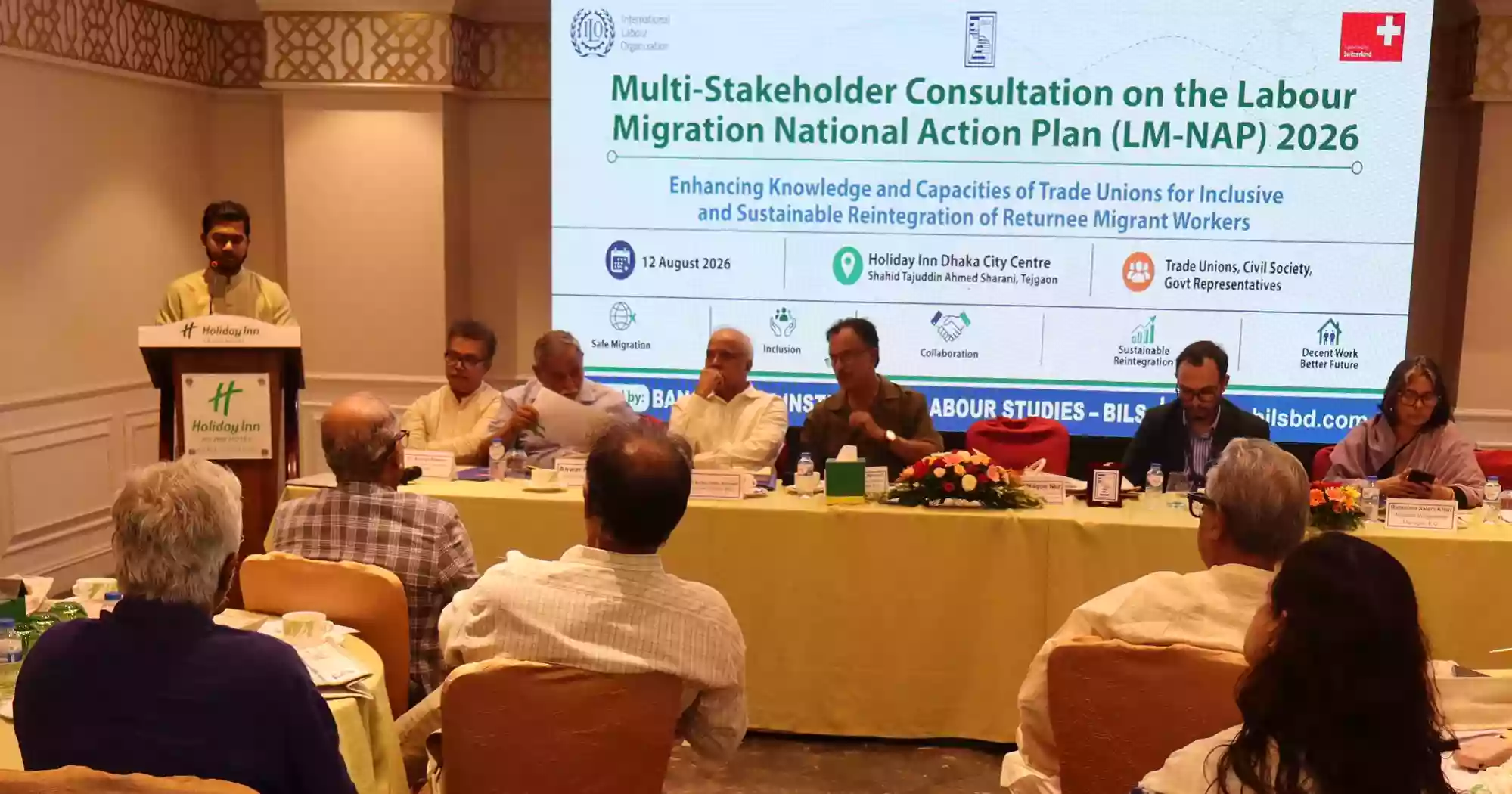
Speakers at a multi-stakeholder consultation today called for making labour migration management in Bangladesh effective, inclusive, and rights-based.
The consultation meeting was organized to finalize the National Action Plan on Labour Migration 2026 held on Wednesday at hotel in Tejgaon, Dhaka.
The event was arranged by the Bangladesh Institute of Labour Studies (BILS) under its project titled "Capacity Building of Trade Unions for Inclusive and Sustainable Reintegration of Returnee Migrant Workers," with support from research institution iSocial and funding from the International Labour Organization (ILO). The project is supported by Switzerland.
Chaired by NCCWE Chairman and BILS Advisory Council Board Member Mesbahuddin Ahmed, the meeting was attended by State Minister for Expatriates' Welfare and Overseas Employment Nurul Haq Nur as the chief guest. BILS Executive Director Syed Sultan Uddin Ahmmed delivered the welcome address, while BILS Director Kohinoor Mahmood moderated the session.
Dr. Ananya Raihan, Chairperson and Chief Consultant of iSocial, presented the National Action Plan on Labour Migration 2026. Rahnuma Salam Khan, National Programme Manager of ILO, and Sakil Akhtar Chowdhury, General Secretary of BILS, discussed the presentation.
Special guests included BILS Vice Chairman Anwar Hossain, SCOP Joint Convener Md. Fayez Hossain, TUCSA Advisor and WARBE Development Foundation Chairman Syed Saiful Haque, BAIRA Director Ali Haider Chowdhury, and ILO SME Development Specialist Gunjan Dalacoti.
Addressing the event, State Minister Nurul Haq Nur emphasized prioritizing the interests of remittance fighters above political affiliations. He stressed the need for inter-ministerial coordination to utilize returnee workers' experience for skill development and to ensure their social security. He also mentioned that efforts are underway to increase the allowance provided to returnee workers by the Wage Earners' Welfare Board.
Terming migration an inter-state issue involving human rights, Syed Sultan Uddin Ahmmed highlighted the role of the state in safeguarding rights. He noted that since 80 percent of remittance earners originate from South Asia, better coordination among sending countries is essential.
Presenting the plan, Dr. Ananya Raihan emphasized breaking recruiter agency syndicates and signing 10 bilateral agreements over the next five years.
To ensure maximum protection, dignity, and welfare for migrant and returnee women workers, he called for amending existing migration laws, rules, and policies, or adopting a separate legal and policy framework. He also advocated forming a special committee to create a roadmap for implementing Recommendation 26 of Article 5 of CEDAW.
Dr. Raihan urged stakeholders to protect female workers' rights, arrange hostel accommodations for women workers in GCC countries, modernize service systems, make expatriate cards mandatory to bring public, private, and NGO services onto a single platform, bring all district-level government offices under one roof, and ensure services through modern digital platforms.
Additionally, he stressed rescuing stranded workers abroad, establishing safe houses for abused female domestic workers, inspecting workplaces to resolve complaints, creating a database of returnee workers, enrolling them in the national labour registry, and providing microcredit, mental health services, social allowances, and long-term rehabilitation under the Reintegration Policy 2025.
Speakers noted that international labour migration remains a key driver for job creation, foreign remittance earnings, and overall economic stability in Bangladesh. However, challenges such as high migration costs, skill mismatches, limited labour market diversity, and inadequate support for returnee worker reintegration persist.
The draft action plan was prepared by BILS, iSocial, and the ILO based on real-ground challenges and recommendations from the Labour Reform Commission. It draws from key national frameworks, including election manifestos, five-year plans, reports of the Labour Reform Commission and Women Affairs Reform Commission, and the National Reintegration Policy.
The consultation brought together representatives from ministries, government departments, senior trade union leaders, civil society organizations, national and international agencies, and field volunteers to gather feedback and finalize the plan. Realistic recommendations were formulated at the end of the meeting to ensure effective implementation, coordination, and monitoring of the action plan.