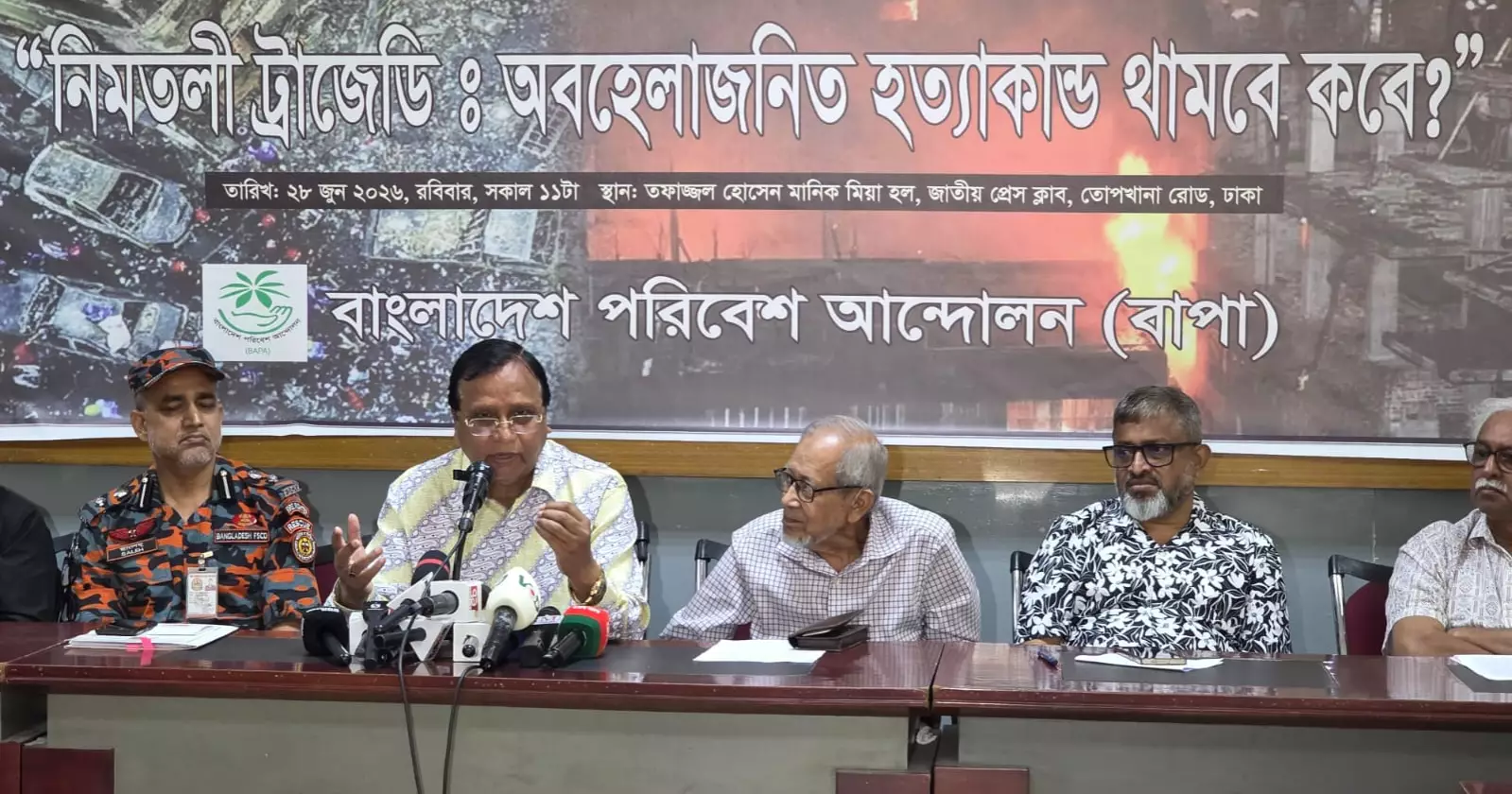
Highlighting that tragic incidents like the Nimtoli fire are not isolated accidents but consecutive reflections of policy failure and weak urban governance, speakers at a seminar demanded the strict enforcement of building codes, political will, and the immediate relocation of chemical warehouses from residential areas.
The civil society organization Bangladesh Poribesh Andolon (BAPA) organized the seminar titled ‘Nimtoli Tragedy: When Will Negligent Homicide Stop?’ at the Tofazzal Hossain Manik Miah Hall of the National Press Club on Sunday morning to mark the solemn Nimtoli Day.
Speaking as the chief guest, Dhaka South City Corporation (DSCC) Administrator Freedom Fighter Abdus Salam noted that some landlords lease out premises for chemical warehouses in residential areas solely out of financial greed, making ordinary citizens victims of disasters like the Nimtoli and Churihatta fires.
"Along with public awareness, strict implementation of building code regulations is essential. It is possible to radically change the country if we can regulate the educated and wealthy classes of society," Salam said.
BAPA President Prof. Dr. Nur Mohammad Talukdar, who chaired the event, pointed out that chemical traders have set up businesses along Dhaka’s riverbanks, severely polluting the Buriganga and Dhaleshwari rivers.
He stressed that a lack of proper policies hinders the implementation of environmental laws and called for institutional coordination alongside public involvement to save Dhaka.
Special Guest Md. Saleh Uddin, Deputy Director of Fire Service and Civil Defense, raised alarms over rampant building code violations.
"Buildings are extended to 10 stories despite having approval for only 5 stories, yet RAJUK takes no effective measures. There is no alternative to political will and strict legal enforcement," he said, adding that fire service personnel often find hazardous chemicals stored even under beds during operations in Old Dhaka.
Presenting the keynote paper, BAPA Joint Secretary Prof. Dr. Ahmad Kamruzzaman Majumder stated that while rapid urbanization and industrialization have boosted economic progress, safe chemical management, risk assessment, and urban planning have failed to keep pace.
He described disasters like Nimtoli, Churihatta, FR Tower, and the recent Bailey Road fire as systemic institutional failures.
Architect Iqbal Habib, an executive member of BAPA, questioned the role of the capital's development authority, noting, "If RAJUK claims 94 percent of buildings in Dhaka are constructed illegally, what are they doing? Why is there no regular monitoring or effective action?"
He, along with former CPB General Express Ruhin Hossain Prince, strongly advocated for introducing a "City Government" system to ensure planned, public-friendly urban governance.
Among others, former Fire Service Director Major Shakil Newaz emphasized the need for a coordinated certification registry for chemical businesses, while disaster management expert Gawher Nayeem Wahra urged authorities to bring the Fire Service under the Ministry of Local Government to match global standards.
Meanwhile, Bangladesh Chemical and Perfumery Merchant Association President Mohammad Shariful Islam claimed that 34 highly hazardous chemical items have already been removed from the Mitford area.
To prevent future industrial and chemical disasters, BAPA presented an 11-point policy recommendation package at the seminar.
The demands included:
1.Complete Relocation: Remove all illegal chemical warehouses and hazardous industries from Old Dhaka and other residential zones into a planned "Chemical Storage Zone" or "Chemical Village" within a strict timeframe.
2. National Framework: Formulate an international-standard National Chemical Safety Management Framework to specify the accountability of all relevant institutions.
3. Modernization of Fire Service: Equipping the agency with specialized Chemical Fire Response Units, modern rescue gear for narrow lanes, and developing fire hydrant networks in dense areas.
4. Strict BNBC Implementation: Maintain regular drives against unauthorized commercial usage, hazardous electrical setups, and chemical warehouses.
5. Digital Licensing: Implement digital licensing systems for chemical businesses alongside mandatory routine safety inspections.
6. National Hazard Database: Conduct a technical survey of vulnerable buildings to compile a GIS-based Hazard Map and publicize the list of highly risky structures.
7.Mandatory Fitness Certificate: Make annual renewable safety and fitness certificates mandatory for all commercial and high-rise buildings.
8. Emergency Preparedness: Introduce mandatory Emergency Response Plans, regular fire drills, and community volunteer groups across commercial establishments.
9. Coordinated Institutional Monitoring: Ensure institutional accountability and swift investigation by fostering coordination among RAJUK, City Corporations, Fire Service, Ministry of Industries, and the Department of Environment.
10. Political Commitment & Investment: Mirror the safety reforms undertaken in the RMG sector post-Rana Plaza to protect citizen lives through robust public-private financing and political resolve.
11. Action Plan: Launch a time-bound (5 to 10 years) National Urban Fire and Chemical Risk Management Action Plan with designated institutional responsibilities and clear funding frameworks.
The seminar, moderated by BAPA General Secretary Alamgir Kabir, was also attended by victims' family members, environmentalists, and central leaders of the organization.