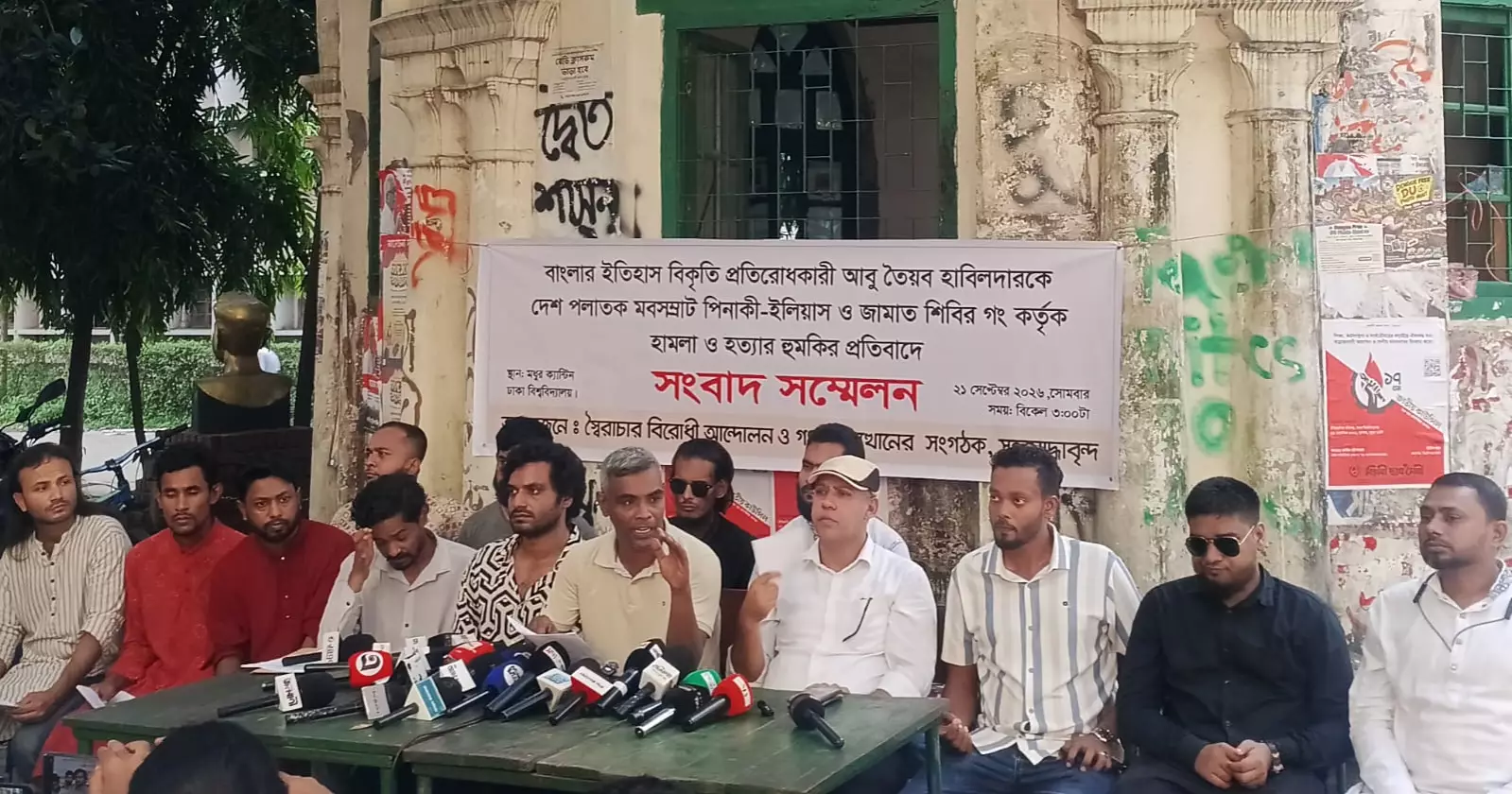
Abu Taiyeb Habildar, who tore down and removed portraits of Pakistan’s founder Muhammad Ali Jinnah from the Dhaka University Central Students’ Union (DUCSU) museum, on Monday alleged that he received threats on social media following the incident.
He made the allegation at a press conference held at Madhur Canteen on the Dhaka University campus by a group calling itself the “Organisers and Fellow Participants of the Anti-Autocracy Movement and Mass Uprising.”
Apart from Taiyeb, Maskur Ratul, Abdul Majid Antar, Shamim Hossain and Abu Baka, among others, attended the press conference.
The speakers said Taiyeb removed Jinnah’s portrait from the museum on September 14 in protest against its display there.
They alleged that social media personalities Pinaki Bhattacharya and Elias Hossain, as well as Jamaat-Shibir allies, subsequently made statements that they described as threatening to Taiyeb.
The speakers said any disagreement with Taiyeb’s action should be addressed through legal and democratic means and that threats of violence should not be used to settle political or historical disputes.
They also criticised the display of Jinnah’s portrait, arguing that his political role and position on the language issue should be presented in a broader historical context.
Referring to Jinnah’s speeches in Dhaka in March 1948, they said his call for Urdu to be the sole state language of Pakistan was an important part of the history preceding the Language Movement.
The speakers described Jinnah as a “cultural icon of the 1971 genocide” and said displaying his portrait without adequate historical context could contribute to what they called distortion of the history of the Liberation War.
They demanded that DUCSU disclose the policy, criteria and decision-making process under which the portrait was displayed.
If the portrait remains on display, they demanded that information on Jinnah’s position on the 1948 language controversy, the Two-Nation Theory and discrimination faced by Bangalees be presented alongside it.
They also called for the museum to give due importance to the Language Movement of 1952, the Mass Uprising of 1969 and the Liberation War of 1971.
The group placed eight demands, including an impartial investigation into the alleged threats against Taiyeb, ensuring his security and freedom of expression, and forming an independent historical advisory committee comprising historians, Liberation War researchers and university teachers to advise on the presentation of historical materials at the museum.