Tobacco and nicotine products remain a major obstacle to achieving the Sustainable Development Goals (SDGs), particularly the target of reducing premature deaths from non-communicable diseases (NCDs), experts have said at a roundtable recently.
Nearly 71 percent of all deaths in Bangladesh are attributable to NCDs, including cardiovascular diseases, stroke and cancer, with tobacco use among the major contributing factors, they said.
They stressed that without strong legislation and effective enforcement, achieving the SDG target of reducing premature deaths from NCDs by one-third would be difficult.
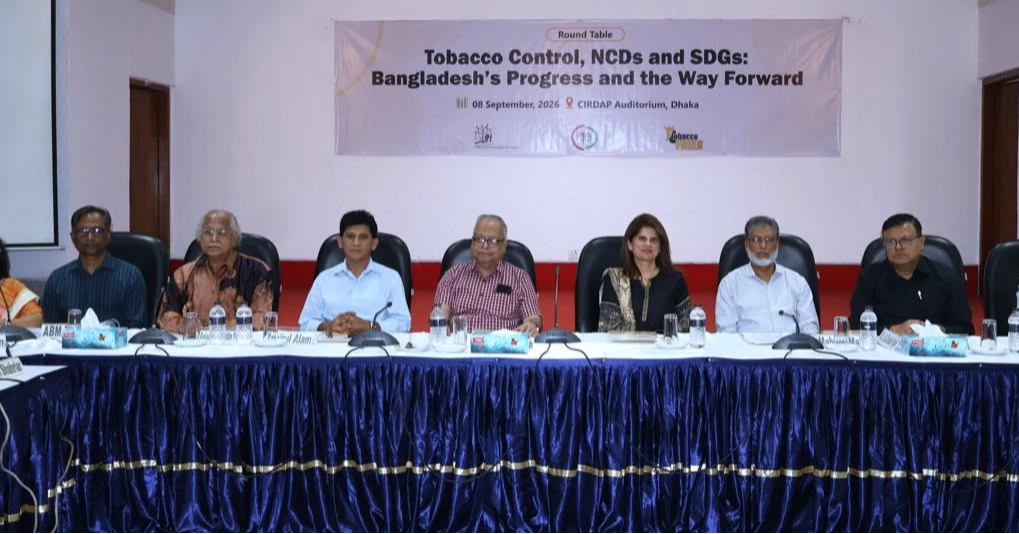
The remarks came at a roundtable titled “Tobacco Control, NCDs and SDGs: Bangladesh’s Progress and Way Forward”, organised by PROGGA (Knowledge for Progress) and the Anti-Tobacco Media Alliance (ATMA) at the CIRDAP Auditorium in Dhaka on Tuesday.
The discussion highlighted that around 200,000 people die each year in Bangladesh from tobacco-related diseases, making tobacco use a major challenge to achieving SDG 3, the health-related goal.
Tobacco also poses a significant barrier to achieving other SDGs, including those related to poverty eradication, food security, quality education, gender equality, environmental protection, climate action and biodiversity conservation, speakers said.
They welcomed the government’s recent amendment to the tobacco control law but expressed concern that e-cigarettes, vapes, nicotine pouches and other emerging tobacco and nicotine products remain outside its scope.
The speakers called for urgent legal measures to address the health risks posed by these products and protect public health.
They also urged the government to formulate the necessary rules under the amended law at the earliest and implement Article 5.3 of the Framework Convention on Tobacco Control (FCTC) to protect tobacco control policies from tobacco industry interference.
Speaking as the chief guest, National Professor Dr Mahbub Ullah, who chaired the event, said tobacco control goes beyond the health sector and is directly linked to the country’s development, economy and protection of future generations.
“Translating political and institutional commitments to tobacco control into action would help accelerate progress toward achieving the SDGs,” he said.
Professor Dr Golam Mohiuddin Faruque, president of the Bangladesh Cancer Society, said the suffering of cancer patients reflects the devastating consequences of tobacco use.
“Tobacco control measures must be strengthened to protect people from the poison of tobacco,” he said.
Reaz Ahmad, editor of Dhaka Tribune, said media platforms should publish more reports highlighting the links between tobacco control, tackling NCDs and achieving the SDGs.
ATMA Convener Mortuza Haider Liton and ABM Zubair, executive director of PROGGA, also addressed the event, along with representatives of various tobacco control organisations.
Hasan Shahriar, head of programmes at PROGGA, delivered the keynote presentation, while Nadira Kiron, co-convener of ATMA, moderated the session.