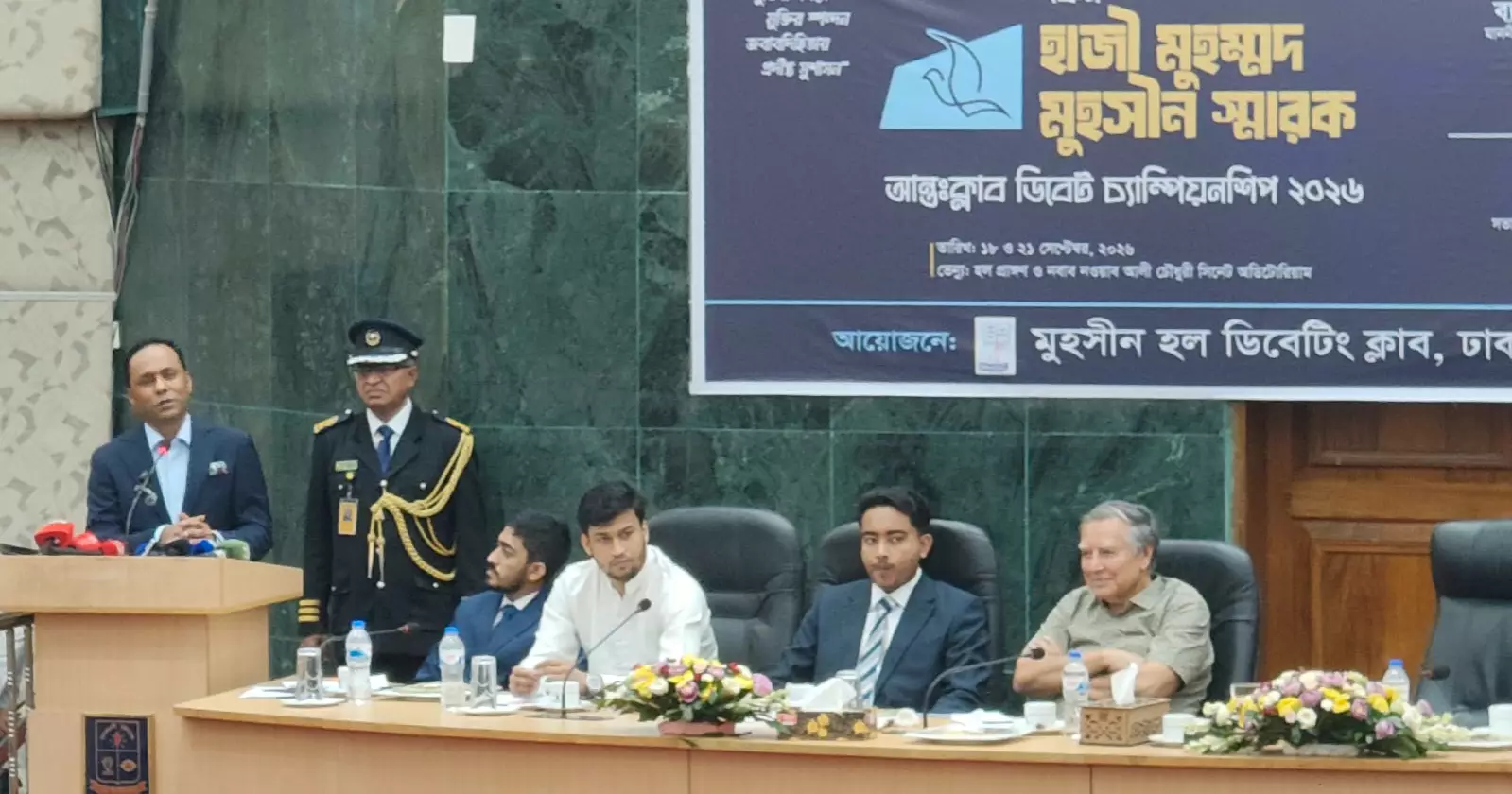
Deputy Speaker Barrister Kayser Kamal on Monday said there is a lack of tolerance for opposing views in Parliament, which he described as regrettable.
“Parliament is meant to make laws. But more time is spent on other discussions than on lawmaking,” he said while addressing the 5th Haji Muhammad Mohsin Memorial Inter-Club Debate Championship 2026, organised by the Mohsin Hall Debating Society, at Dhaka University in the evening.
The Deputy Speaker said debate competitions provide opportunities to showcase talent and intellect and express views about objectives, vision and the future.
“On one side, someone presents an argument, and the other side refutes it with a counterargument. This creates a space for tolerance,” he said.
Kayser Kamal said the level of tolerance seen outside Parliament is unfortunately somewhat lacking in Parliament. “It is very regrettable,” he said.
He said many Members of Parliament could learn from debate competitions organised in their respective constituencies and apply that experience in Parliament, particularly in terms of tolerance for opposing views.
The Deputy Speaker said people tend to accept a statement supported by statistics, history or evidence more readily than a statement made without reference to supporting information.
He said he firmly believes that today’s debaters will lead Bangladesh in different sectors both at home and abroad in the future.
Kayser Kamal said Parliament is one of the three organs of the state, with the legislature making laws, the executive implementing them and the judiciary overseeing them.
“But today, in the Jatiya Sangsad, where laws are supposed to be made, unfortunately, in post-independence Bangladesh, more time has been spent on other discussions than on lawmaking. This personally causes me a lot of pain,” he said.
The Deputy Speaker cited figures on the proportion of parliamentary time spent on lawmaking during different parliamentary terms.
According to the figures he presented, only 9.56 percent of parliamentary time was spent on lawmaking during the seventh Parliament, 9.4 percent during the eighth, 7.67 percent during the ninth, and 10.87 percent during the 10th Parliament.
Kayser Kamal said the 11th Parliament spent only 17 percent of its time on lawmaking, while the 12th Parliament spent only 7 percent. “In the current, 13th Parliament, so far 12 percent of the time has been spent on lawmaking,” he said.
He said he sometimes asks himself whether Parliament is actually making laws or merely passing laws. “Historically, sometimes it seems Parliament is not making laws; it is a Parliament for passing laws,” he said.
The Deputy Speaker said this is one of the reasons why democratic transition and institutionalisation of democracy have remained difficult for Bangladesh for a long time.
He said bills come to Parliament from the executive, which sends draft laws to lawmakers. “If the lawmakers do not sufficiently examine and analyse those laws before passing them, can that law truly be said to represent the people of Bangladesh?” he asked.
Kayser Kamal expressed concern over attempts to create an unstable environment in Dhaka in recent days, attributing the situation partly to a lack of unity among the forces that participated in the anti-fascist movement.
He warned that democracy could again face disruption if all sides fail to maintain unity.
DU Vice Chancellor Prof Dr ABM Obaidul Islam, Editor and Publisher of The Daily Star Mahfuz Anam, Mohsin Hall Provost Shah Shamim Ahmed, among others, spoke at the event.