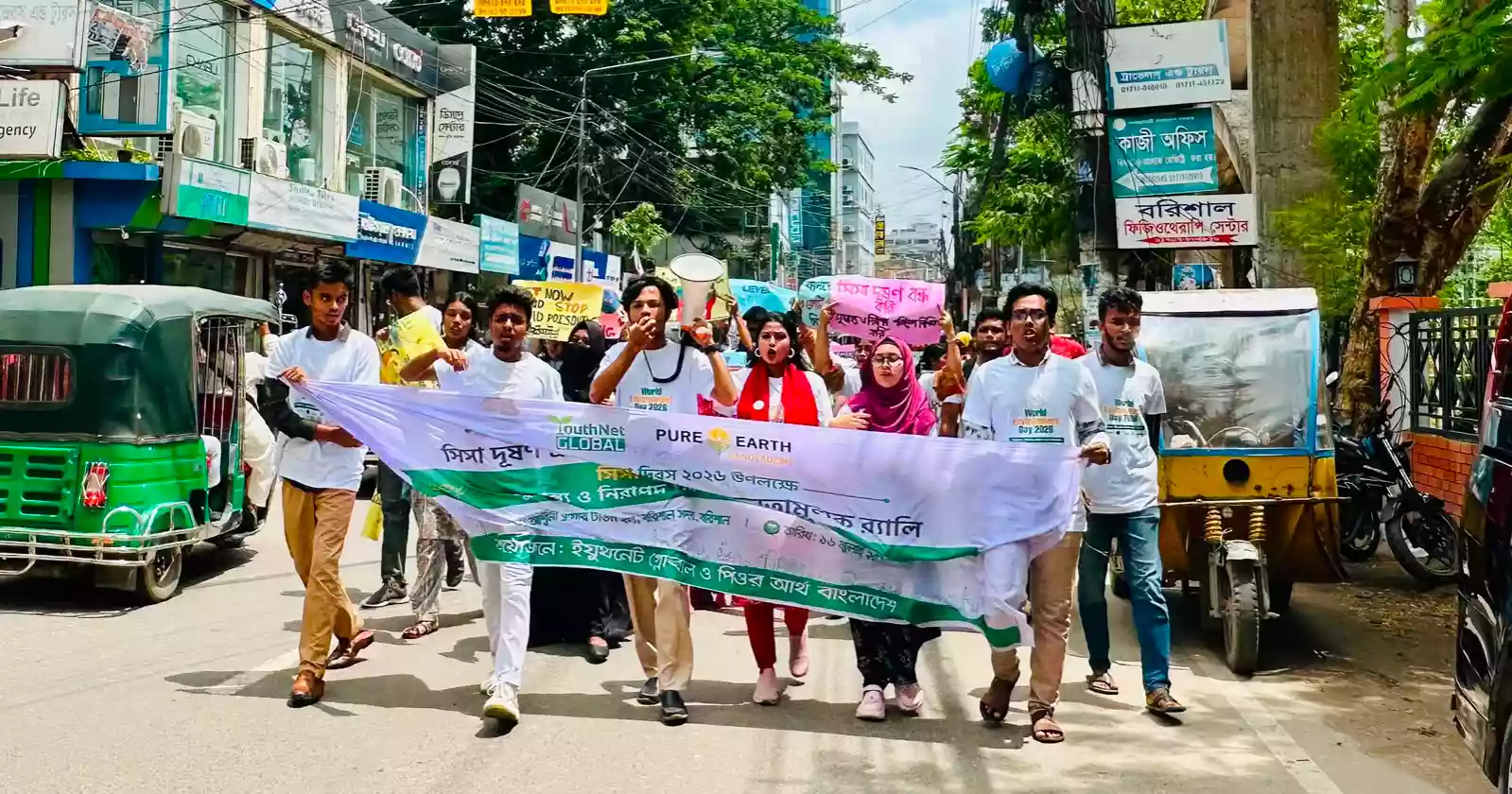
Speakers including young activists, environmental campaigners and community members at a rally urged for stronger government action to protect children from lead poisoning and eliminate preventable exposure to the toxic metal.
Organised by YouthNet Global with support from Pure Earth, the rally was held under the theme "Stop Lead Pollution, Ensure Healthy Lives and a Safe Environment" as part of a week-long nationwide campaign across all eight divisions to raise awareness about lead poisoning and promote preventive measures.
Call for urgent action as pollution, encroachment choke once-thriving Mathabhanga River
Speakers said Bangladesh is among the countries with the highest burden of childhood lead exposure, with an estimated 36 million children at risk.
They warned that unsafe recycling of used lead-acid batteries, along with other sources of contamination, continues to pose a major public health challenge.
The rally began at Aswani Kumar Hall premises and crossed through major streets of Barishal before ending at the Central Shaheed Minar.
Students, teachers, environmental activists, government officials and young people from different communities took part in the programme, carrying banners and placards calling for stronger action against lead pollution.
Speakers at the rally said uncontrolled breaking and recycling of used lead-acid batteries is one of the major sources of lead contamination in Bangladesh. Such activities release toxic substances into soil, water and air, putting workers, children and nearby communities at long-term health risk.
Experts at the event said eliminating poisoning requires coordinated efforts from government agencies, industries, civil society and communities. They called for stronger enforcement, safer industrial practices, scientific monitoring and sustained awareness initiatives to build a lead-safe Bangladesh.
They added that protecting children from lead poisoning is not only a public health responsibility but also an investment in the country’s future.
Health experts said children are particularly vulnerable to lead exposure as their brains and bodies are still developing.
Even low levels of lead exposure can affect cognitive development, reduce learning ability, contribute to behavioural problems and cause permanent damage to the nervous system. The World Health Organization (WHO) has stated that there is no known safe level of lead exposure.
During the programme, organisers placed a five-point demand agenda, including recognising lead as a toxic chemical, developing a national strategy to tackle lead pollution, introducing regular blood lead testing for children and vulnerable groups, implementing Extended Producer Responsibility (EPR) for lead-acid battery producers, ensuring safe collection and environmentally sound recycling of used batteries, and strengthening research and institutional capacity.
Sazid Mahmud, Barishal Divisional Coordinator of YouthNet Global, said protecting children from lead exposure requires stronger community engagement and local monitoring.
“Lead pollution is not only an environmental issue; it is a question of children’s rights, public health and environmental justice. Ensuring a safe childhood requires stronger local awareness, accountability and collective action,” he said.
Kazi Saifuddin, Assistant Director of the Department of Environment’s Barishal office, said the government is working with NGOs, communities and industries to strengthen enforcement and encourage safer practices.
“The government is working with NGOs, communities and industry to ensure stronger implementation of regulations and promote safer practices to reduce lead exposure,” he told the gathering.
YouthNet Global Executive Coordinator Sohanur Rahman said unsafe lead-acid battery recycling is threatening the health of workers and communities living near recycling sites.
“Lead pollution is a preventable public health crisis. Protecting children requires stronger regulation of battery recycling, community awareness and meaningful participation of young people in environmental solutions,” he said.
Mitali Das, Country Director of Pure Earth Bangladesh, said lead exposure can come from multiple sources, including consumer products, toys, household items and unsafe recycling activities.
She stressed the need for stronger government monitoring, safe recycling systems for used lead-acid batteries and wider public awareness campaigns to protect children from harmful exposure.