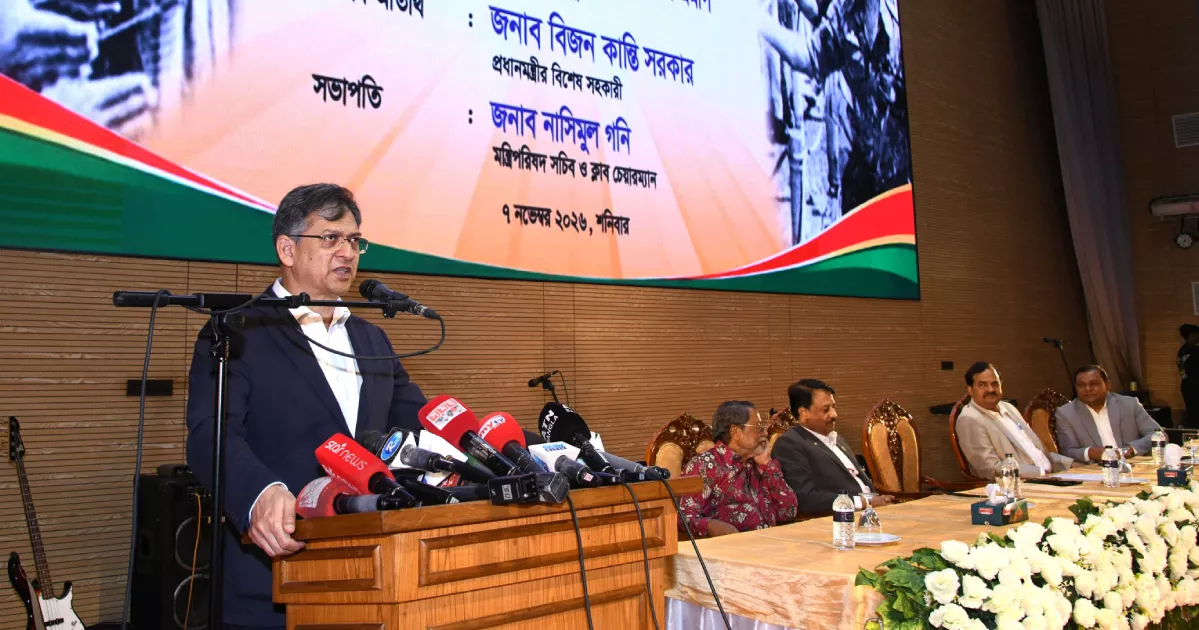
Home Minister Salahuddin Ahmed on Saturday said Shaheed President Ziaur Rahman had protected the country's fragile independence and sovereignty through the 'Sipahi-Janata Revolution' on November 7, 1975.
He made the remarks at a discussion and cultural programme organised by the Officers Club, Dhaka, marking National Revolution and Solidarity Day 2026.
The minister said the hopes and aspirations of the people remained unfulfilled after the 1971 Liberation War. He said one-party rule had led to economic inequality, corruption, political instability and growing public anger.
At that critical time, he said, soldiers and ordinary people foiled geopolitical conspiracies, secured Ziaur Rahman's release from captivity and placed him in a position of national leadership.
Salahuddin said Ziaur Rahman did not lead the November 7 revolution for personal gain or political ambition. Rather, the people saw him as a leader at a critical moment in the country's history, he added.
He said Ziaur Rahman freed Bangladesh from subjugation and helped establish multi-party democracy, a modern economy and an inclusive constitution. He also said Ziaur Rahman united the people and laid a strong foundation for Bangladeshi nationalism.
The minister said November 7 was not the achievement of any particular political party but belonged to all those who believed in Bangladeshi nationalism and freedom.
Referring to the 1857 uprising, he said what the British called the 'Sepoy Mutiny' was actually the first war of independence in the Indian subcontinent. Although that uprising failed, the 'Sipahi-Janata Revolution' of November 7, 1975, succeeded, he said.
He added that Bangladesh might have faced long-term subjugation had the November 7 revolution failed.
Speaking about the July mass uprising of 2024, the minister said it had not happened overnight. Rather, it was the result of the sacrifices of countless people who faced enforced disappearances, killings and extrajudicial killings between 2009 and 2024.
He said no single group or political force should claim sole credit for the 2024 uprising, as it belonged to the entire nation.
The Home Minister also urged civil servants to perform their duties without political influence or pressure.
He stressed that civil servants must refuse unlawful orders, remain impartial and carry out their responsibilities fairly, including during elections.
Salahuddin said he considered himself a member of the civil service family as he had previously been a member of the Civil Service Association and served as a government official.
He said some sections of the civil service had, in the past, helped hold 'night-time' elections under political pressure, greed or fear. Such actions had seriously damaged the institutions, and the civil administration had also paid a heavy price, he added.
The minister warned against allowing the administration to be used for political purposes, including establishing one-party rule or keeping a government in power for an extended period. He said such a shameful chapter in the country's history should never be repeated.
Highlighting the responsibilities of government officials, Salahuddin said deputy commissioners represented the executive authority of the state at the field level and therefore had important duties to perform.
He urged them to maintain professionalism and conduct themselves properly while carrying out their responsibilities.
Stressing the need to protect democracy, he said power must be handed over peacefully to those who receive the people's mandate every five years, as changes in government were an essential part of democracy.
The programme was presided over by Officers Club Dhaka President and Cabinet Secretary Nasimul Ghani.