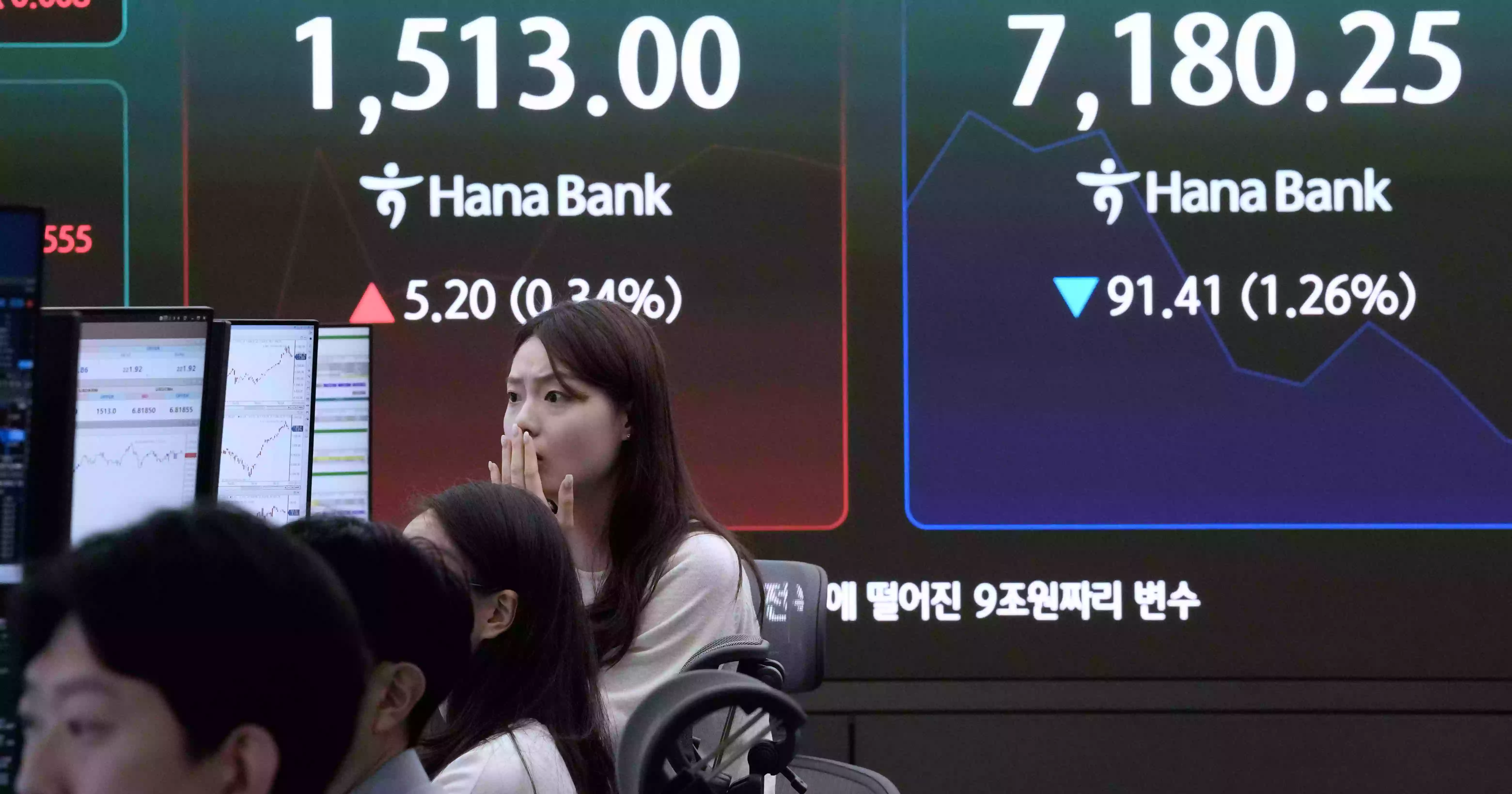
Asian stock markets mostly declined on Wednesday as rising bond yields and concerns over prolonged inflation linked to the Iran war continued to pressure investors and weaken the technology-driven market rally.
Japan’s benchmark Nikkei 225 fell 1.2 percent to 59,804.41, while the yield on the country’s 10-year government bond remained near its highest level since 1997 at just under 2.8 percent. The US dollar slipped slightly against the Japanese yen, trading at 158.92 yen.
Chinese markets also ended lower, with Hong Kong’s Hang Seng Index losing 0.7 percent to 25,607.67 and the Shanghai Composite Index declining 0.3 percent to 4,156.47.
Australia’s S&P/ASX 200 dropped 1.3 percent, while South Korea’s Kospi lost 0.9 percent following a broad sell-off in the previous session. Taiwan’s Taiex index also edged down 0.4 percent.
US futures showed little movement after Wall Street recorded losses on Tuesday. The S&P 500 fell 0.7 percent for its third consecutive decline, while the Dow Jones Industrial Average lost 0.6 percent and the Nasdaq Composite dropped 0.8 percent.
Technology stocks continued to weaken after strong gains earlier driven by enthusiasm over artificial intelligence. Investors are increasingly concerned that many tech stocks have become overvalued.
Market attention is now focused on chipmaker Nvidia’s upcoming quarterly earnings report, which investors believe could influence the future direction of technology stocks and the broader US market.
Oil prices remained volatile amid uncertainty surrounding the Iran conflict and possible disruptions in the Strait of Hormuz, a key route for global oil shipments.
US benchmark crude oil fell $1.04 to $103.11 per barrel in early Wednesday trading, while Brent crude dropped $1.11 to $110.12 per barrel.
Meanwhile, rising bond yields continued to unsettle markets. The yield on the 10-year US Treasury climbed to 4.66 percent from 4.61 percent a day earlier, compared with below 4 percent before the Iran war began.
Analysts say higher yields could increase borrowing costs for mortgages and major corporate investments, including AI data center projects, potentially slowing economic growth.
Despite market concerns, several major US companies have continued to report stronger-than-expected earnings, supported by resilient consumer spending despite higher fuel prices and economic uncertainty.