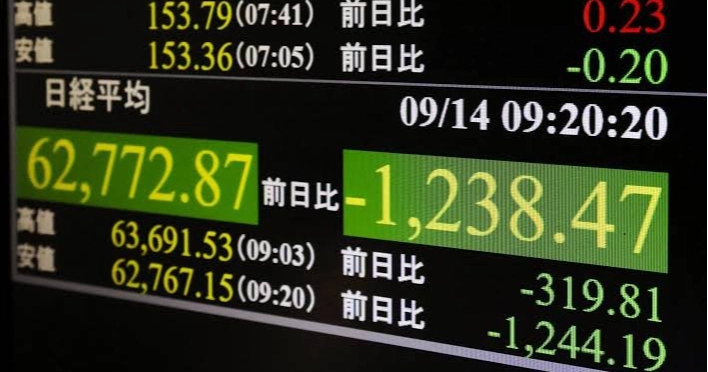
Asian shares were mixed Monday, while shares of Japanese investment giant SoftBank Group, a major investor in OpenAI, plunged more than 10% after leading AI companies called for slower development to improve safety.
US stock futures edged lower, while oil prices rose more than 3% as concerns about global supplies increased after Saudi Arabia shut down a major oil pipeline used to bypass the Strait of Hormuz following an attack.
South Korea's Kospi fell 2.5% to 6,739.68, while Japan's Nikkei 225 declined 0.8% to 63,474.58. Hong Kong's Hang Seng gained 0.3% to 24,886.81, and the Shanghai Composite rose 0.2% to 3,894.28.
SoftBank shares fell 11.2% in Japan after OpenAI CEO Sam Altman supported Anthropic CEO Dario Amodei's call over the weekend for the AI industry to slow development to ensure greater safety.
Altman also told Fortune in an interview published Saturday that OpenAI would not go public this year as it remains focused on safety.
Both OpenAI and Anthropic are privately held but are expected to list their shares in the coming months.
The decline in SoftBank shares may reflect concerns that regulators could slow AI development to prevent serious risks, said Dan Baker of Morningstar. He also noted that further cases involving loss of control over advanced AI models could lead to a slowdown.
Other Asian AI-related stocks also declined. South Korea's SK Hynix fell 5.3% and Samsung Electronics dropped 2.8%. Japan's Tokyo Electron declined 0.9%, while Kioxia Holdings fell 6%.
Australia's S&P/ASX 200 edged up 0.1% to 8,747.60, while Taiwan's Taiex fell 0.6%.
Oil prices rose early Monday as tensions between the United States and Iran remained high and Iran-backed Houthi rebels increased attacks on Saudi Arabia.
Brent crude, the global benchmark, gained 3.2% to $107.94 a barrel, compared with about $72 before the war in Iran began in late February. US crude also rose 3.2% to $103.26 a barrel.
ING commodities strategists Warren Patterson and Ewa Manthey said prospects for a de-escalation of the Iran war and reopening of the Strait of Hormuz appeared weaker. However, they said the situation remained fluid, with significant volumes of oil still moving through the waterway.
On Friday, Wall Street's S&P 500 rose 0.9%, ending a four-day losing streak. The Dow Jones Industrial Average gained 1%, while the Nasdaq composite rose 1%.
Investors are also watching this week's Federal Reserve meeting, where policymakers could raise interest rates as inflation remains above the Fed's 2% target.
Inflation concerns linked to the Iran war's impact on energy prices, along with rising US government debt, have triggered a sell-off in government bonds and pushed Treasury yields higher.
The yield on the 10-year US Treasury rose to 4.98% from 4.95% Thursday, despite expanded buyback operations by the US Treasury Department aimed at stabilizing the bond market.
In currency trading, the US dollar rose to 154.06 Japanese yen from 153.58 yen. The euro fell to $1.1570 from $1.1598.