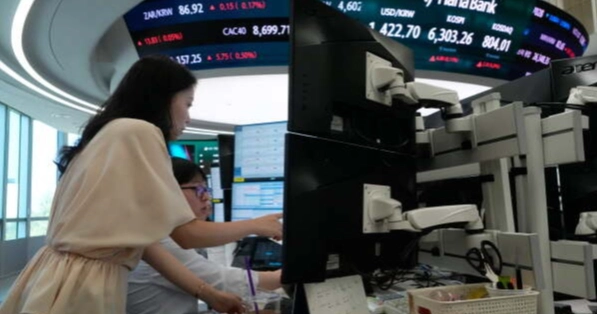
Asian stocks were mixed on Friday after US shares pulled back in the previous session, while oil prices climbed more than 1% amid continued uncertainty over the reopening of the Strait of Hormuz.
Japan's Nikkei 225 fell 0.3% to 65,500.10, while South Korea's Kospi declined 0.8% to 6,242.88. Taiwan's Taiex also dropped 0.4%.
In contrast, China's Shanghai Composite rose 0.8% to 3,931.54 after the country reported that exports increased by around 24% in July. Although growth slowed slightly, demand remained strong for electronics and other high-tech products. China's trade surplus narrowed during the month, while imports also eased.
Hong Kong's Hang Seng edged up 0.2% to 25,582.34, while Australia's S&P/ASX 200 slipped less than 0.1% to 9,265.20.
On Wall Street, stocks fell Thursday as higher oil prices and a stream of corporate earnings weighed on investors. The S&P 500 declined 0.2%, the Dow Jones Industrial Average dropped 0.9% and the Nasdaq composite lost 0.1%.
Brent crude jumped nearly 4% Thursday as uncertainty continued over efforts to reopen the Strait of Hormuz, a key route for global oil supplies.
Iran has said it is nearing an agreement with Oman on reopening the strategic waterway, while US President Donald Trump has also previously indicated that a deal could be close. However, negotiations have faced repeated setbacks over the past five months.
A reopening could require a compromise, as the Trump administration has rejected any Iranian plan to charge fees to ships. Iran, meanwhile, has insisted on retaining some control over the waterway.
Early Friday, Brent crude, the international benchmark, rose 1.6% to $83.78 a barrel, while US benchmark crude gained 1.2% to $78.22.
About one-fifth of the world's traded oil and natural gas previously passed through the Strait of Hormuz. Oil prices have climbed as high as $113 a barrel during the conflict, increasing inflationary pressure by raising fuel and shipping costs.
Markets remain concerned about the war and the possibility of an investment bubble linked to artificial intelligence. However, stronger-than-expected corporate earnings have eased some worries that US stocks may be overvalued.
About 85% of S&P 500 companies have reported their latest earnings, with overall profit growth on track to be the strongest since 2021.
Warner Bros. Discovery gained 1.7% after posting better-than-expected earnings, while Molson Coors rose 1.3% following encouraging results.
Honeywell Aerospace was among the biggest losers, falling 23.2% after its results came in well below expectations. Digital advertising company AppLovin dropped 19.7% after reporting mixed quarterly results.
Meanwhile, SpaceX shares rose 6.1% after a lockup period expired Thursday, making more than 911 million shares held by early investors and employees eligible for sale. That figure is more than twice the number of shares initially offered to the public in the company's initial public offering.
SpaceX shares climbed as high as $225 following its market debut in June but have since fallen below the initial offering price of $135. The stock was trading around $115.
Investors are also awaiting the US monthly jobs report for July, due Friday.
The US labour market remains relatively strong, although hiring growth has slowed. A weekly report released Thursday showed applications for unemployment benefits increased last week, though layoffs remained at historically low levels seen in recent years. Employers added only 57,000 jobs in June.
In early Friday trading, the US dollar slipped to 158.35 Japanese yen from 158.42 yen, while the euro was unchanged at $1.1524.