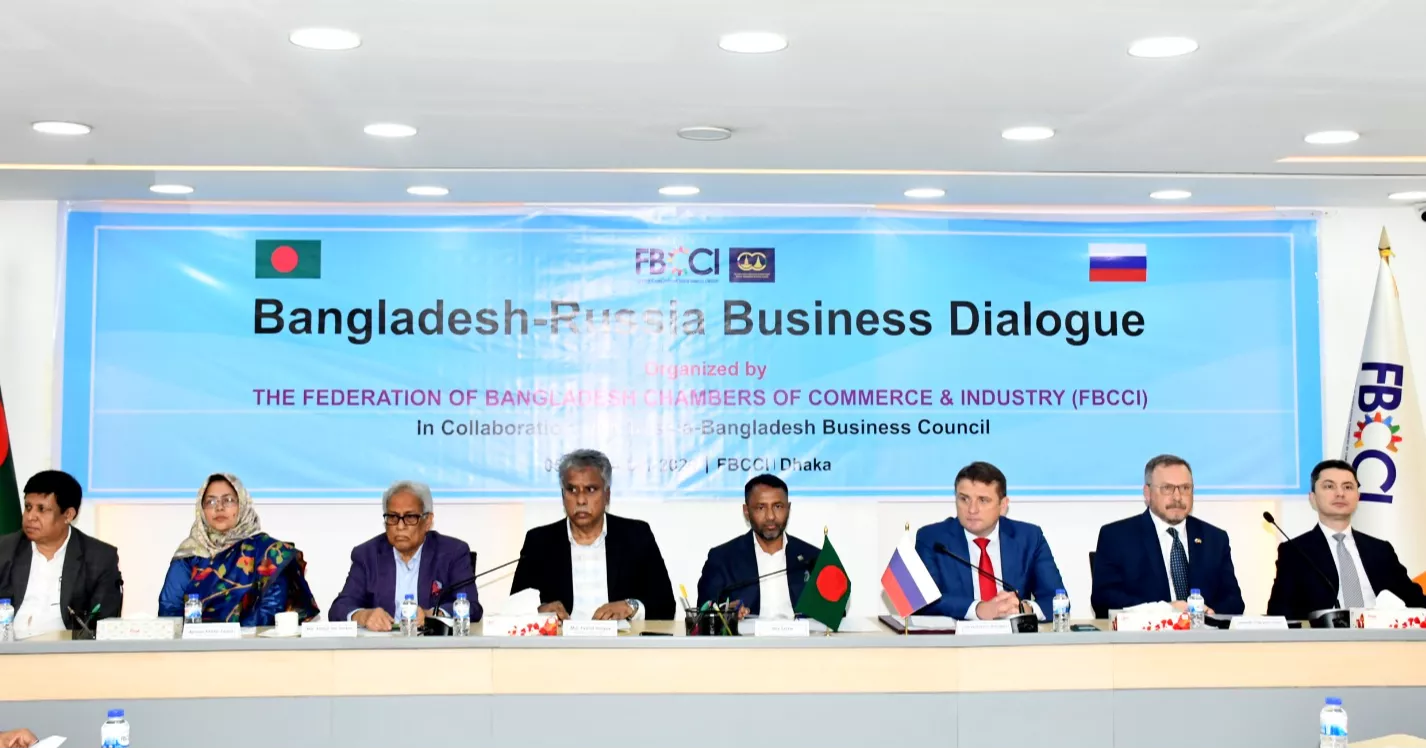
Business representatives from Bangladesh and Russia on Thursday called for removing existing trade barriers to take investment and bilateral economic ties to a new level, stressing the need for a simpler payment framework to tap the untapped potential.
The call was made at the "Bangladesh-Russia Business Dialogue," held at the FBCCI office in Motijheel.
The Federation of Bangladesh Chambers of Commerce and Industry (FBCCI) and the Russia-Bangladesh Business Council jointly organised the event, chaired by FBCCI Administrator Fazlul Hoque.
In his welcome address, Fazlul Hoque said the current global context offers both countries significant scope to expand trade.
"There are hardly any major obstacles to trade and investment between the two countries, but the minor ones must be identified and addressed jointly," he said.
Head of the Russian delegation Ilya Shestakov said Bangladesh is one of Russia's top trading partners in South Asia in terms of trade volume.
He said Russia is keen to increase the supply of agricultural products, food and fertiliser to Bangladesh, and to work jointly in energy, information technology, cyber security and e-governance.
However, Shestakov stressed that building a sustainable bilateral payment infrastructure is vital to realising this trade potential.
Russian Ambassador to Dhaka Alexander Khozin emphasised further strengthening bilateral relations and economic cooperation.
He said it is crucial to meet trade and investment demand, simplify regulatory procedures, and remove existing hurdles related to logistics and market access.
He also mentioned cooperation in education and human resource development alongside trade and investment.
On the occasion, FBCCI and the Russia-Bangladesh Business Council signed a memorandum of understanding (MoU) to strengthen trade ties, expand commerce and boost strategic partnership.
The MoU aims to create a favourable business environment for enterprises and organisations of both countries and to exchange up-to-date information to unlock new trade and investment opportunities.
The two sides will also work together to implement joint projects involving companies from both countries and to organise trade fairs, exhibitions, business missions and investment forums.